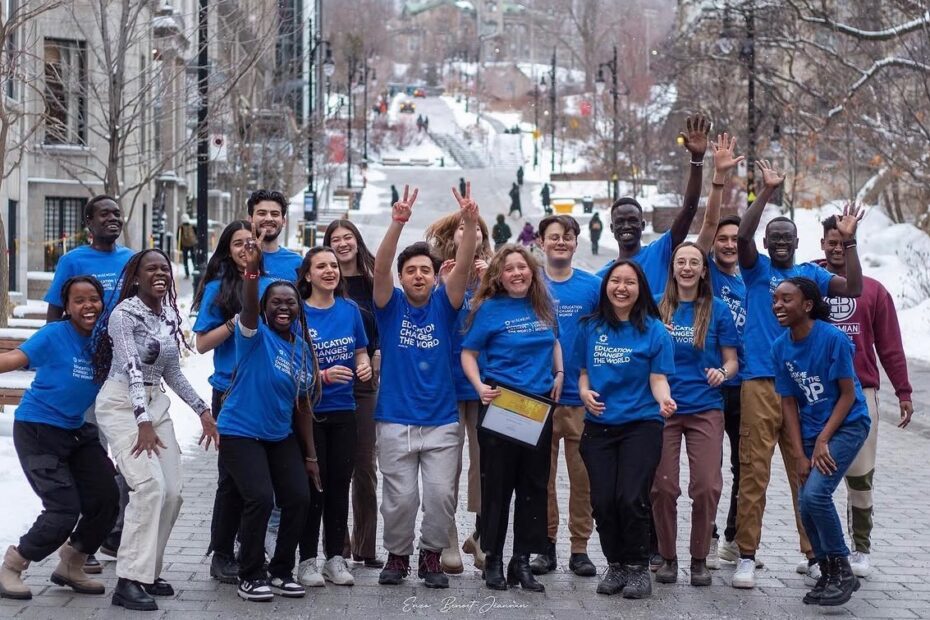
World University Service of Canada’s McGill Committee fosters educational opportunities and a community for refugee students
Good People is an article series highlighting McGill students doing community-oriented work on and around campus. Because it’s important to celebrate good people doing good things.
The World University Service of Canada’s Student Refugee Program is a unique initiative that combines refugee resettlement with access to higher education. Founded in the 1920s, World University Service of Canada (WUSC) is a Canadian non-profit organization dedicated to improving educational, employment, and empowerment opportunities for young people globally.
The organization’s Student Refugee Program (SRP) is a student-led sponsorship program that supports refugee students at Canadian universities.
The Daily spoke with Mohammad Alnatour about WUSC’s McGill committee. A Syrian refugee living in Lebanon, Alantour arrived in Canada in August 2022 through the SRP, when he started his undergraduate degree in anatomy and cell biology at McGill. One year later, he became an executive member of WUSC’s McGill committee before leading the group as Co-Chair the following year. Now in an advisory role, Alnatour will start his master’s degree at McGill’s Integrated Program in Neuroscience in January 2027.
We spoke about Alnatour’s involvement with WUSC, the importance of community for refugee students, and why he believes in doing hard things if it means getting to change someone’s life for the better.
This interview has been edited for clarity and conciseness.
Enid Kohler for The McGill Daily (MD): How did you first get involved with WUSC? What drew you to the organization?
Mohammad Alnatour (MA): The Student Refugee Program, one of WUSC’s pillar programs, sponsors refugee students who were unable to continue their studies at home to come study here in Canada. It gives them an opportunity for a brand new life as immigrants here in Canada.
I was a student of the SRP. Before coming here, I was a Syrian refugee in Lebanon. I heard of the program and I applied. I got rejected the first year, and then I got accepted, thankfully, the next year. I was eventually placed at McGill.
MD: I’m curious, what was it like to be part of WUSC upon arriving at McGill? What were your initial impressions of the organization?
MA: Well, for me, I was one of [WUSC’s] beneficiaries at the beginning. It’s a life-changing experience, not just for the person who benefits [from the program], but also for the people around it. During my first year at McGill, I felt I was given so much support that I felt obliged to give back. And this is why I got involved first as a VP Internal, and in the following year, I became the Co- Chair. Right now, I’m in more of an advisory position to advise the new team on how to approach and navigate future plans.
MD: In a nutshell, what kind of activities and events does your organization run?
MA: Our biggest program is the SRP. The program has sponsored over 50 students, with more than 35 of them being active students on campus right now.
The SRP still is our main program. But in the past few years, we realized we needed to do more on campus to engage with the student body, because the program entirely relies on student involvement.
That’s when we started doing more activities, whether that be social activities to foster a feeling of community for the students that we bring here to study at McGill, or advocacy events to highlight the refugee crisis around the world. We’ve also decided to expand the scope of our audience to offer opportunities for students or scholars at risk in general. We have other programs running right now under the committee, like a winter drive through which students can donate winter clothing for students at risk. We also started a French learning program for newcomer students that would like to integrate better into the community.
MD: Either as a WUSC scholar or as an executive member, what has been a highlight of your experience working with the organization?
MA: After coming here and realizing that I would not see my family and loved ones for quite some time while I was studying in Canada, you know, that hits hard. After a couple of weeks, the homesickness really starts to kick in.
But then at the beginning of the semester, WUSC held one of its very special events, very close and dear to my heart, which is simply a fall picnic that we do at the beginning of the semester.
During that picnic, I really felt a sense of belonging and I felt that there was a community for me here, that there was a family for me that would support me during my studies and in my new life. It really started to feel like home, finally.
MD: The theme of this column is “good people doing good things.” In the context of your work with WUSC, what does being a “good person” mean to you?
MA: During the SSMU referendum period last year, when we had to campaign to renew the student levy which is our main way of funding the SRP, I would constantly call my parents and tell them how stressful this was. Some nights, I would barely even sleep because peope’s lives would have literally been at risk had this not gone through.
My dad used to always ask, ‘You’re a pre-med student, you already have a lot on your plate. Why do you keep giving this much time and energy to this?’ And I always told him that I was given this chance, and without it, I wouldn’t have been here.
Now, I have the chance to contribute that back to someone else’s life. This is what being a good person feels [like] to me, that even when you are not tasked or asked to do something, if you feel that you can do something that will change someone else’s life, I believe that you should do it.
And this is what I’ve done. Successfully running the referendum means about 18 extra students over the next five years can be sponsored, and 18 extra students mean 18 extra lives that are changed.
Learn more about WUSC McGill and opportunities to get involved on Instagram, @wuscmcgill, through their website, wusc.ssmu.ca, or email wusc.mcgill@ssmu.ca.
If you know good people doing good things who you would like to see featured in this column, email news@mcgilldaily.com.