

Content warning: racism, violence
From the dark of the stage, theatre artist esi callender speaks: “Slave Play is a comedy of sorts. It should be playedas such. I’m not sure where the music is coming from, but it’s there. You should not work to make the audience comfortable with what they are witnessing at all.” And so began Black Theatre Workshop’s (BTW) Montreal reading of Jeremy O’Harris‘ highly controversial Slave Play.
In its original 2019 run on Broadway, Slave Play riled audiences and critics. In one talkback with the director, for example, an audience member rose from the crowd and shouted to air her grievances about the piece. The play, she claimed, was just “a whole bunch of stuff about how white people don’t get how racist they are.” Not all agreed with this perspective, however. Despite Slave Play’s ability to provoke, or perhaps because of it, many critics celebrated the work for its bold approach in confronting the historical legacies of slavery that persist within interracial relationships.
The title Slave Play is a double entendre; representing both the play’s discussion of slavery and its use of play in the bedroom to explore those legacies. Act I sees three couples roleplaying as an enslaved woman and her overseer, a white mistress and a mixed-race man, and an enslaved man and an indentured servant, respectively. Featuring brown-skinned dildos, slur-filled dirty talk, and incendiary slave-master power play, the first act thrusts (pun intended)uncomfortable stereotypes about Black people onto the audience, to show that they subtly persist within everyday life.
Act II arrives with a twist. Titled “Process,” this portion of the performance is interrupted by two therapists, who emerge from the crowd. These therapists reveal to the audience that, all along, the couples have been participants in a group therapy project known as “Antebellum Sexual Performance Therapy: A RADICAL therapy designed to help Black partners reengage intimately with white partners from whom they no longer receive sexual pleasure.”
The conversations that follow are both hilarious, and deeply psychoanalytical. Characters fight, cry, and plead with one another as they explore their desires in their relationships, as well as their desires in relation to their identities. At the Montreal reading of Slave Play on October 24, audience members were laughing, clapping and even interjecting. I heard one person yell “Oh shit” from the crowd.
Beneath the comedy, of course, the weight of the subjectmatter endures. Being Black in the United States, where the historical and continued oppression of Black people pervades daily life, is not so easy, especially when non-Black loved ones cannot understand this experience.
As complicated and painful the themes are in Slave Play, writer O’Harris also weaves in a sublime wit. His stage directions are poetic. Music is ubiquitous. Love is the premise. None of the characters would be in therapy if it weren’t for the care they had for their partner. What the play argues, then, is that care and romantic love in the United States is inextricable from its history of slavery.
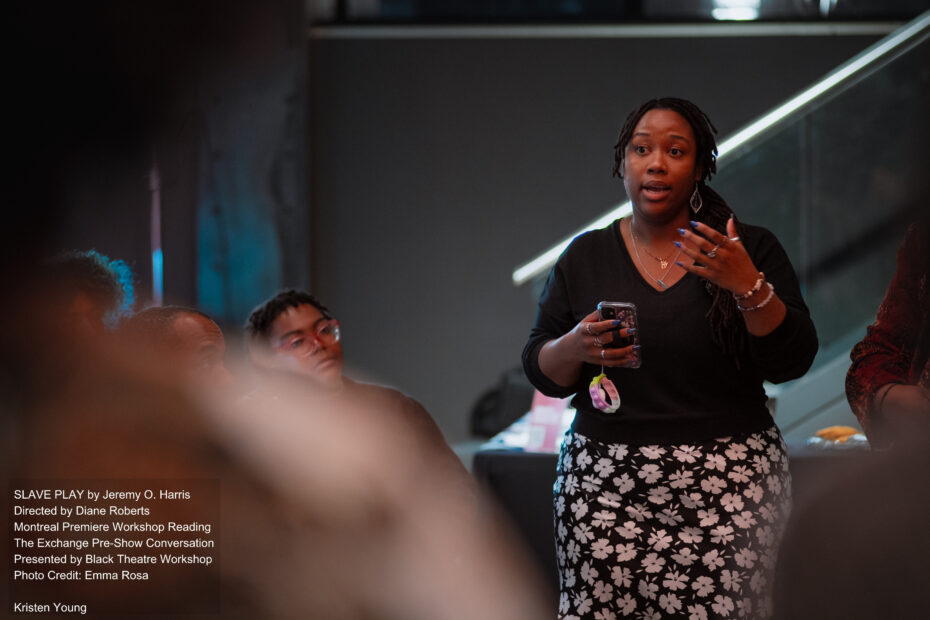
Slave Play is a part of BTW’s series of readings titled tête-à-tête, which invite viewers to engage in conversation with theatre. Rather than put on a main stage show, BTW produces three readings of plays which might otherwise not be shown due to cast size or controversy. Alongside these readings, BTW also hosts pre-show conversations, in collaboration with Concordia University’s Black Community Engagement Office and University of the Streets Cafe. The goal is to bring private tensions into public discourse and ask new questions.
In an interview with the Daily, artistic Director Dian Marie Bridges explains that in running Slave Play, she wanted to “really question why do we do theater? Why are these plays important? What gives people an incentive to come to theatre? What is the role of art in the Black community? …That comes down to community. That comes down to conversation.”
O’Harris is equally interested in these questions. In his documentary about the making of the play, Slave Play. Not a Movie. A Play, he states that Pornhub created a map of the most popular porn per state, where “ebony and lesbian porn were the top porn in New York.” O’Harris continues: “[I]f all you people are going home and watching this in your secret little rooms and then also like, you know, voting for Obama but like saying the N-word when you hear a Kendrick Lamar song [when] you’re all alone…I want to play with all of those aspects in this room because like, I know you can handle it because you do at home…so let’s see you handle it here.”
This is the sentiment of tête-à-tête. Bridges tells the Daily that part of the reason why she programmed Slave Play was because she “wanted to see if we were ready for it [Slave Play], if we could have a conversation about it.” So what kind of conversations emerge from Slave Play? What does it mean to show Slave Play in Montreal?
For Bridges, “Slave Play as therapy really speaks to the psychological impact of slavery on [America]…It’s a different relationship [in Montreal].”
At the talkback following the show this weekend, audience members were curious about actors’ relationship to their characters. They asked questions such as, “Did you take your role seriously?” and “Was it difficult to play a character with trauma that might parallel your own?”
Perhaps these questions demonstrate that despite not being in the United States, we all have something to take away from the intrinsic complexities of race and traumatic history within our identities and how they affect our relationships. Or that as the stage directions declare, “Everything in life is a performance.”
Whether ugly, beautiful, explicit, poetic, or painful, language is the power that shapes us all. It can poke at us, hang over us, or give us a voice. Slave Play plays with all of these factors, highlighting how conversation is where we can make sense of it all.