

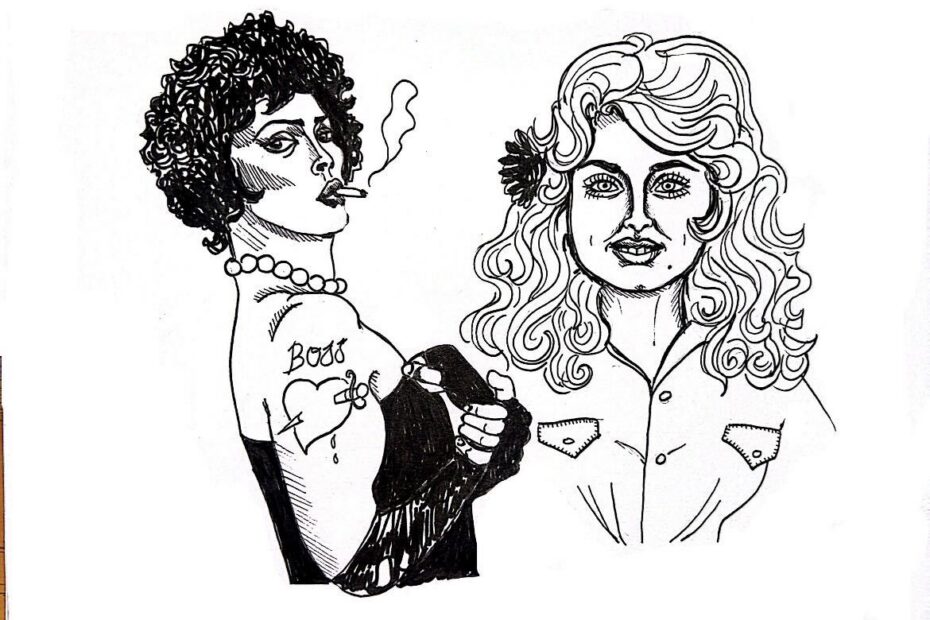
Tim Curry and Dolly Parton may seem like unlikely icons to place side by side, yet their legacies share a common thread: both have encouraged generations of people to embrace their individuality and challenge the expectations that smother their lived realities. Through their respective careers, Curry and Parton have helped make self-expression a source of pride rather than shame, leaving behind bodies of work that continue to resonate with LGBTQ+ audiences long after their first moments in
the spotlight.
As Dr. Frank-N-Furter in The Rocky Horror Picture Show, Curry embodied a flamboyant, gender nonconforming character who defied conventional ideas of sexuality, masculinity, and self- respect. The film’s enduring cult following and its famous participatory midnight screenings have transformed it into more than a purely cinematic phenomenon: it has become a space where audiences continue to experiment with identity, celebrate their differences, and find community.
Parton’s influence, meanwhile, demonstrates how a mainstream icon can foster acceptance for the socially outcast through a different kind of cultural power. Rooted in country music and Southern traditions, she has time and time again chosen to use her wide-reaching appeal and gift for storytelling to bring LGBTQ+ experiences into the broader public consciousness. From writing and recording the original song “Travelin’ Thru” for Transamerica, a film centred around the exploration of transgender identity, to her unwavering public support for LGBTQ+ rights, Parton showed repeatedly throughout her career that compassion need not be constrained by such arbitrary divisions as who one is capable to love.
These two public personalities reveal how utilizing their massive cultural influence with deliberation can create transformational possibilities for people who rarely got to see themselves reflected with dignity in mainstream culture. Curry’s theatrical defiance makes space for experimentation, transformation, and the joy of refusing conventional labels; while Parton’s warmth, humour, and generosity demonstrate the power of extending that space through empathy and public advocacy. Neither legacy can be reduced to a single character, song, or statement — instead their significance lies in the ways their work continues to give audiences permission to envision lives and realities beyond any external expectation.
Tim Curry: The Power of Being Unapologetic
Few performances have become as inseparable from queer cultural history as Tim Curry’s in The Rocky Horror Picture Show. With glittering eyeshadow, towering platform heels, fishnet stockings, and an unapologetic appetite for pleasure, Curry transformed an unconventional sci-fi musical into a celebration of sexual liberation. Decades later, audiences still gather in theatres worldwide to recreate its scenes and sing along to its musical numbers. For LGBTQ+ audiences, Frank-N-Furter represented something rarely afforded to queer characters in mainstream entertainment: the leisure of extravagance. Curry’s legacy extends beyond a memorable performance — through Frank-N-Furter, he helped bring alternative expressions of gender and sexuality into the spotlight which challenged social norms. Adapted from Richard O’Brien’s 1973 stage musical, The Rocky Horror Picture Show follows wholesome American sweethearts Brad and Janet, whose encounter with the inhabitants of a mysterious mansion upends their conventional understanding of sexuality and desire.
At the centre of their surreal experience is Frank-N-Furter, a flamboyant scientist from the planet Transsexual whose androgynous appearance and uninhibited behaviour disrupt the couple’s carefully ordered world. The risk of taking on such a role was considerable. Frank-N-Furter required a bold performance, that of someone utterly unaffected by society’s traditional expectations of masculinity. Curry, however, was drawn to the challenge. Reflecting on the role, he explained being attracted to risk: “I would choose risky over anything. That’s the best way to be.” Although Brad and Janet technically occupy the roles of the protagonists, Frank-N-Furter commands the screen from the moment he first appears. His entrance and the ensuing performance of “Sweet Transvestite” establish a character who refuses to be diminished by convention. Curry plays him with a magnetic combination of theatricality, sensuality, humour, and a sense of danger making Frank-N-Furter simultaneously seductive and menacing. He does not merely challenge the rules — he makes breaking them look irresistible.
At the time of the film’s release, and for a few of the decades that followed, LGBTQ+ people were frequently relegated to limited or stereotypical portrayals in mainstream entertainment. The 1970s saw queer characters that would more often than not serve to provide comic relief, tragic storylines, or cautionary tales. Frank-N-Furter offered a striking alternative: a character whose gender expression and sexuality were central to the story, rather than details to be concealed. Through its camp aesthetics and exaggerated performances, Rocky Horror’s gleeful parody of existing sci-fi and horror conventions challenged audiences to reconsider the boundaries between masculinity and femininity; normalcy and deviance. Its irreverence managed to make challenging the tropes of the genre entertaining without stripping them of meaning.
Yet Frank-N-Furter is no straightforward hero. His story does not culminate in a celebration of any moral virtue, nor does his gender expression map neatly onto any single established LGBTQ+ identity. But that complexity is part of what makes Curry’s performance so compelling. Queer characters need not to be flawless in order to deserve representation. Allowing gender nonconforming characters to be morally ambiguous — even outright villainous — challenges the expectation that marginalized people must demonstrate some sort of exceptional goodness to justify their place on the silver screen. Frank-N-Furter’s outsize, monstrous exuberance can be read as a reflection of the historical association between queerness and deviance, but it can also be understood as a source of power. Rather than seeking acceptance by becoming “respectable,” Frank only ever takes pleasure in his
own excesses. His character invites audiences to consider whether being an outsider might be something more than a cause for shame. The film’s mantra, “Don’t dream it, be it,” distills that philosophy into a simple invitation: stop treating self- expression as an impossible fantasy…and begin embracing the person you want to become.
One of the most remarkable aspects of The Rocky Horror Picture Show, however, is the unique showgoing tradition that has developed around it. Screenings of Rocky Horror are rarely passive experiences: spectators often arrive in corsets, feather boas, leather jackets, formal gowns, and whatever else allows them to participate in the spectacle. They shout familiar lines, dance along, and watch live performers reenact the same scenes before the big screen. These gatherings have transformed a cult film into a living theatrical experience. For LGBTQ+ viewers, they can offer an opportunity to experiment with appearance and identity in an environment where unconventional self-expression is part of the celebration. O’Brien, the creator of Rocky Horror, has acknowledged the production’s impact on conversations about gender and sexuality. In an interview with The Guardian, he reflected on how the work had helped people feel less isolated, expressing gratitude for its wider social impact. More than five decades after its stage debut, Rocky Horror continues to demonstrate how a performance can challenge the most stringent of cultural expectations.
To reduce Curry’s career to a single role, however, would be to overlook the extraordinary range of his work. His performances demonstrate a particular gift for combining theatrical extravagance with mischievous humour. In Clue (1985), he cultivated an impeccable sense of comedic timing to the absurd and intrigue-driven murder mystery. As Pennywise in the 1990 television adaptation of Stephen King’s It, he brought to life a deeply unsettling villain whose lurking menace became unforgettable. He has also appeared as the Lord of Darkness in Legend, Long John Silver in Muppet Treasure Island, and the concierge in Home Alone 2: Lost in New York. Across these performances, Curry added a fantastical feeling of glee to characters who disrupt ordinary life, always making room for the strange, the excessive, and the unexpected. That same sensibility is what connects his broader career to the spirit of Rocky Horror: a willingness to find delight in what convention tells us to reject.
The world has changed considerably since The Rocky Horror Picture Show first reached audiences: LGBTQ+ representation in film has expanded, and conversations about gender identity and sexuality have become considerably more visible. Yet acceptance remains uneven across social and cultural fields, and the freedom for people to express themselves freely cannot be taken for granted. The film remains meaningful because it celebrates the refusal to be confined by expectations: Frank-N-Furter is excessive, and impossible to contain. He does not ask permission to occupy space — he simply arrives and commands all attention. Curry was the one who brought the character to life, with a performance that was as mischievous as it was subversive. His portrayal helped turn what could’ve been a merely provocative stage creation into an enduring cultural icon, inspiring generations to question the boundaries around gender, sexuality, and self-expression. Yet what makes Curry’s performance so enduring is not simply that it challenged conventional ideas of gender and sexuality, but that it made defying those expectations look liberating. To me, that is part of what makes his legacy so meaningful to queer audiences.
Dolly Parton: A Voice for Belonging
Dolly Parton occupies an unusual place in North American pop culture. A country music superstar known for her rhinestone-studded outfits, towering blonde wigs, and unmistakable voice, she has long appealed to audiences even far outside her genre. Among her most devoted fans are disproportionately many LGBTQ+ people, for whom the meaning of her work extends beyond her music. Parton’s appeal to queer audiences begins with her public persona: her exaggerated femininity and ‘camp’ have made her a favourite among drag performers, who frequently recreate her signature looks. Parton has largely embraced these impersonations — in her appearance on the cover of Out magazine in 1997, she acknowledged her established place in the queer culture.
However, the connection goes deeper than rhinestones and wigs. Parton has spoken about being judged for her appearance and background, experiences that according to her have informed her empathy for groups who are treated as outsiders. Her 1971 song, “Coat of Many Colors,” recounts how children mocked her for wearing a coat sewn by her mother from scraps of fabric. Rather than presenting the coat as a source of shame, Parton celebrated the love behind it. For LGBTQ+ listeners, the song’s emotional logic can resonate with the experiences of bullying and rejection all too common in their childhoods. Parton has connected her appeal to queer audiences with her own experiences of feeling different, allowing listeners to find personal meaning in a story that was not explicitly written about queer identity. Others of her songs have acquired similar significance through reinterpretation — “Jolene,” with its intense focus on another woman’s beauty, has inspired numerous queer readings into its lyrics. Meanwhile her 1991 song “Family” more directly acknowledges differences that can occur among one’s relatives, including sexual orientation, while affirming that familial belonging should not be contingent on any sort of conformity on the part of the individual.
When Parton made her transition from country music into film and television, it only expanded her cultural reach into the queer community. Her move to Los Angeles brought her into partnership with Sandy Gallin, an influential talent manager who was openly gay. Their professional relationship helped expand her career into mainstream entertainment, including major film roles. Her 1980 debut role in
9 to 5, in which she stars alongside Jane Fonda and Lily Tomlin, follows three women confronting workplace sexism and an exploitative boss, contributing to her appeal among audiences — often queer ones — drawn to narratives of resistance. In 2005, she wrote and performed “Travelin’ Thru” for Transamerica, a film about a transgender woman travelling across the United States. The song received an Academy Award nomination, and Parton performed it at the 2006 Oscars, bringing a story centred on the transgender experience to one of the entertainment industry’s most visible stages. She also explored queer family relationships in her 2019 Netflix anthology series, Dolly Parton’s Heartstrings. One episode follows a gay couple navigating family secrets and rejection around a New Year’s Eve wedding. Its recognition from the Gay & Lesbian Alliance Against Defamation (GLAAD) highlighted the value of incorporating LGBTQ+ relationships into mainstream storytelling. Above all, these projects demonstrate how Parton translated her cultural influence into opportunities to underline queer narratives, placing stories that might otherwise have remained at the margins before much wider audiences.
Her support for the queer community became particularly evident during the HIV/AIDS epidemic in the 1980s, when gay men were faced with widespread stigma, discrimination, and public rejection. Her production company, Sandollar Productions, co-produced Common Threads: Stories from the Quilt, the landmark 1989 documentary about the NAMES Project AIDS Memorial Quilt. Her book editor, Elissa Altman, has also revealed that Parton privately covered the medical costs of a staff member’s gender transition in the 1990s. Her advocacy continued for decades: she spoke up in support of same-sex marriage in 2009 and voiced support for transgender people amid Tennessee’s passing of Bill 1, which banned gender-affirming medical care for minors as of July 1, 2023. Across the decades, her support for the LGBTQ+ community took on many different forms from public awareness campaigns to personal assistance. Her activism takes place within a broader philanthropic mission: in 1995, Parton established the Imagination Library, which distributes free books to young children in honour of her father who never learned to read. Following the devastating wildfires in Tennessee in 2016, she provided financial assistance to families who had lost their homes, as well as later contributing to COVID-19 vaccine research. It is clear that, for this star, compassion extended beyond words and into meaningful projects that directly affected people’s lives.
Parton’s relationship with LGBTQ+ audiences is particularly significant in the American South. For some, she represents a connection to the music, humour, and cultural traditions of home without requiring them to accept the prejudice that can accompany those traditions. Her influence has surfaced in legal debates over queer expression: in a ruling striking down a Texas law restricting drag performances, federal judge David Hittner cited Parton as an example of a mainstream entertainer whose flamboyant clothing and suggestive performances could potentially be restricted under an overly broad interpretation of the law. His reference illustrated the difficulty of regulating drag without also raising questions about artistic expression in mainstream entertainment. This example is particularly fitting for an artist whose public image has long played with the boundaries of femininity and theatrical exaggeration. Parton’s appearance is not merely decorative; it has become part of a cultural language that drag performers can reinterpret and that queer audiences can claim for themselves.
Parton’s significance lies in her ability to challenge prejudice without distancing herself from the culture that made her famous. Her career demonstrates that advocating for LGBTQ+ acceptance does not have to mean abandoning one’s roots. Through songs that invite reinterpretation, films that foreground LGBTQ+ experiences, and advocacy spanning the HIV/AIDS epidemic to contemporary debates over transgender rights, Parton has made queer acceptance part of a broader cultural conversation. The rhinestones and wigs may make Parton instantly recognizable, but her enduring influence comes from what she has accomplished with her visibility for those who lack a voice. For LGBTQ+ audiences in particular, her legacy continues to represent the possibility of making compassion a principle that transcends differences in identity, background, or belief. Though the impact of both Curry and Parton’s lives and careers will eventually belong to history, their art continues to invite new generations to dream boldly, express themselves with freedom, and build communities where difference is celebrated. Between Tim Curry’s theatrical defiance and Dolly Parton’s enduring compassion, these two cultural icons have helped generations of LGBTQ+ people embrace their identities, find community, and live unapologetically.