

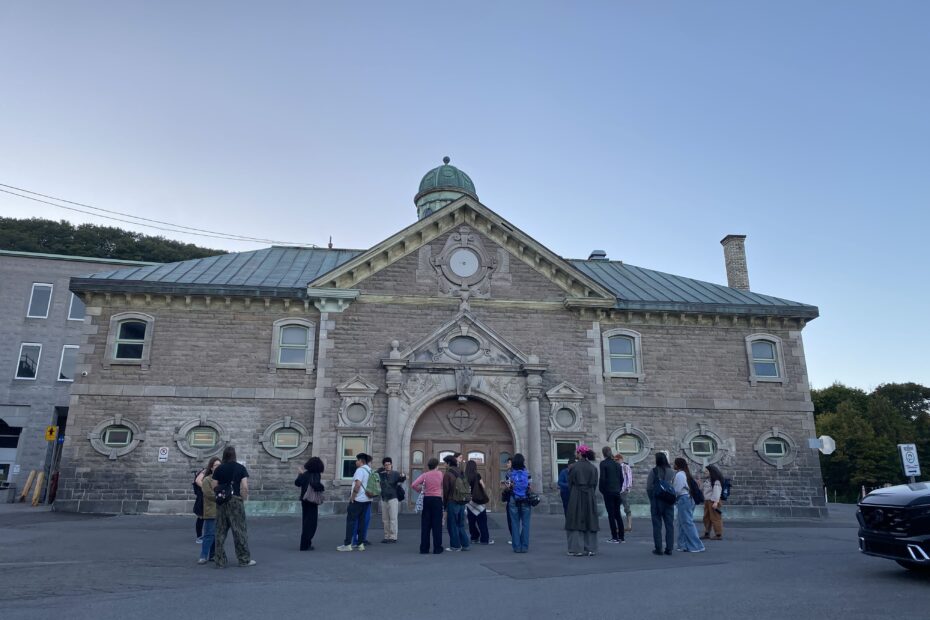
Mohawk Mothers organize to honour the children allegedly buried on the site of the Allan Memorial Institute and former Royal Victoria Hospital
Four years ago, McGill announced that it would begin the first stage of underground investigation on the site of the former Royal Victoria Hospital (RVH). Sustainability Park, formerly called the New Vic Project, was described by provost, Christopher Manfredi, as “the most significant project our university has undertaken since its inception.” The Société québécoise des infrastructures (SQI) is responsible for the entire site, and has been working with McGill on the project since the site was vacated in 2015.
However, the project has been stalled by fierce resistance and battles in court. The Kanien’kehá:ka Kahnistensera, also known as the Mohawk Mothers, allege that the site holds unmarked graves of Indigenous children. The Indigenous solidarity collective has been fighting the construction since it was proposed, arguing that McGill continues to deny and infringe on the group’s right to investigate those responsible for abuses against Indigenous peoples. “We deserve the opportunity to honour our loved ones and grieve them properly,” the Kahnistensera write on their website.
The group is also committed to searching the grounds for undiscovered evidence related to the CIA’s MK- ULTRA medical program, a series of illegal psychiatric experiments conducted at the Allan Memorial Institute between 1948 and 1964 under Dr. Donald Ewan. Victims were given drugs and psychologically tortured for the purposes of manipulating the psyche: speakers at the vigil detailed the program’s use of electroshock therapy to erase victims’ memories and the ubsequent use of “psychic drilling” to reprogram the mind. Activist and Kanien’kehá:ka nation member, Kahentinetha Horn, described the experiments as “sheer scientific cruelty,
The Kahnistensera held their first vigil behind the Allan Memorial Institute on May 23, 2025. The event serves as a way to hold space for ancestors, says organizer CJ, as an answer to the questions of how we can educate and commemorate the site. They held 12 vigils throughout the summer of 2025, and returned Friday, Palestine to North America, known as Turtle Island by many of the continent’s Indigenous peoples. “The same thing is happening in many different places,” a participant shared on the “present-day perpetuation of colonialism” that the Kahnistensera describe.
Horn described the series of vigils as an invitation to pay homage to the people who may be buried there. The vigil began behind the Allan Memorial Institute next to the Morgan pool, which was constructed at the height of the MK-ULTRA experiments. “You can’t just take children and throw them in a mass grave and cover them up,” Horn said during the vigil. She expressed that the vigils are part of the responsibility to take care of those children. “When we’ve completed our mission here, we will come back and have a closing ceremony for them,” she promised.
The general sentiment of the vigil was that non-Indigenous residents in Montreal, known as Tiohtià:ke in the language of the Kanien’kehá:ka, are living on stolen Indigenous land. “This whole island of Montreal is Mohawk,” Horn stated. “This land is Mohawk land. [Tkaronto] is Mohawk land too. Ontario is a Mohawk name.” She reiterated that McGill is built on Mohawk land, echoing the Kahnistensera’s statement that “McGill is a gravesite,” and that “it’s all built on blood,” as written in their handout. “I linked to the Residential School System, and that many members of our campus and broader community are deeply impacted by this. Hence, in the spirit of reconciliation, McGill’s work with the SQI is and will always be grounded in caution, and will involve ongoing conversation with local traditional and elected Indigenous leaders.”
The legal battle between McGill and the Kahnistensera has been long and ongoing. In March 2022, the Kahnistensera filed a lawsuit against McGill and the SQI alleging that the former hospital grounds contain unmarked gravesites. An October 2022 court decision from the Superior Court of Quebec granted the Kahnistensera with an injunction that halted development until a proper archaeological investigation could be conducted. Both parties agreed to appoint a panel of three archaeologists, which was mandated to assess and identify the archaeological techniques to be used on the site for the detection of human remains and unmarked graves.
“McGill is destroying evidence and making it harder for people to find their lost family members as we speak,” the @takebacktekanonontak Instagram account, dedicated to solidarity with the Kahnistensera, wrote in a March 2024 post. “McGill is continuing construction regardless of the damage it could cause to those searching for their lost family members and to those wishing to find more evidence regarding the CIA’s MK-ULTRA medical program.”
Nonetheless, McGill maintains that there are no human remains on the site. They deny that Historic Human Remains Detection Dogs (HHRDD) detected remains, and claim that the bone fragments found during the investigation are from animals and hold “no relation to or indication of clandestine human burial.” During a tour of the site at the vigil, the Kahnistensera claimed that many of the fragments were too small to identify, and that the university never performed the lab analysis that they claimed to have conducted. They write in a flyer that several pieces of evidence of human remains have been found, and that McGill, Quebec, and the SQI refuse to respect forensic practices. In the Instagram post advertising the vigil, @takebacktekanontak lists the “results of three remote-sending technologies” used near the Morgan pool, confirmed by Askîhk Research Services (run by the SQI) as “three separate lines of evidence supporting the presence of human remains.” These include ground penetrating radar (GPR), HHRDD, and “subterra grey probe, [which identifies] burials by detecting fatty acids resulting from soft tissue decomposition and changes in soil compactness from digging burial shafts.”
The overall cost of the project, including planning, restoring, and construction, is projected to be 870 million dollars. Amid budget cuts over the past two years, the university has described the Sustainable Park project as “a top priority for McGill…[that] will continue.” “Where is this money coming from?” the Kahnistensera asks. “Where is your tuition going? What are you paying for?”
McGill writes that the allegations that there may be unmarked graves on the RVH site are currently being investigated. “They just don’t know what to do, because we can’t stop,” stated Horn. “We have our duty, we’re not going to stop, we’ll never stop.”