
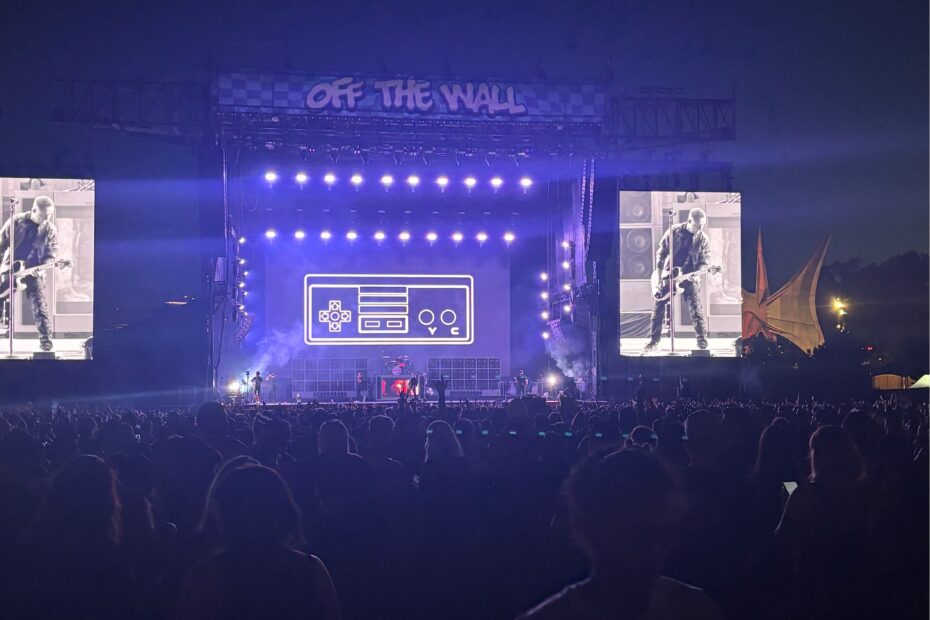
There was something special about this past summer in Montreal. The energy of the city was palpable, and the city’s well-established festival scene managed to draw on a rejuvenated Montreal crowd by pulling record numbers of attendees. But none drummed up the nostalgia and united subcultures quite as much as one in particular — the Vans Warped Tour.
Following a 12-year hiatus from Montreal, the Vans Warped Tour returned in full force this past summer as part of a limited run of shows celebrating its 30th anniversary. Founded by music promoter Kevin Lyman, the festival toured nonstop from its inception in 1995 up until 2019, establishing itself as the longest-running travelling music festival in North America and the epicenter for pop-punk, punk rock, and ska culture. To understand how the Warped Tour became a defining fixture of alternative music, we have to look back at the acts, stories, and unique quirks that gave the tour its legendary status.
“A freak show takes the stage”
To look at the Warped Tour through the same lens as other well-established music festivals would be a grave misunderstanding. Tickets are cheap. The tour does not have any official headliners. Lineups are a mix between well-established names within each sub-genre alongside a number of up-and-coming acts, who you can often catch hanging out at their on-site merchandise tents. Set times are announced the day of the show and are posted on an inflatable billboard at the venue.
For those on tour, days were long and sets were short. Bands quickly packed their equipment into cramped vans before rushing off to the next stop as soon as their sets ended. Well-established and mid-sized bands often took smaller paychecks in exchange for the opportunity to stay on tour while some lesser-known bands would cover their own expenses by renting out their unused bus bunks to food an merchandise vendors.
Up-and-coming bands were eager to join in on the action — prompting Lyman, in 1998, to create the longstanding tradition known as the “BBQ Band.” In essence, the BBQ Band was a lesser-known artist or band who, in exchange for a thirty minute set time, would have to buy and cook food for the bands, stage workers, and sponsors.
To put it bluntly: touring was chaotic. Musicians were young, energetic and non-conformist. In its infancy, the Warped Tour may have looked like a travelling musical circus barely scraping by. But in reality, the seeds for an explosion of counterculture had been planted, and no one was more aware of this than the bands who took its stages. The prospect of superstardom was close — and they knew it.
“Maybe it’s not my weekend / But it’s gonna be my year”
The Warped Tour helped launch a number of musical acts into the mainstream consciousness while also benefitting from a time when punk and pop-punk albums were flying off the shelves.
Sublime, who headlined the Tour’s 1995 debut, went from being a club-playing ska-punk band in Long Beach, California to a major international success thanks in part to Warped and their 1996 self-titled album which spent 179 weeks on the Billboard 200 chart. From getting kicked off the tour when the band’s mascot dalmatian, Lou Dog, bit multiple people, to the death of lead singer and guitarist Bradley Nowell just months before the release of their most commercially successful album, the star-crossed icons embodied the madness that was early Warped.
Blink-182 was another band who found themselves at the centre of mainstream success while being a staple of the tour. Having been introduced to Lyman by Pennywise guitarist Fletcher Dragge in 1996, the young, crude and remarkably talented group went from being a lesser-known skate punk band playing in their underwear to pioneers of the pop-punk genre, selling over 50 million records worldwide.
“We’re the somber media darlings”
Ultimately, though, what made Warped such an effective springboard to mainstream success for so many bands wasn’t just the exposure it offered — it was its ability to unite different subcultures into a wave of anti-conformist culture.
We’ve come a long way from shows being overrun by agents of chaos inciting havoc on and off the stage. But the ethos remains the same. Today’s shows bring together young talent, like the Paradox, with renowned veterans, like Sublime, now led by Nowell’s son Jakob. Together, they channel the same angst, rage and, rebellion that made the Warped Tour the celebratory cultural scene it is today.
What makes the Warped Tour so special is not a claim to understand everyone in a world of people longing for acceptance. Instead, the tour’s magic rests in showing concertgoers just how much conformity the mainstream demands — and giving them the freedom to say, “fuck that.”