

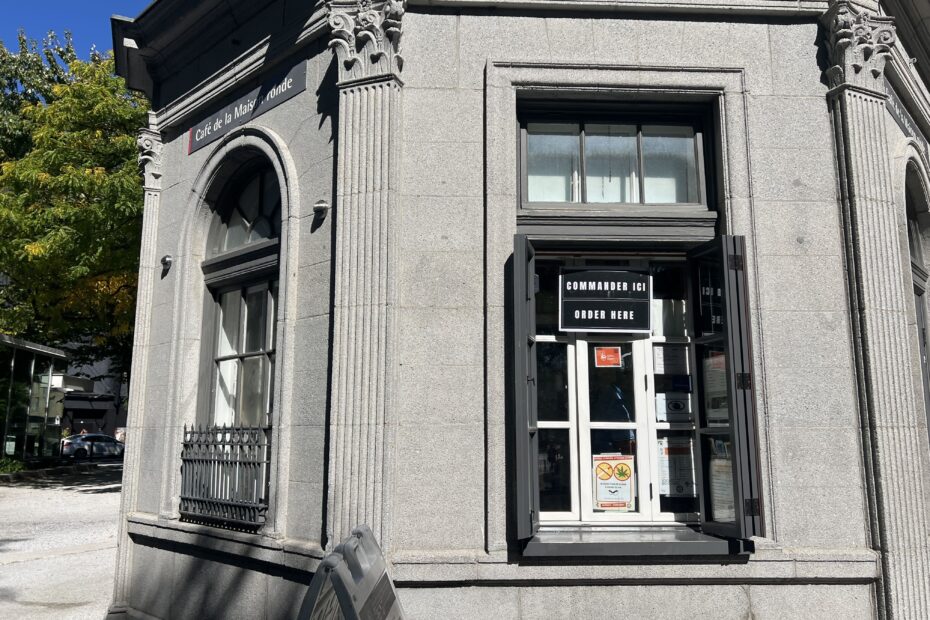
On one of the few precious warm days before the frigid fall chill sets in, my dear friend and fellow editor Justin and I took a short metro ride from downtown to Le Café Maison Ronde, or The Roundhouse Cafe. The Roundhouse is a sub-project of L’Itinéraire, a public organization which aims to help vulnerable peoples in Montreal. It is also the first and only Indigenous-run cafe in the city which is surprising, considering the sheer density and diversity of Montreal’s cafe scene.
The Roundhouse, which is right outside the Atwater Station exit in Cabot Square, does not possess the lavishly decorated storefront you might imagine with a typical cafe; nor is it, like other cafes situate along the bustling Rue Sainte-Catherine, sandwiched between a myriad of fluorescently-lit stores. Rather, it operates out of a stone gazebo structure that one might not even recognize as a cafe at first glance. With no easily visible signage or in-house seating, the cafe is evidently meant for those who know to look for it.
And who would know to look for it? According to L’Itinéraire’s website, The Roundhouse’s primary mandate is to promote interactions between various Indigenous communities. This demographic was reflected in the individuals populating the small, jewel-toned round tables outside the cafe. The lunch rush meant that my food got served after a 30-minute wait, yet it was graciously topped off with a free bannique sucrée (“sweet bannock” pastry) for our patience.
I ordered an Indigenous Taco: bannock bread stuffed with juicy ground beef and topped with diced tomatoes and sour cream. Justin got a cappuccino and a BLT between two pieces of bannock bread. A key symbol of Indigenous culinary identity, bannock bread has historically been a quick and effortless source of carbohydrates, especially in times of hardship and food rationing. Before European settlers arrived in Montreal, Indigenous peoples made bread out of dried camas bulbs, which were then flattened and baked. Later, English and Scottish traders arrived and introduced bannock, an unleavened flour, which Indigenous peoples began to incorporate into their recipes. Now, bannock bread is an important dish in Indigenous cuisine, its recipe having been tweaked and perfected over centuries. Justin remarked on its slightly olive-y notes and density in his BLT. Meanwhile, I noticed an imbued smokiness that was brought out in the bannique sucrée, which was dotted with cranberries and white chocolate.
This was supposed to be an article reviewing the cafe, simply detailing my first time trying Indigenous food and promoting the presence of establishments that offer it, given that they are few and far between. However, as Justin and I sat at Square Cabot that fine Thursday afternoon, other things became apparent to us: the amount of police presence in a relatively peaceful park in broad daylight, the tents of the unhoused that peppered the area, and the array of interactions between Indigenous peoples in the hour and a half we spent there.
As I would come to learn, Cabot Square is a site where many Indigenous people congregate to resist political structures and mobilize amongst themselves. The Cabot Square Project, launched in 2014 by the Native Women’s Shelter of Montreal (NWSM), aims to provide support, safety, and advocacy for vulnerable populations in and around Cabot Square. The Roundhouse is directly involved in the fulfilment of these objectives: it uniquely employs Indigenous people, many of whom are unhoused and/or under vulnerable circumstances. In fact, a 2023 report from the government of Quebec showed that 13 per cent of Montreal’s unhoused population identified as Indigenous, despite Indigenous people only comprising 0.6 per cent of Montreal’s overall population. Therefore, issues of homelessness and Indigenous marginalization can be understood as highly intertwined.
In addition, due to gentrification in Ville-Marie, more and more unhoused people are being pushed into Cabot Square. A volunteer for Resilience Montreal, an Indigenous-led organization that aims to support unhoused and Indigenous people in the area, told the Daily how gentrification in Ville-Marie had systematically displaced many unhoused people. According to her, this was done in an effort to raise estate value and quell dissent from business owners, who view unhoused people as liabilities. This also explains the police presence Justin and I noticed in the otherwise serene park, instead of along the busy adjacent road.
Cabot Square, then, is a space defined by contradiction. It is meant to be a place where unhoused Indigenous people can seek refuge and community; however, it is also where their behaviour and bodies are most surveilled and disciplined. Significantly, Cabot Square is also representative of the place that Indigenous people occupy in the greater Canadian social sphere: present, but hidden from plain sight, sidelined into corners that then come to be understood as places to be avoided. This is especially ironic considering that Canada as we know it stands on unceded Indigenous land. Indigenous people are deprived of ownership of and autonomy on land that was once theirs, all while colonial mentalities which paint Indigeneity as a threat are continually reproduced, intentionally or not.
Nonetheless, we observed the hope and everyday joys ever-present in this space. People basked in the early autumn sunlight and its temporary warmth, chatting warmly and loudly. One of the employees at The Roundhouse showed us a painting he had made that read, “Happiness is not a destination, but a way of life.” While the sun is out and the “feels like” figures are above freezing, consider taking a trip down to Cabot Park and The Roundhouse cafe (if you can find it). The food is cheap, good, and most importantly, full of heart.