
The origin of the powwow is unknown, but it is a relatively new tradition, started in the 1800s and popularized in North American Indigenous communities in the 1900s. In the 1830s when colonial governments implemented reserves, singing and dancing were used to keep Indigenous culture alive. Very quickly, many different forms of Indigenous practices, including powwows, were outlawed through Canada’s 1876 Act. While for decades many First Nations people fought against the ban, it wasn’t until after World War II that change was made. Returning veterans from the war heavily protested their right for religious freedom and practice, which led to an amendment to the Indian Act in 1951 to allow Indigenous peoples to hold traditional ceremonies. It wasn’t until the 1960s that powwows became more popular as a way to create cross-cultural exchange between different Indigenous cultures and non-indigenous people.
The 25th Annual McGill Powwow was held by the McGill Office of Indigenous Initiatives and John Abbott College at the McGill MacDonald Campus on Friday, September 18. For McGill students on the downtown campus, the day started out grey and cold, the feeble rays of September sunlight blocked by the tall downtown buildings. However, on the Macdonald campus, summer was still in full swing; the powwow took place on Watson Field, where the surrounding trees allowed the sun to shine down on spectators in full. This joyful reminder of summer weather was the perfect preface to the powwow.
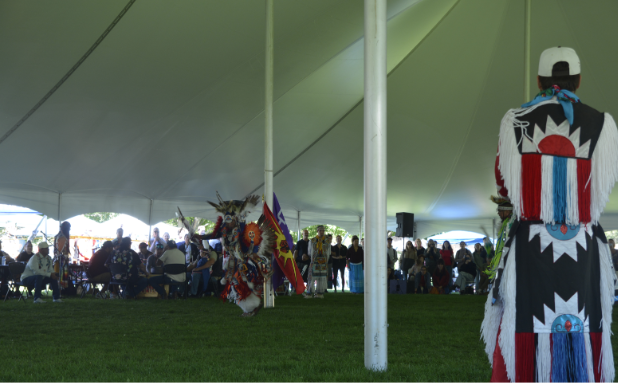
In the middle of Watson Field, a white tent reflecting the sunlight served as the centre for activities. Spectators and participants alike lined the perimeter of the tent standing or sitting on the grass and in chairs. Among the spectators were students, various members of the community, local vendors, and dancers.
The powwow was kicked off by the Grand Entry, a traditional opening ceremony, which began with all the dancers entering from the eastern corner of the tent to pay symbolic respect to the Eastern Door. The Kanien’kehá:ka (Ga-niyen-ge-HAA-ga) or Mohawk people, are the Keepers of the Eastern Door due to their traditional eastern territory spanning over parts of Quebec, Vermont, and New York. The dancers moved around the tent in a counter-clockwise circle, as per Mohawk tradition, led by four flag-bearers, including Tom Dearhouse. He carried the Hiawatha Belt Flag, a deep purple banner set with five interconnected white shapes after a wampum belt design representing the five nations of the Haudenosaunee (Hoh-DEE-noh-SHOH-nee) or Iroquois Confederacy. Carried alongside it was the modern version of the Mohawk Warrior Flag designed for the Rotisken’rakéhte (Mohawk Warrior Society), an LGBTQ2S+ flag, and a POW/MIA flag honouring veterans. All four flags were hoisted on two centre poles under the tent. To conclude the ceremony, several different prayers were said and songs were sung.
Following the Grand Entry, participants and spectators settled into the tent for the rest of the day. One side of the tent was allocated to the emcee’s table along with four drum circles, each comprising between five to ten men around a large drum. Throughout the competitions, the different drum circles alternated synchronized performances while singing. The host drum was Black Bear, co-hosted by Spiritwolf Singers, and accompanied by Ottawa River and Eagle River Singers. The different drum groups were there to accompany the different dances during the day. The host drum is the drum group that is responsible for playing during the important events, such as the Grand Entry.
Ahead of the anticipated competition dances, the emcees of the event — Lance Delisle, in English, and Marie-Céline Charron, in French — opened the floor of the tent to all present for an inter-tribal dance. A large group of schoolchildren on a field trip made up the majority of the dance, following the lead dancers in a simple movement pattern where they hopped twice on each foot to the beat of the drums.
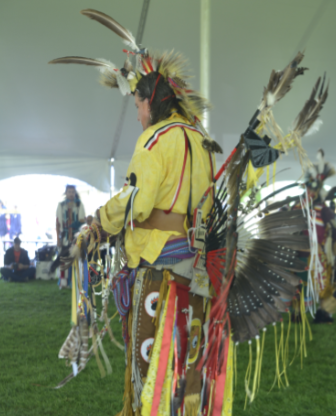
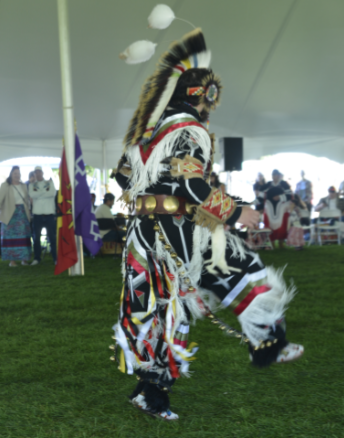
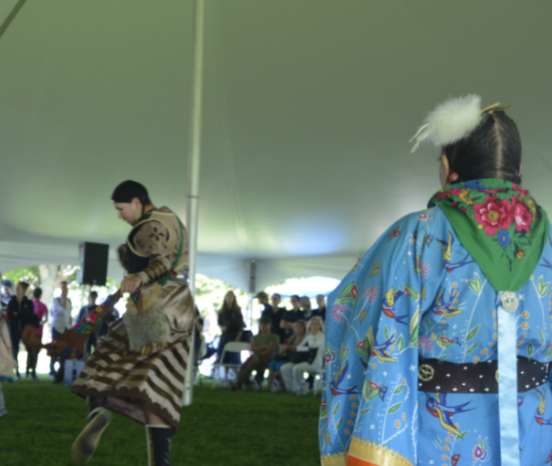
The competitions themselves were short, but there were 12 categories in total that were divided by type of dance, gender, and age. The categories for men included Traditional, which encompasses traditional sharptight movements emulating battle-like dancing steps; Fancy, which is a non-traditional dance with more elaborate dramatic movements dance moves and regalia; and Grass, which is meant to mimic the movement of grass in both the regalis and the steps. Women have a similar Traditional category with sharptight steps; the Jingle category, which uses dresses with metal cones hanging from the ress to add more auditory and visual elements; and finally, Fancy Shawl, which is meant to emulate a butterfly through the use of the dancer’s shawls as they dance to a fast beat.
Each category began with around three to ten dancers spread out in the tent as the three judges went to each corner to observe. Once the drum went off, the dancers gave their all. For about one minute, the dancers moved all around the tent, keeping time, and showing off their tricks to the judges until the drum stopped, at which point the dancers held their finishing pose. This cycle continued about three to four times per category. After the dancing was done, the performers lined up in front of the judges.
Once it was time for the Men’s Traditional category, Dearhouse— 63 years old, stepped into the circle with two other dancers. He discussed how he had chosen his regalia to honor his Ojibwe heritage and its traditional teachings. His outfit incorporated the four colours traditionally used by Ojibwe people to represent the cardinal directions: red, black, white, and yellow. Dearhouse also mentioned incorporating the concept of following the sun into his outfit. In Ojibwe culture, the sun is thought of as an elder brother. This idea resonated with Dearhous, as an elder brother himself, and as someone who has many responsibilities as a social worker and an educator of traditional teachings. Dearwood’s regalia consisted of a bustle headpiece made of deer and porcupine, as well as bells around his legs to help him dance in time.
After the competitions ended, a short break was taken to allow dancers to rest and gave the audience the opportunity to look around at the vendors. Observers were able to browse a series of stalls set up outside of the tent that featured Indigenous craftsmakers, McGill associations, Indigenous organizations, and food.
After the break, the performances continued with the Hoop Dance. Hoop Dancing originated in the 1930s, and involves a performer who uses hoops to create shapes to tell a story. In this particular performance, the dancer recreated the motions and shapes of birds using the hoops. This was the only non-competitive performance in the powwow, so the emcees put out a rug and encouraged people to leave tips.
The powwow concluded with the announcement of the winners for each category and the closing ceremony. The 25th Annual McGill Powwow was a beautiful event that celebrated and fostered a place for learning more about Indigenous culture. Instead of looking through the colonial lens of a textbook, take the time to go to a powwow and see for yourself what some aspects of Indigenous culture looks like. To attend, check out the McGill Annual Powwow or stay up to date with the Office of Indigenous Initiatives.