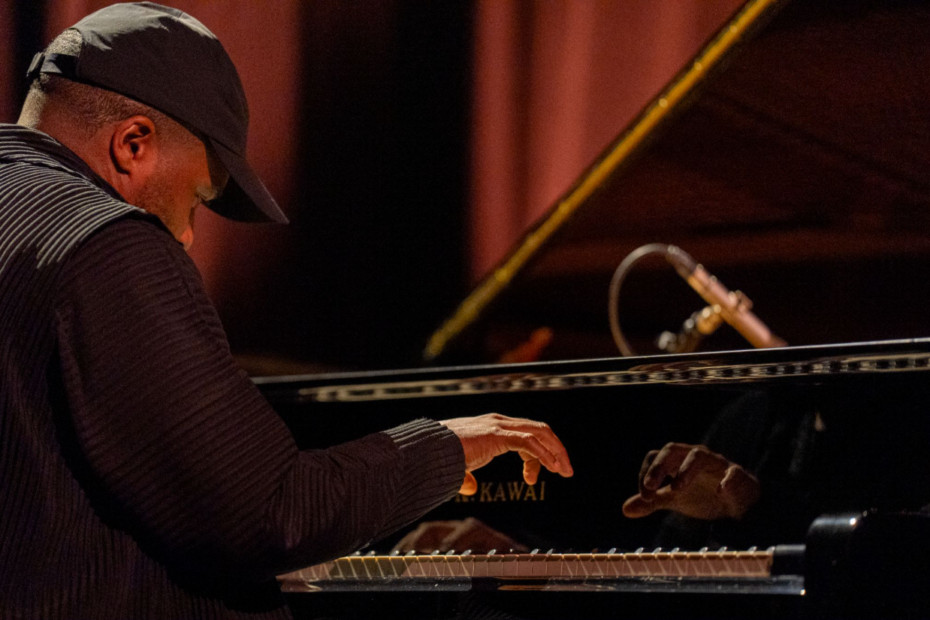
Solo jazz piano is notoriously difficult. Without a ‘rhythm section’ of bass and drums, the pianist lacks rhythmic support or harmonic grounding. At the same time, the rewards of this can be immense: the pianist retains complete control over harmonic content, tempo and style that even the tightest piano trio cannot match. Seasoned pianists throughout the jazz tradition have cut their teeth on the art of solo piano, from Fats Waller and Art Tatum to Thelonious Monk and Oscar Peterson. Sullivan Fortner now carries the torch of this legendary lineage. As a jazz pianist from New Orleans, Louisiana (the birthplace of jazz), his fluency in everything from stride to soul to bebop shows as clear as day in his playing.
The evening of June 25 saw Fortner perform a solo show at Gesú Concert Hall, near the end of a packed first day of the Montreal International Jazz Festival. Fortner darted quickly onto the stage, phone in one hand and a paper cup of steaming hot tea in the other, smiling at the crowd. “As per usual, I don’t know what I’m gonna do,” he said, and the audience responded with a nervous chuckle. “Bear with me.”
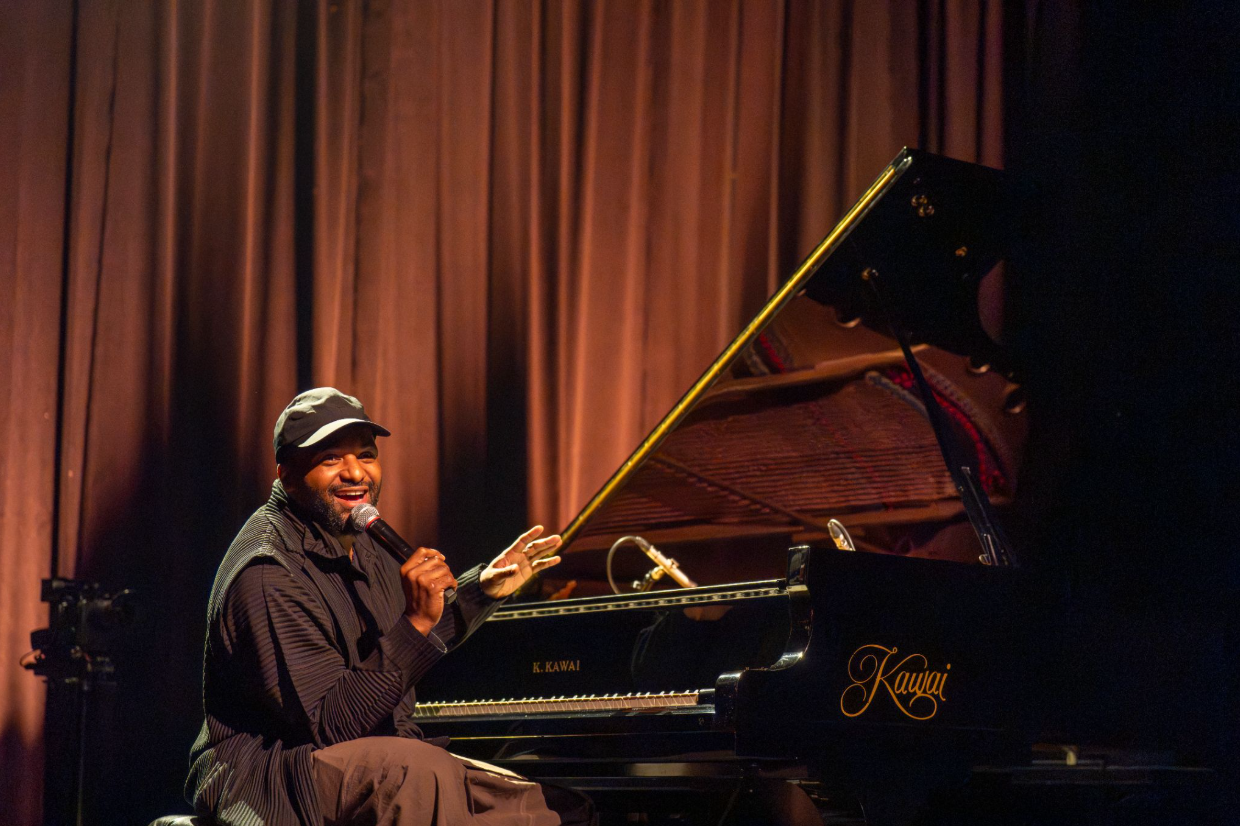
Seated at a Kawai grand piano, he began with a crowd favourite, “Don’t You Worry ’Bout a Thing” by Stevie Wonder — an interpretation long-time Fortner fans knew from his 2023 album Solo Game.
“Don’t You Worry ’Bout A Thing” began with a sparse and fleeting arrangement of the famous verse. Throughout the tune, different sporadic ideas, bubbling up from the deepest depths and raining down from the highest registers of the piano, began to enter into a clear conversation with the main melody, creating a shimmering veil of harmony. In interviews, Fortner has said that he sees harmony as a “set of simultaneous melodies” — an idea stemming straight from classical counterpoint and Ellingtonian composition. As he broadened his harmonic and rhythmic horizons over the course of the song, it became clear that this was not just a catchphrase: it was a core philosophy of Fortner’s playing. It would be easy to imagine each finger having a mind of its own, constantly in a battle between its own desires and the resolution of the larger harmonic theme. The melody, which is ordinarily relegated to the highest voice of an arrangement, was shifted time and again between hands and across different octaves, much as Ravel or Beethoven would transfer thematic motifs through different sections of a symphony orchestra. All of this was overlaid with a masterful articulation and touch, where different voices would come out of the blue, suddenly taking dynamic precedence at times even over the main melody. While many may think of harmony strictly as a way to embellish melody, the care and attention Fortner gave to every harmonic idea made it clear that he didn’t view things in such a straightforwardly hierarchical way.
He deconstructed “Don’t Worry ’Bout a Thing” piece by piece, peering at each harmonic and rhythmic idea from a few different angles before returning it to its place to fiddle with a new theme. Throughout this demonstration of mastery, Fortner maintained an air of ease and a playful touch. His tapping foot, a quiet onlooker for most of the tune, gradually became a participating accompanist, matching the instrument’s volume as Fortner entered a dynamic peak before fading again into the background of the simple verse. Fortner ended the tune just as he’d started it: with the simplicity of the Stevie Wonder classic.
Fortner’s trademark harmonic exceptionalism and his favoured use of deconstruction were put on pause for a profoundly simple rendition of Oscar Peterson’s L’Impossible. While interpreted by Peterson in certain instances as a Bossa Nova, Fortner’s performance skewed more towards a genre-ambiguous, sine-like purity. A steady offbeat chordal ostinato sounded for nearly the entire duration of the piece, providing a novel departure from the pianist’s relentless explorative rhythmic and harmonic forays. He kept Peterson’s simple diatonic melody relatively free of ornamentation, allowing the audience space to focus on the sound of the piano, the beauty of the melody, and his precise articulation. The peaceful etude seemed to wind its way through gentle hills and across expansive valleys before ending abruptly to nearly everyone’s surprise. The audience was left almost offended: what happened to the melody?! The steadiness and timelessness? Perhaps that’s just what happens, and it is certainly what Fortner intended.
In addition to being one of jazz’s most cherished legends, Oscar Peterson grew up in the heart of Montreal, where he is now celebrated as one of the city’s most prolific artistic innovators. Fortner evidently took advantage of the location of this venue to highlight Peterson’s legacy — In addition to L’Impossible, his set included a piece from Peterson’s Canadiana Suite, entitled Place St. Henri in honour of the composer’s childhood neighbourhood in south-west Montreal.
Place St. Henri showcased Fortner’s expertise and knowledge of the jazz repertoire in fiery fashion. Jumping into the tune from a tense silence, his hands slid rapidly from the polar ranges of the concert grand towards middle C, before converging and floating into the higher register in synchrony. This synchrony proved to be short-lived, however, when Fortner proceeded to enter into the familiar out-in left-hand stride pattern championed by everyone from James P. Johnson and Art Tatum to Oscar Peterson. While stride piano is well regarded at all tempos, Fortner decided to employ it at a virtuosically fast clip while his right hand flew around the upper keys in a blur evoking the song’s composer. The audience was already in awe, but Fortner took it further up a notch, dialing up the tempo and the intensity with unwavering precision. An audible murmur and dispersed laughter could be heard throughout the audience.
Even as the fiery rampage of the piano reached an immensity in volume that seemed to overtake the man at its keys, there was no question that he alone still held the reins. Fortner, who had been peering at the audience and swaying back and forth throughout the show, was now 100 per cent focused. Hunched over, he kept his eyes glued to his darting hands. Just as the heat reached peak ferocity, Fortner dialed back to his tempo primo — a masterful demonstration of tension and release. Then, before anyone could even get the idea of relaxing, Fortner gave a bold flourish, halting the momentum completely with a bang on a low note and jumped clean out of his seat, bolting off the stage. Almost instantly, the audience erupted in almost disbelieving applause. Fortner walked back onstage moments later to a standing ovation.
Once the audience had collected themselves, a final ballad resonated through the concert hall, contemplative and lush. Fortner rounded out the soft tune before following it with a sweeping final cadenza, paying homage to the dualities that had characterized the whole show: a blend of fast and slow, complexity mirrored against simplicity, order balancing chaos. These are the ingredients with which Fortner works, and from my experience are highlighted especially during his solo performances.
After all, Fortner is not simply a pianist. He is, first and foremost, an arranger — an expert at organizing and rearranging complex webs of rhythm and harmony to create something with as much scope as an orchestral composition within the 88 keys of his instrument. Every tune he plays is orchestrated with a distinct texture, evocative of a range of feelings. With a back pocket full of arranging techniques to pull from, built up over a lifetime of training and experience, every set Fortner plays is guaranteed to be completely unique. What unites them is his humour, insight, and musicality, which suffuses every piece he plays with his distinctive musical fingerprint. Fortner frequently tours with acclaimed vocalist Cecile McLorin Salvant, and his piano trio with Tyrone Allen and Kayvon Gordon (releasing an album, Leave That In There, in late August). While these groups are all incredible in their own ways as distinguished faces of modern jazz, an opportunity to see one of Fortner’s rare solo shows should not be missed.