Good People is a bi-weekly column highlighting McGill students doing community-oriented work on and around campus. Because it’s important to celebrate good people doing good things.
In 2026, Deloitte predicts that women will make up less than 30 per cent of the global technology workforce, given that they are consistently underrepresented in academic programs in science, technology, engineering, and mathematics (STEM). What is more, women make up only 25 per cent of tech positions on a global scale, as reported by Forbes and the National Center for Women and Information Technology.
Girls Who Code confronts gender disparity in STEM by making the field inclusive and accessible for women and gender-diverse people. With an eye towards breaking gender barriers, the organization offers computer science lessons and mentorship for elementary and high school students across Montreal. It also runs hackathons for university students, networking events, and workshops.
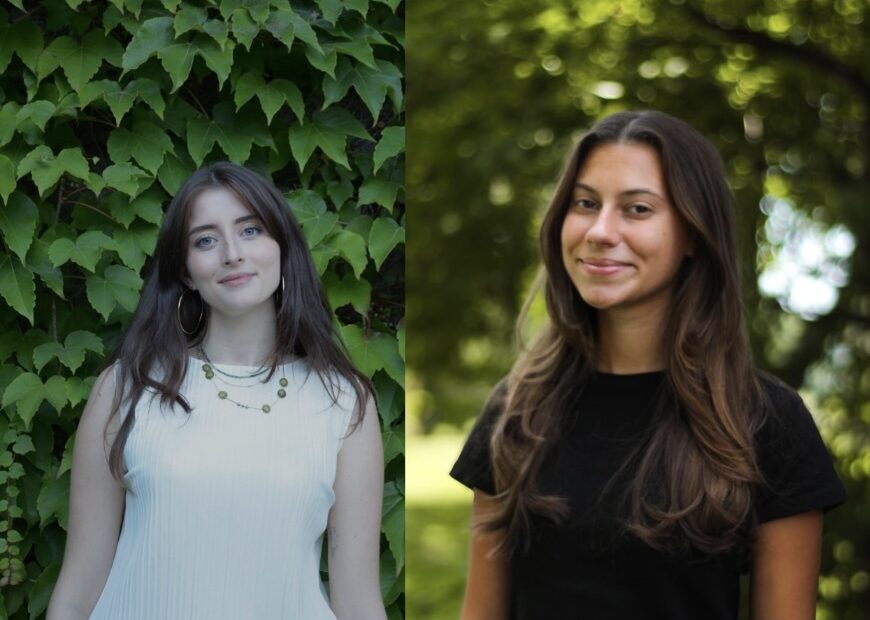
The Daily spoke with Girls Who Code executives Jenna Cacchione and Virginia Ceccatelli, U3 students studying Computer Science and Economics at McGill. We talked about the creative side to coding, imposter syndrome, and why young girls and gender-diverse students belong in the computer science field.
This interview has been edited for clarity and conciseness.
Enid Kohler for The McGill Daily (MD): How did you get involved in Girls Who Code, and why?
Virginia Ceccatelli (VC): I was never really exposed to coding in high school. It wasn’t really a subject that was taught, and I always thought it was scary as a field and very masculine. When I started my studies in International Relations in university, I got a bit of exposure to Python and R and had so much fun with it, so I transferred into Computer Science. I want to give girls the opportunity to get into coding and see that it’s a creative process as well.
Jenna Cacchione (JC): Similar to Virginia, I did my first year in [another program, Economics,] and then I switched into Computer Science. My high school didn’t have anything computer related…Had I had a program like this, maybe I would have switched into CS a little bit earlier. I really just wanted to give back [by giving] other girls that same opportunity.
VC: CS really is like learning a language. Like any language, the more you speak it and the earlier you’re exposed to it, it’s so much easier to pick it up.
MD: That’s a really good comparison. For those who aren’t familiar with your organization, can you pitch Girls Who Code in a few sentences?
VC: [Girls Who Code] a way to make coding fun and creative, and to change the narrative that [coding] is anything relegated to the masculine sphere. We give back to young girls [by seeing] them learn every week. It’s really rewarding.
JC: [Coding] can be really daunting. Sometimes I look at my computer screen and I’m like, ‘oh my God, what am I even doing?’ For younger girls especially, it can be super intimidating, especially since it’s a male-dominated field. I hope our facilitators can act as big sisters to our students.
MD: Why is it important that young girls and gender-diverse students have access to program like Girls Who Code?
VC: In general, the CS field is massively male-dominated. Most role models in the industry are guys. So for us, it’s really to show girls that they can do it; it’s not that hard. For guys, this message is something they might have been told growing up, and for girls, it’s not necessarily the narrative.
MD: You mentioned that the Computer Science space is predominantly male-dominated. In your own professional and/or academic experiences, what kind of patterns have you observed in terms of female representation and inclusivity?
VC: I’m not working in the field yet, but through research projects, I’ve found that you have to prove yourself more. If you’re in a room that has seven guys and two girls, the two girls have to prove that they know what they’re talking about, that they can actually do everything that everyone else can. I feel like there’s this constant voice that’s second guessing my abilities as a girl coder.
JC: I have to agree. I also find imposter syndrome is very much there. Exactly what you said, if you’re sitting at a table with a bunch of men, and you’re the only two girls, I sometimes feel like, ‘I don’t belong here.’It’s a mental challenge. Like, ‘no, I’ve put in the work. I do belong here.
MD: On that note, what do you hope students will take away from the program beyond practical coding skills?
JC: I hope that students realize that it’s okay to ask for help. Sometimes you do need guidance. I had tons of [it], and I was very lucky to have had mentors who were part of Girls Who Code. I hope that [these girls are] able to ask for help and possibly find a mentor later on in their academic career.
MD: Do you have a favorite memory of your work with Girls Who Code?
VC: In my year of being a facilitator for Girls Who Code, I taught at the same high school and a lot of the girls stayed the entire year. In the beginning, they were shy about asking questions, but it was really nice to see them gradually gain so much confidence.
JC: I like the fact that our whole executive team is going through the same thing: we’re all looking for internships, we’re all studying pretty much the same classes. It’s nice to have that community.
MD: The theme of this column is “good people doing good things.” In the context of your work with Girls Who Code, what does being a “good person” mean to you?
JC: To me, being a good person means giving back and helping younger girls. Acknowledging that I didn’t have the guidance or knowledge that I do now, and then giving it to the next person.
VC: Instead of resenting the system and having to stretch myself to catch up to get to where I am now, I can give these girls what I wish I had. Being a good person also means sticking together as girls and by helping girls realize that they can do it if they want to. There’s nothing stopping them.
Learn more about Girls Who Code and opportunities to get involved on Instagram, @girlswhocodemcgill, or through their website, girlswhocode. ssmu.ca
End note: If you know good people doing good things who you would like to see featured in this column, email news@mcgilldaily.com