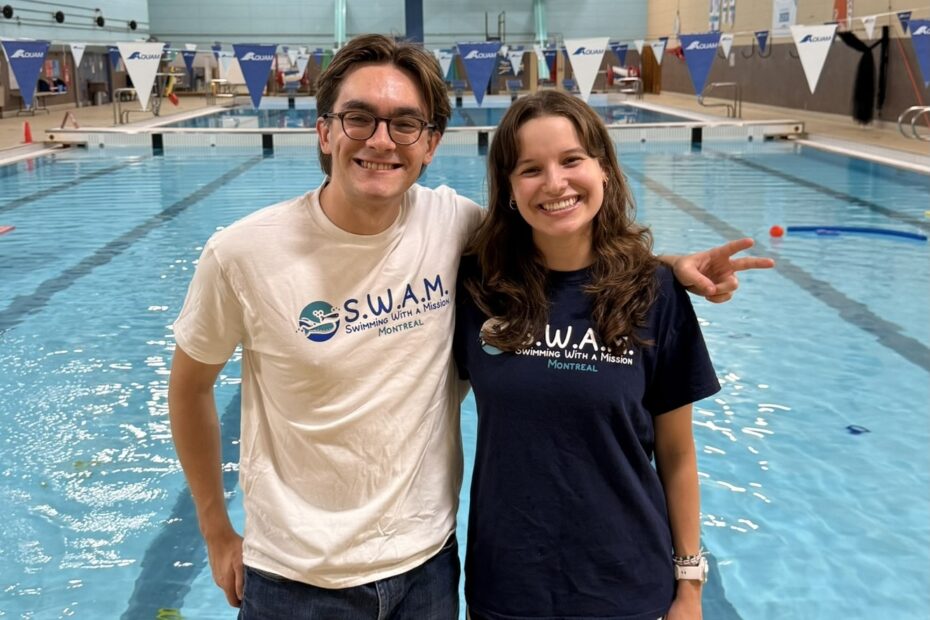
Good People is a bi-weekly column highlighting McGill students doing community-oriented work on and around campus. Because it’s important to celebrate good people doing good things.
Founded in 2009, Swimming With a Mission Montréal (SWAM) is a registered not-for-profit organization led by student volunteers. A chapter of the national organization SWAM Canada, it seeks to provide affordable and accessible one-on-one swimming instruction to children with disabilities aged 3 to 18. Instructors are paired with one swimmer for the course of the eight week program. Every week, they teach 30-minute lessons with the ultimate goal of fostering confidence in the water.
The McGill Daily spoke with Co-Presidents Anna Bogdan, U3 Psychology, and Benjamin Lévesque Kinder, U3 Neuroscience. We discussed their motivations for joining SWAM, making sports accessible, and the power of swimming to transform how children with disabilities move through the world.
This interview has been edited for clarity and conciseness.
Enid Kohler for The McGill Daily (MD): I want to start by learning more about your involvement with SWAM. Why and how did you join the organization?
Benjamin Lévesque Kinder (BLK): I got involved in the winter of my first year. I had been a camp counselor many summers in a row during high school, giving swim lessons to kids. One week, I was assigned a girl who had an undiagnosed autism spectrum disorder. Her support needs were very high, much higher than the camp had the resources for. She loved swimming. We just wandered around the whole day. It was awesome. When I came to McGill, I learned about SWAM at Activities Night and knew it was something I wanted to do.
Anna Bogdan (AB): I’ve been a competitive swimmer since I was very, very small. When I was injured, I transitioned over to coaching. When I came to McGill I really wanted to continue. I went to Activities Night and saw that there was a club that was offering swimming lessons for children with disabilities, and I thought it was a great way for me to continue my coaching experience, but also to help out the community in Montreal.
MD: You both mentioned you found out about SWAM. at Activities Night. As co-presidents, how would you pitch your club to a prospective student member at Activities Night?
AB: SWAM offers swimming lessons to children with disabilities. Typically, a swimming lesson for a child with a disability is upwards of $300, but our lessons are about $45. We’re about the only place in Montreal that offers lessons at this level. You’re partnered up with just one instructor for the entirety of eight weeks, every single Sunday for 30 minutes. You see your child become more comfortable in the water and have more confidence in their own abilities, and become more engaged and happy overall.
MD: You already touched on this in your response, Anna, but why is SWAM important?
Why is it important that it exists in Montreal?
BLK: There are a few reasons. This is a demographic for whom it’s hard to get exercise. Getting out of the house and doing activities can be difficult for those with sensory issues. SWAM is conscious of this: we have a lot of staff and procedures set up. We’ve had parents tell us that it’s one of the few places that they can just be somewhere.
A key reason is affordability. Most of the population cannot afford hundreds of dollars of swim lessons every week. We have a lot of new arrivals to Quebec in our program, people who arrive in Canada and have children who are newly diagnosed, and now they have to adapt not only to a new culture, but also what it means to get the right support for their kids.
It’s the highlight of my week, every Sunday morning when we do this. Because it’s totally different from everything else I do. To me, it feels like real life again. There’s all this other stuff and none of it is kind of real, but this is.
You show up, and none of your concerns matter to anyone here. It does become sort of trivial. As a student, you’re thinking about graduation and graduate school in these very long time spans. And then I go to SWAM, and you’re making progress on a week to week basis. I think that is refreshing.
MD: On that note, what have you learned from your work with SWAM that has influenced your own outlook on life?
AB: For me, one of the things that I learned is that progress is not always necessarily linear. It requires a lot of patience and it requires a lot of confidence within yourself. I’ve also learned how important it is to make sure that you’re always there to support and encourage each other.
BLK: I’ll pick up on the point you made about progress not being linear. There was a scheduling mishap a few semesters ago, where a lesson for my swimmer was moved to a different timeslot. For these kids for whom routine is a big, big part of how they move through the world, it throws them off-kilter. They feel uncomfortable. So there were a few lessons where I struggled to get anything done, and my swimmer was irritable. It was like all the progress we had made was gone.
But then on the next lesson back, seemingly out of nowhere, he swam unassisted, basically unprompted. He just went after it. I was so surprised. After that experience, we realized that for all of us, progress isn’t linear. We like to think that we’re always making progress upwards and so on, but that’s not true. That’s something that I’ve also carried into my day-to-day life.
MD: What is your vision for the future of SWAM? What do you hope children will take from their swimming lessons and apply into their future lives?
AB: We hope that SWAM is like a stepping stone to the rest of their lives going forward. We’re hoping that these children not only have more skills to be safer in the water, but we also hope that they can build other skills, for example, social skills and communication skills, to be able to create meaningful connections with others.
BLK: To give a concrete example, one of our swimmers had been with the program for three or four years. His dad told us that he had joined a water polo team for kids with disabilities, and that he would not have been able to do that without the swimming foundation he had built.
It would also be nice at some point to build a relationship with the Special Olympics in Quebec. It is a big problem in the disability space that once you age out, resources go to zero. The amount of money that gets put towards programs for children is huge, but once they turn 18, it’s all over. We also hope to expand the chapter to reach more kids.
MD: The theme of this column is “good people doing good things.” In the context of your work with SWAM, what does being a “good person” mean to you?
BLK: By virtue of our position, Anna and I have become the spokespeople for SWAM. But really, we’re not the good people. The good people are really the almost 100 instructors who come in every week. It’s not easy getting up on Sunday morning at 9 AM to trudge through snow, to do this for some kid, in a city you showed up in less than a year ago. Without all of them volunteering their time, Anna and I would be two people with a logo. SWAM is the team we have behind us.
AB: Although Ben and I are the heads, typically the ones that make the most amount of difference in the community are our instructors. So I think being a good person is being able to help others out. As a university, we have all of these services and resources, so why not use them to serve underserved populations?
To learn more about SWAM and opportunities to get involved, visit swammontreal.caor @swammontreal on Instagram.
End note: If you know good people doing good things who you would like to see featured in this column, email news@mcgilldaily.com