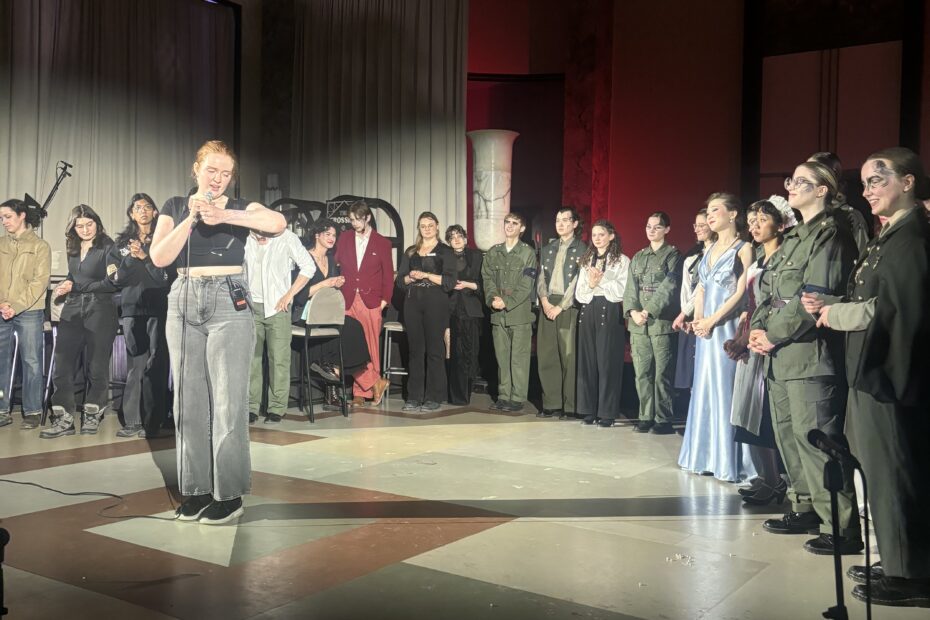
An hour before the closing performance of Antigone, the 2026 McGill Classics Play, on February 7, the Daily interviewed the show’s writer and director Madelyn Mackintosh (MM) and co-writer Caroline Little (CL). They’ve been dating for three years, having met through McGill theatre.
The following interview has been edited for clarity and conciseness.
Justin Friedberg for The McGill Daily (MD): How did you guys get involved with the Classics Play? What was the development process like for Antigone?
Madelyn Mackintosh (MM): We were taking [History and Classical Studies Associate Professor] Lynn Kozak’s Greek myth class together last year (romantic). I wanted to direct again and we were in class when Lynn said they were looking for a director. I had heard of the Classics Play and the Greek myth class was interesting. I also knew I’d be working with Lynn, who runs the Classics Play and is lovely and wonderful. I was drawn to Antigone given the geopolitical context of the time (late February of last year, when Trump had just been inaugurated). So I asked Adam Zanin if he would do a raw translation of the Ancient Greek text, which he did over the summer, and Caroline if she would help with the writing.
A big part of the division of labor between Caroline and I was how to structure the show as a contemporary play as opposed to the original Sophoclean text. That restructuring element was me. I come from a politics background and Caroline comes from a writing background. A lot of the show is an ethical debate between the characters, so I can do that, I can speak and write like a politician effectively. But when it comes to the storytelling pieces, that is where I needed Caroline very desperately.
Caroline Little (CL): You had a dream, I made it real.
MD: During that writing process, how did you approach adapting the play for a contemporary audience?
MM: We joke that they had just invented theatre. There’s a lot of distance between what you would expect from a play today and how they did it. Some of that is cultural. In Ancient Greece, you weren’t allowed to show death on stage. We wanted to reintegrate some elements of the story that were recounted off stage. The original text is similar to myth. There’ll be gods introduced in the story but they assume you know the context and they aren’t explored further. There are several characters that I think are underused — Antigone’s sister is a great example of this. In the original text, she acts as a foil to Antigone in the first third of the show and then vanishes.
CL: Now she ends the show on a massive monologue that I felt guilty writing.
MM: Also, this is a hefty show. I hope it feels like we’re depicting a tangible form of tyranny. It’s one thing to play a maniacally evil character like a Disney villain — it’s another to play somebody who’s evil in a way that you can look in the news and see is hurting people right now.
CL: We were really looking to create an evil that people would understand.
MM: Stephen Miller was the biggest influence for Creon’s voice. I don’t know that I hate anyone more than Miller. Part of the rationale for that is he’s not dumb. He’s an intelligent form of evil who can articulate why he hates immigrants, people of color, and gay people. It was important to me that Creon felt like a real person with realistic motivations and traits and some softness or humanity in places.
CL: I think it’s a lot worse when villains have humanity. It’s easier to hate people who don’t seem like you at all. This show operates along the gray area.
MM: In staging the show, I wanted the audience to feel like the citizenry of Thebes. If you saw this injustice, what would you do? Would you speak up? Would you tell what you think is the truth, even if it required sacrifice?
MD: Speaking of staging, why set the play in the 1920s?
CL: We were influenced by the Weimar era in Germany, a time of rapid progressivism. Germany was pro gay and trans. Marlene Dietrich, who inspired Antigone’s costuming, was openly bisexual and operated in gay clubs. You wouldn’t think that came right before World War II. Unfortunately, I think we’re seeing a lot of that now from the 2010s into the 2020s: an explosion of progressivism and then a rapid decline back into alt-right thinking.
MM: A big part of the show, in my view, is about cycles of tyranny and violence and how cruelty begets more cruelty. I’m fascinated by the notion that we can give this almost 2,500 years old text the aesthetics of the early 1900s and some of the language of today and it still makes sense. Asking people to think about that lineage of tyranny was part of the goal. Another important thing to me about the show is I think Antigone is driven by love. It sometimes sounds silly or cringey, but I think empathy is the strongest antidote we have to the form of tyranny that we see on the rise today. I don’t think it is a coincidence that this was the show that came out of a writing partnership with the person I’ve been dating for three years. I think it allowed some of the love that the characters share for one another to be expressed in the text more clearly.
CL: Yeah, and it also meant that you could be a lot more honest with me than most writing partners.
MD: Why is the Classics Play important?
CL: It’s important these texts aren’t studied in a vacuum. These stories are still relevant. When you study them in a library or conference, you forget that people wrote and performed them, that it touched them in a certain way. I think it’s important that these shows continue to be staged and it’s great work that Lynn is doing to make sure that happens. It’s really important to hear something. You can’t know if a poem is working until you’ve said it out loud, and I think it’s the same with theatre as well.
Antigone ran from February 4-7, 2026 in the Grand Hall of Montreal’s Le 9e.