
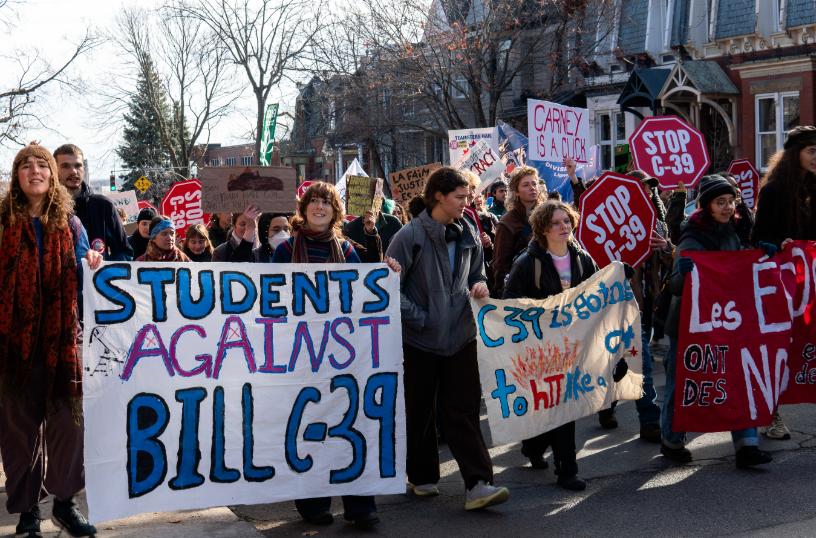
This is something that is going to affect the entire world,” said Samantha Van Wingen, McGill Environment student and Push Back organizer, referencing Bill C-39 in an interview with The McGill Daily. Introduced on September 21 by the Liberal Party, the bill promises to fast-track environmental assessments for major infrastructure projects like pipelines and railways, aimed at bolstering the Canadian economy. To Van Wingen, the bill “allow[s] two Canadian cabinet members to make decisions that are going to affect everybody around the world.”
The bill has already sounded alarms among Canadian environmental scientists: 56 Fellows from the Royal Society of Canada, experts on environmental and biodiversity issues, published an open letter in October condemning the publication of the bill without substantial changes. Bill C-5, its counterpart, passed in June 2025. It contained the Building Canada Act, which allows the designation of certain projects as those of ‘national interest,’ with Bill C-39 adding in that certain zones may now be designated as ‘regions of national interest.’ As a piece of omnibus legislation, this bill proposes several wide-spanning changes under the guise of ‘national interest projects,’ including reforms to collective bargaining which labour groups worry will strip them of the right to strike. These ‘regions of national interest’ would be considered pre-approved for development needs.
Push Back is an English sect of La Repousse, a coalition of student climate groups across Quebec. Founded in September of this year in response to the Liberal Party’s proposition, La Repousse includes student groups from Montreal, Quebec City, and Sherbrooke. Their recent activities have centred around spreading the word and organizing resistance to these monumental legislations. Anne Césaré, McGill Environment student and La Repousse member, describes the organization’s goal as “to amplify the movement, amplify the demands, amplify our voices, share mobilization and facilitate the fight against climate change.” According to Van Wingen, La Repousse is a largely Francophone organization; its leaders felt that McGill students were an untapped source of activism, leading to Push Back’s creation.
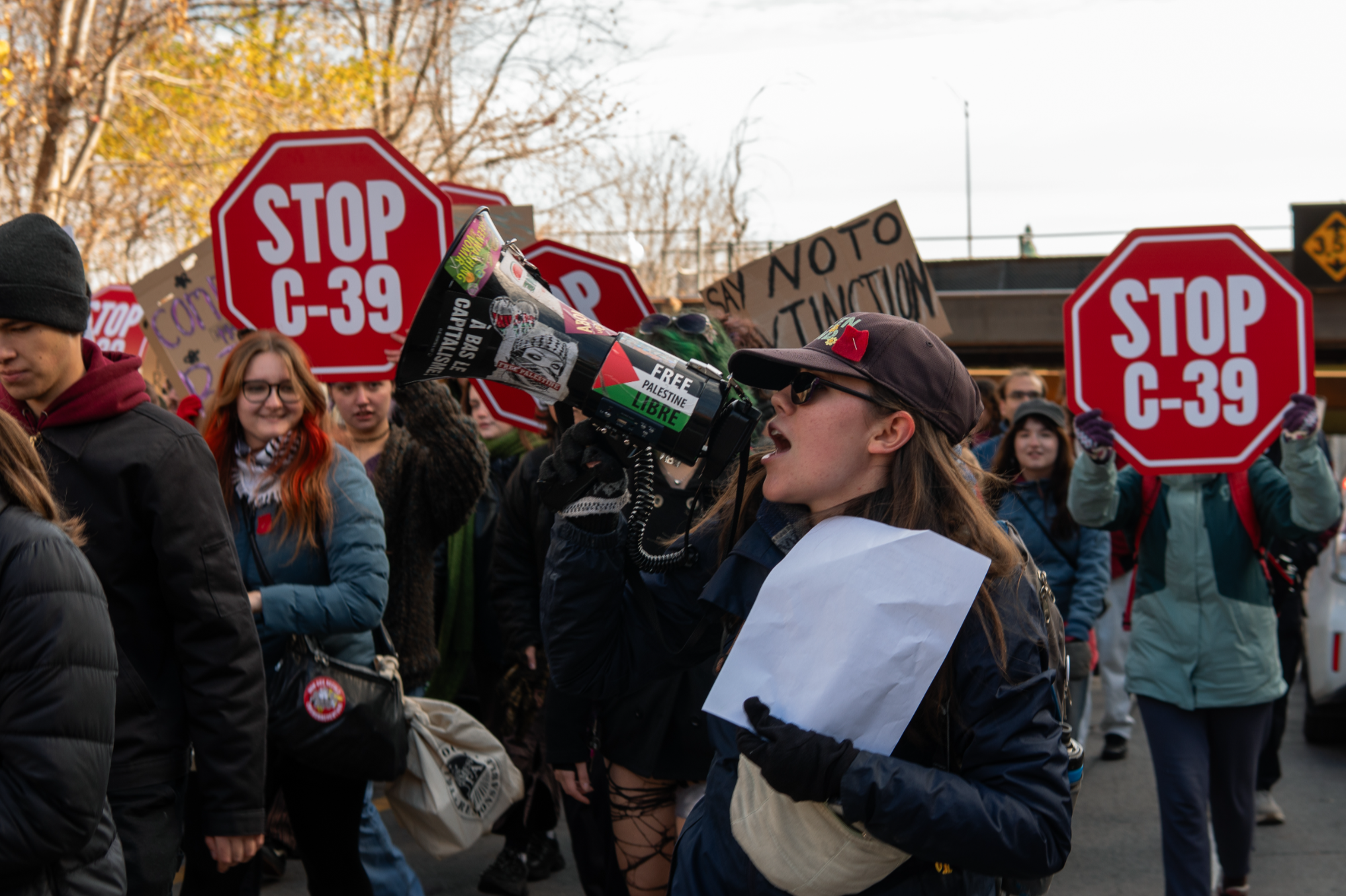
On November 12, both La Repousse and Push Back organized for the national day of action against Bill C-39 in Montreal. According to Césaré and Van Wingen, over 200 Montreal students, about 40 from McGill, joined them at the protest. “Across the country, different groups and organizations have mobilized to march to different Members of Parliaments’ offices and to protest against the bill,” Césaré said. She stressed that “[Bill C-39] has not been adopted just yet. It’s still in the review process…There is still time to change things. The goal is to pressure our Members of Parliament to change their vote in order for Bill C-39 to never be adopted.”
“Simply put, Bill C-39 is a threat to the environmental, as well as the democratic, backbone of Canada. [The bill is made to] fast track the development of mega infrastructure projects that go against our climate objectives,” said Césaré. “It’s pushing forward an agenda for fossil fuel extractivism, which further entrenches Canada’s reliance on [them]. Not only is that not desirable for Canada’s economic prosperity, security, or diversifying trade partners, it’s also going against every climate objective that we have. In the one year and a half that Carney has been in power, he’s been able to prevent us from reaching our 2030 climate production emission reduction targets by 20 years.”
To Alex Lam, organizing member for Push Back at McGill’s MacDonald campus, the bill shows a “blatant disregard for the future of humanity [and] for the future of life on this earth in every blatant giveaway to Carney’s corporate friends.”
Van Wingen described the ‘regions of national interest’ designated by Bill C-5 as “sacrifice zones” for both the environment and the rights of those who live there. A part of the bill particularly striking to Lam is the “complete disregard for Indigenous rights.” Bill C-39 does not mention the United Nations Declaration on the Rights of Indigenous Peoples, and lacks a mention of the principle of Free, Prior, and Informed Consent, according to Indigenous activists and law specialists. “You’re removing any kind of framework for establishing robust consultation if [that power is vested in] one minister,” said Lam, especially not one “whose stake is ultimately in allowing this economic development to go through.”
Since the protest, Push Back members have organized a weekly schedule for visiting the offices of Montreal MPs and sharing their concerns. “The goal is to bring a constant presence and a reminder of the rights and the demands of their constituents,” Van Wingen stated.
Both organizations are planning informational letter and poster campaigns aimed at cautioning Montrealers against voting for Liberal MPs in the upcoming partial elections in Rosemont and Laurier-Ste-Marie. Additionally, they are looking for McGill departmental associations to hold General Assemblies centred around publishing a statement in opposition to Bill C-39.
La Repousse has also published an open letter in La Presse with over 350 signatures condemning the Carney administration’s lack of action on the climate crisis. “The national interest narrative …doesn’t include students, nor the future generations.”
The coalitions are not the first of their kind in Quebec’s rich history of student movements. “In 2019, the environmental movement in Quebec was growing. We had the biggest protest in the history of Montreal …A protest of that size wouldn’t have been impossible if it wasn’t a collaboration,” said Césaré. Over 500,000 people attended the event, which was largely organized by students including climate activist Greta Thunberg. Student groups have long been key instigators of change in Montreal, from the 2012 tuition hike protests to the recent protests against financial austerity by the CRUES coalition. These groups allow young people to collectively mobilize in a city with seven universities and 12 CEGEPs.
“The more people are talking about the bill, the more it’s going to become unpopular. And the more likely it’s going to be that the Carney government will not pass it. We have the power to spread the word, and get people to care about it, and show the government that people do know what they’re doing, and people do care,” Lam emphasized. “If the bill does pass, the fight is not over. Continue speaking out about it and fighting back against it.”


