

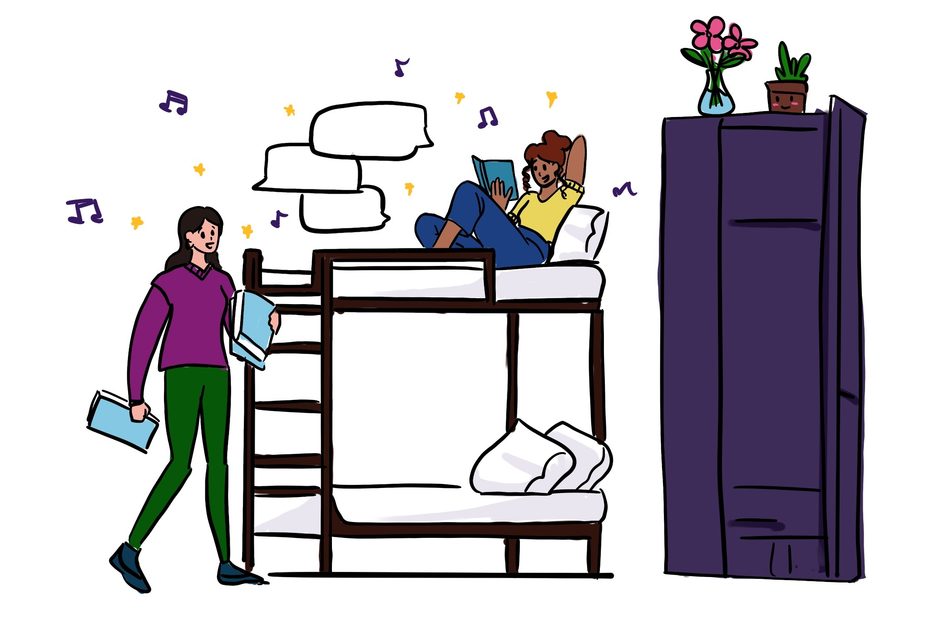
When thinking about the “McGill Experience,” a plethora of feelings and images spring into mind: seeing one’s dorm for the first time, meeting new friends at OAP, and walking down to campus on an early autumn morning. There is so much excitement in living on your own for the first time; everything feels so intimidating, yet so free. For many students, moving to university is the beginning of the most exciting chapter of their lives. But what about those who are from Montreal, and never move into residence? What about those that either can’t afford or don’t have a reason to move on campus? How much do their experiences differ from those of students living in residences?
There are, of course, little differences between students who live in residence first year compared to those who don’t. Most residences offered by McGill are a five to 15- minute walk from campus. This means that the average student in residence can afford to wake up about an hour or two before their lecture begins. In contrast, a person living off campus with the same morning class would probably have to wake up much earlier to accommodate a longer commute. Moreover, the time it takes to get to class increases exponentially the more they rely on public transportation. For example, a student living in Brossard must take the bus, then the REM, and then walk ten minutes before entering campus, meaning they have to wake up almost an hour earlier than a residence student. This factor also applies when returning home. Many extracurricular clubs and social activities don’t start until after 6 PM, and can drag on until as late as 9 PM. For students belonging to these clubs who don’t live downtown, they have to repeat their morning commute reversed and arrive home as late as 10 PM. To make matters worse, certain forms of transport, like the metro and certain bus routes may feel less safe during later hours, especially for women traveling alone. These factors make it much less convenient for offcampus students to get involved in student life.
Nevertheless, the hours students wake up at and the hours they get home constitute only minor differences between residence and non-residence life. After all, some students may be morning people, for whom waking up early is not a challenge, regardless of how close they live to campus. One could additionally argue that students offcampus make up for the time they lose on public transportation by not having to do the same volume of chores such as cooking dinner or doing laundry, as they may still live with their parents. There is, however, an important distinction between the students living on and off of campus, the most important of which is the volume of social interaction one gets from living in a residence.
Indeed, dorm-life is filled with social interaction. Whether that be a positive factor or not often comes down to the sociability of individual students, but being in proximity to so many people of the same age definitely comes into play in how easy it is to make friends. After all, students living on campus have a wider range of social events they can attend, whether they are organized by the residence or independently by students. This greatly increases students’ chance of developing a sense of community, which may not always be the case for students who still live at home.
Most importantly, more social interaction means more chances to network. It may appear overly cynical to analyze social interaction solely based on its transactional value, but there are simply too many examples of successful business ventures, partnerships, and creative projects that have emerged as the result of a dorm friendship. Websites like Facebook and Napster were created to facilitate socializing and sharing music between students living on campus. Bands like MGMT and The Pixies were formed as a result of dorm-friendships. For students living in residence, this form of networking happens much more naturally, through communal living. This does not mean that students living off campus cannot network, but they may find themselves as easily immersed into McGill’s community in order to develop useful connections.
Furthermore, while McGill’s Quebec-residency tuition brings more class diversity to campus due to its low cost, in comparison to the international tuition, this class diversity becomes virtually obsolete when considering the demographics of residences, which mostly includes out-of-province and international students. While McGill as an institution may be open to class diversity, the university’s residence system still possesses the same flaws as other, less inclusive spaces. Networking, one of the most essential parts of the McGill experience, is ultimately facilitated for wealthier students who can afford to live in residences. While lower-class students may attend the same classes and go to the same events, they simply cannot compete, on a social level, with students who can afford to live on campus. The difference in experience between a student living at home and a student living in residence is therefore not simply a matter of how much time one can sleep and how close one is to campus; it is a socio-economic issue.
Living on campus indirectly advantages out-of-province and international students. Their increased ability to network and their constant social interaction in the residence community, allows for greater career and social opportunities. While this phenomenon is less prominent than in the United States where tuition costs even more, McGill’s student life is unfortunately not free of its own elitist bubbles.