

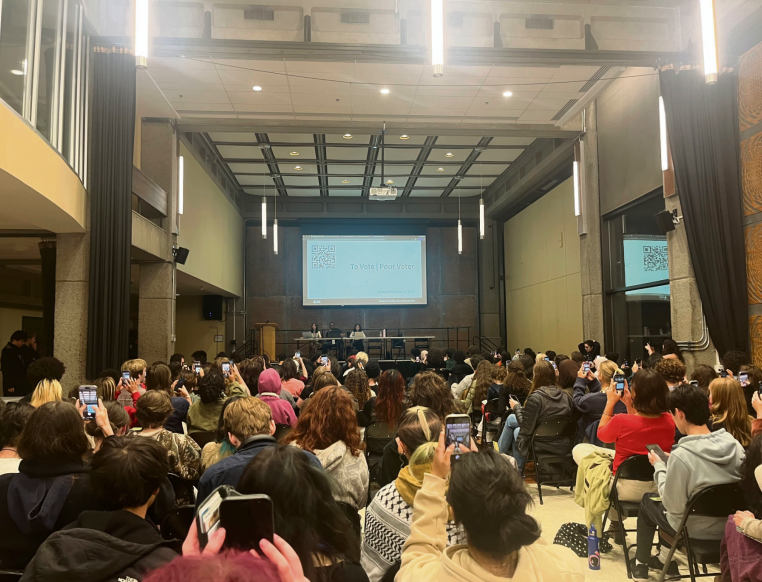
On September 28, 2026, the Students’ Society of McGill University (SSMU) held a General Assembly in the SSMU ballroom which presented a motion demanding the academic boycott of McGill’s exchange program with the Hebrew University of Jerusalem (HUJI).
The motion called for “the SSMU General Assembly to compel the President and Vice President of University Affairs to advocate against renewal or reinstatement of the exchange program consistent with SSMU’s existing Policy Against Genocide in Palestine and the Policy on Harmful Military Technology.” While the current exchange agreement, signed in December 2023, is set to renew in 2028, both McGill and HUJI are required to negotiate renewal terms nine months prior, which would be late 2027.
In order for this motion to be voted on at the GA, a quorum of no less than 350 McGill undergraduate students needed to be satisfied. If passed, the motion states that the SSMU President and VP University Affairs will be called on to present “a motion mirroring the language of [the GA] motion” at the Senate meeting, scheduled for January 13, 2027, per the motion.
James Thomas Reid, the SSMU Speaker, called the GA to order and opened the assembly with a brief overview of the agenda. This included various summaries of reports including the SSMU executive committee summer report and the Board of Director report both presented by President Hamza Abu-Alkhair, and a report presented by the accountability commissioner Lounes Azzoun.
Following these announcements, discussion was opened for a finite time, where students were able to ask Abu-Alkhair questions regarding the reports as well as current SSMU activities. The queries ranged from an update on the sudden closure of Midnight Kitchen last year, where Abu-Alkhair answered that SSMU had launched a new Free Lunches program, to questions regarding how to get involved in SSMU. As the questions progressed, more students entered the SSMU ballroom. Reid periodically gave updates on how many more people were needed to meet quorum, causing students in the ballroom to text friends and peers, encouraging them to attend the GA. Reid also clarified that meeting attendance as well as voting was in-person only, standing in accordance with clause 4 in the 2026-2027 SSMU standing rules, which said, “Meetings shall be in person, unless the Steering Committee deems it necessary to be hybrid (in-person and Zoom) for extraordinary reasons.”
At 7:25 PM, quorum was finally met, which led to the end of the question period. A 15 minute recess time was scheduled before the motion was presented, however, this was soon asked to be suspended by a student. The student body voted in favour of this suspension by a large majority, which allowed for the GA to move on to the presentation of the motion. Reid explained how the mover, Sumayya Kheireddine, will be given five minutes to present the motion.
Similarly to last year’s GA, where her motion on the one day strike for Palestine was passed in, Kheireddine opened her speech by stating that, as of September 28, 2026, it has been 1086 days since the beginning of the genocide in Gaza. Kheireddine went on to specify that the motion was not about any particular McGill student or faculty member, but rather about the significance of interuniversity institutional relationships. Kheireddine hence encouraged students to vote “yes” on the motion asking McGill to terminate the agreement between the school and HUJI for two reasons; the first being that through its training of Israeli defence and intelligence, HUJI is a part of the Israeli military complex, and the second being that the campus is located on the ruins of the illegally occupied Jerusalem. She encouraged students to recall McGill’s rich history of academic boycott, arguing one cannot treat partnerships as neutral when connected to a military involved in occupation, genocide, and denying Palestinians’ right to education. She further emphasized that by partnering with this institution, McGill normalizes these violations of human rights.
The time allotted to deliberate this particular motion was 5 minutes. This was followed by a 5 minute question period and a 10 minute discussion period. Both of these periods were quickly suspended by individual students, and passed with a ⅔ majority vote, suggesting that students were eager to move onto voting. Correspondingly, Reid announced the voting period at 7:47 PM. During this time, no one could leave or enter the building. After a few minutes of voting, it was announced that the vote in favour of the motion was passed by a simple majority, and it would thus move on to an online ratification process opening within 7 days of the GA. The room erupted in cheers, chatter, and clapping.
After the GA, the Daily spoke to a few students about the meeting and the passing of the motion. One student told the Daily, “I’m just really happy everyone showed up tonight and demonstrated substantial support for the movement.” They added, “We show up because we deeply care, and this [voting at a GA] is just one avenue we can add pressure [to the university].”
The Daily also spoke to the Speaker, James Thomas Reid about the importance of student politics. Reid said it was his first time speaking at a General Assembly. When asked if he expected the GA to meet quorum, he replied “I did, yes, because it’s a very pertinent affair. It was a very important meeting and I thought a lot of the student body was very much interested in showing up. So it wouldn’t surprise me that we did.” However, he added, “Did I expect the actual suspension of questions and discussions? I didn’t expect it, but also it wasn’t very surprising.”
Regarding the cheers and clapping after the motion was passed, Reid commented, “It’s unsurprising how people reacted. As I said, this is a very pertinent issue and people are very passionate about that. I’m not surprised of the reaction that happened in the General Assembly, but it was my job to make sure that even though that reaction did happen, we [had to] continue to support order. That was part of my job.”
The ratification was sent to the student body on Friday, October 2 and students will have until October 13 to vote. To pass, the ratification must meet the quorum of at least 10 per cent of the SSMU constituency and receive a simple majority vote.