

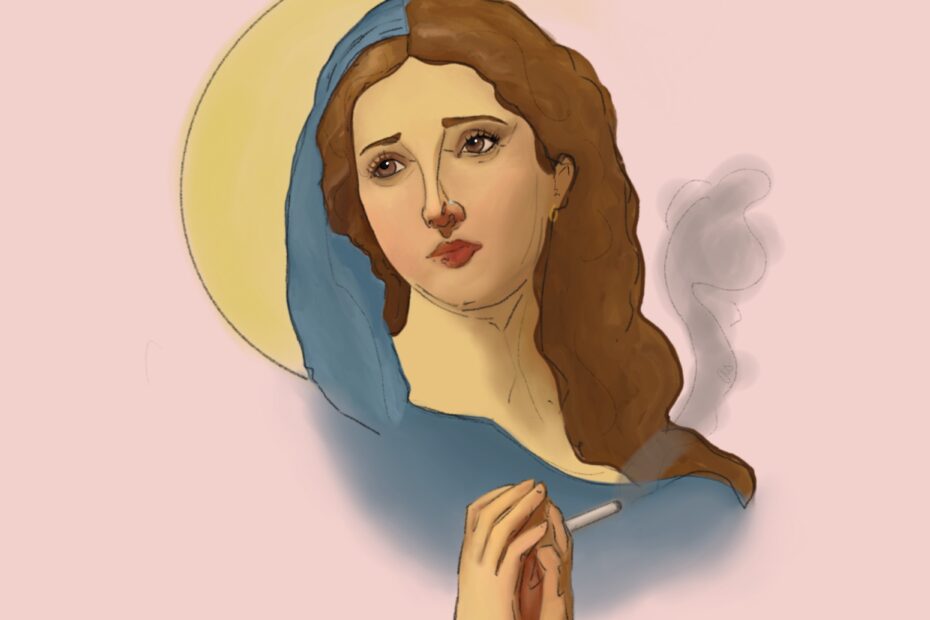
Sigmund Freud once contended that “Where they love they do not desire and where they desire they cannot love,” ‘they’ referring to men. This framework describes a broader cultural dichotomy in which women are categorized based on whether they are worthy of love or desirable for sex. “Where they love,” outlines the Madonna: a pure, virtuous, and nurturing woman that society deems an ideal partner for men. Women with the qualities to be a wife or mother supposedly hold little sexual value and are limited solely to romantic relations. Conversely, “where they desire,” details the Whore: an overtly sexual, promiscuous, near-animalistic, woman. Women deemed part of the Whore category seemingly do not have the typical chaste traits of a wife or mother, hold very little romantic value, and are exclusively seen as sexual subjects. Within Freud’s Madonna-Whore theory, there is supposedly no flexibility. This rigid framework creates a narrative in which women must actively choose how they want to be perceived and furthermore, valued.
Although it was coined by Freud in the 20th century, the Madonna-Whore Complex is centuries old. One of the most notable historical references of it is in a painting from the 15th century CE titled “The Madonna of Humility with the Temptation of Eve.” An article by Brooke Brownlee, a clinical counselor, introduces the complex by dissecting this very painting. The composition shows Madonna, the Virgin Mary, nursing infant Jesus in her arms. She appears luminescent with a halo and is surrounded by archangels Gabriel and Michael as well as the martyr Saint George, an image of purity. Brownlee describes the Madonna, as “nurturing, motherly, and modest.” The arrangement itself is telling: below the Madonna, in the dark, a lustful and naked Eve dwells. Brownlee describes Eve as “using her naked body as a form of temptation, sexuality, and…[sin].” This is an overt example of the contrast between Madonna and Whore — the former is nurturing, while the latter is corrupting.
Another instance of the complex in history is outlined in historian Anna Clark’s book titled, Desire: A History of European Sexuality where she discusses gender roles in Ancient Greece. Clark breaks down the views of Apollodorus, an ancient Greek writer and scholar. Apollodorus described women’s roles as divided by function: mistresses for pleasure, concubines for care, and wives for legitimacy. However, Clark notes how a woman is never allowed to be all three.
These historical examples show how far back the complex stretches and therefore, how deeply rooted it is in society. While these patterns are often disguised in modern life, Apollodorus’ views surrounding women shows how blatant these ideas were in the past. The Madonna-Whore complex plays a subtler role now, but it systematically persists in the media we consume and therefore, the norms young girls learn to embody long before they learn to question them.
Children’s media embody the Madonna-Whore split in classic Disney films, where kids are introduced to the concept of heroes and villains. Princesses are often gentle, modest and innocent, while female villains are sometimes seductive, vain and sexual. A clear example of this is in The Little Mermaid, where the villain of the story, Ursula, with her dark lipstick and strapless, tight black dress reads as the evil seductress. Ariel, on the other hand, plays the Madonna. She is deserving of love and marries Eric in the end, while Ursula, the Whore, dies. This shows how deeply ingrained the Madonna-Whore Complex is in children’s media, working to socialize them into this fixed structure.
If we turn to pop culture, female celebrities are often forced into binary public images surrounding their sexuality. Britney Spears is a classic example of this. Spears started her career with her debut album and song “…Baby One More Time.” This album was followed by her hit music video where Spears plays the character of a Catholic schoolgirl. The character’s image was promoted as an innocent Madonna, with an emphasis on her virginity. However, the discourse surrounding Spears’ body had already categorized her as the Whore. As argued by Emma Spector in a Vogue article, Spears’ virginity was scrutinized by hungry fans, nosey journalists and news outlets. While the public so desperately wanted insight into Spear’s sexuality, they became outraged once Spears began to embrace it in her later music such as in her sensual single, “I’m a Slave 4 U.” Other cultural observers further argued that “If Britney had been more conservative, she would have been probed and prodded by hungry vultures, but when she confidently embraced her femininity, the crowd wanted her head.” Ultimately, Spears’ experience exposes the fundamental contradiction of the Madonna-Whore complex: women are condemned whether they embody purity or embrace their sexuality. There is no acceptable category for a woman to occupy, only different ways to punish her for failing to conform.
These examples boil down to a single message: before a girl has even begun to understand her own sexual identity, it could have already been moulded by the harsh dichotomy of a reality in which women hardly ever “win.” Although these examples are not all-encompassing of the pressures a young girl may feel to submit to the duality, she may first experience the jarring nature of the split in stories she consumes in childhood, where the gentle princess is rewarded and the glamorous villain destroyed. As she develops, she will further understand how this split functions in the real world, she watches it play out in public where a woman like Britney Spears is both scrutinized as the Madonna and condemned as the Whore.
What is the tangible cost of the Madonna-Whore framework? Research suggests that many women internalize it, meaning they adopt the judgments passed on them as their own, often resulting in shame irrespective of the Madonna or the Whore category. For the Madonna, the cost of the framework regards her own pleasure. A study shows that women who most often endorse the dichotomy rated their partner as more entitled to sexual pleasure than themselves. This sexual shame can be inherent for the Madonna, as she is valued for her purity and maternal nature and thus may never be fully sexually gratified. On the other hand, the Whore experiences sexual shame through her objectification. For her, the cost is being treated as a body and nothing more. In another study, researchers examined 160 couples and found that women’s self-objectification predicted greater sexual emotional labour partnered with lower orgasm rates. This shows that when a woman learns to see herself as an object for pleasing others, she may focus solely on how her sexuality serves a partner and entirely overlook herself.
The effects of sexual shame are not isolated to a woman’s sex life. Vladimir Hedrih, a professor in psychology at the University of Niš, claims that sexual shame in women “can manifest as a negative body image, difficulty discussing sexual desires, or avoidance of sexual experiences due to a fear of judgment.” This is particularly significant since sexuality shapes how we experience emotional and physical attraction, how we connect with our community and understand our own feelings. In a broader scope, it is a core facet of identity. For some women, being disconnected from one’s sexuality through shame can create fractures in one’s own identity.
So if the Madonna-Whore Complex is so deeply ingrained in society, how do we move forward? What does that entail? The Madonna is both rewarded and restricted by purity; while the Whore has sexual freedom, yet is reduced to her sexuality. Maybe the deconstruction of this double bind begins in realizing that the Madonna and the Whore are not all that different. What may appear to be two opposing classifications actually follow the same pattern: society’s constraint of a woman’s sexuality. The view of women should not have to be confined to the limits of choice between these reductive patriarchal models; she can want to be both or to be neither. She can change her mind while exploring her sexual identity, even understanding it differently over time. In other words, women should have the freedom to determine their own relationship with their sexuality on their own terms — without having to sacrifice one form of worth to gain another.