

“There is no question that the time has come for McGill to prioritize, in the most earnest and explicit way, Indigenous studies and Indigenous education … Canada must, and will, become a country where First Nations, Metis and Inuit peoples and Nations are respected, honoured and valued. We understand that the hard work of reconciliation should be shouldered by us all and we have seen that McGill is prepared to do its part.”
The final report by the McGill Provost’s Task Force on Indigenous Studies and Indigenous Education
opens with a sober optimism. It was submitted to the university’s administration in 2017 as a conclusive plan of action to align the Institution with the Truth and Reconciliation Commission of Canada’s recommendations. At the time, McGill student athletic teams were still competing under the name “Redmen.” The name was long understood in the popular sense to be pejorative toward Indigenous people despite the university’s insistence that it only referred to the colour of the athletes’ uniforms. In the decade leading up to the report, less than one per cent of students and less than 0.5
per cent of all tenured and tenure-track professors self-identified as Indigenous. The Indigenous Studies Program, established in 2014, had only been offering courses for a handful of semesters. Nearly a decade has elapsed since the report outlined its 52 Calls to Action, which included targets for Indigenous faculty, staff, and student recruitment as well as providing a basis to fund initiatives for Indigenous learning and student wellness. Although McGill is expanding its recruitment of Indigenous
students and faculty, the change has been gradual. The current decade has seen a definitive uptick in the number of Indigenous faculty and staff hired at McGill, though relatively few of them are tenured or tenure-track professors. The report’s more symbolic Calls to Action, which included landscaping part of the Lower Field to more prominently feature the Hochelaga Rock and flying the Hiawatha Belt flag, a symbol of unity for the Haudenosaunee First Nations, have largely gone unanswered. The “Redmen” name was only officially dropped from all McGill athletics teams in early 2019 following an announcement from then-Principal Suzanne Fortier.
McGill’s wavering progress toward change for its Indigenous students and faculty emerges from a tangled and troubling history of discrimination, disregard, and antagonism toward the Indigenous communities of northeastern Canada. As an institution, it had been sustained in part by the resources of Indigenous people in its early days as McGill College under William Dawson. During a period of financial hardship in the late 19th century, the school was granted a loan by the federal government consisting of a combined $40,000 taken from the General Indian Trust and Six Nations of Grand River Funds. The transfer of money was made without the knowledge of any of the intended beneficiaries of either fund, and, although McGill eventually paid its debt in full to the federal government, the money never found its way back to the accounts from which it had been withdrawn. When approached by the Six Nations Council in 1988 regarding the establishment of a scholarship or bursary for students from Haudenosaunee First Nations as a symbolic repayment of the loan, representatives from McGill refused outright.
In 1919, McGill received the personal collection of affluent lawyer David Ross McCord in an endowment that would form the basis for the McCord-Stewart Museum on McTavish. McCord himself was appointed curator of the museum. Included in the collection were several thousand items retained by undocumented means, some with incredible historical and cultural importance such as a headdress possibly worn by Tecumseh in the 19th century. Several decades prior to the establishment of the museum, the Arts building had housed a display of Indigenous archaeological artifacts, including human remains. George Mercer Dawson, nephew of William Dawson, had also previously donated his personal collection of West Coast Indigenous cultural objects to the university. He authored a book on Indigenous anthropology in 1879, in which he declared his support for the forced assimilation of Indigenous people into colonial North American society, deeming them “socially inferior.” By the 20th century, however, McGill’s relationship with the Indigenous community at large had become undeniably more complicated. After admitting its first Indigenous pupils toward the end of the 1800s, the university found itself involved in a different way with the people of Quebec’s First Nations. As a nationally renowned institution for research and education, it was equipped with the structure and methods to aid Indigenous communities who lacked the same resources. The 1940s saw the founding of the Arctic Institute of North America, a prominent organization dedicated to the research and preservation of northern Indigenous culture, under McGill leadership. By the 1970s, a certificate program had been established by the Faculty of Education to train First Nations teachers who would go on to work within their communities. Additional courses were being offered by McGill’s Social Work Program to revitalize the learning of Indigenous languages. The surge in nation-wide Indigenous activism in the ‘70s prompted members of the Departments of Geography and Anthropology to widen the breadth of their field research throughout Indigenous communities in Quebec. Those same communities, including the Eeyou (Cree) nation, benefitted particularly from the ecological research conducted on their territories and the practical advice offered by academics on liaising with the government. The Cree would go on to accept advice from certain of these researchers
toward later negotiations.
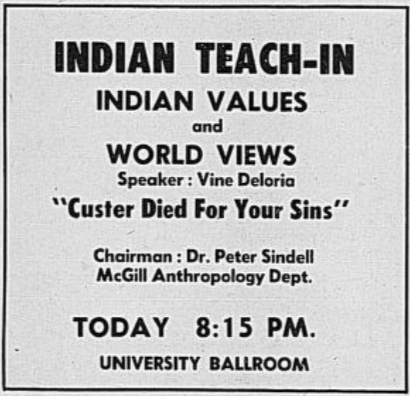
It wasn’t until 2014 that McGill established its Indigenous Studies program, with classes becoming available in the Winter semester of 2015. Earlier generations of Indigenous students had found it their own initiative to facilitate cultural exchange and the discussion of Indigenous social issues with their predominately white classmates. Faced with the ignorance and occasional avarice of their peers, Indigenous students built solidarity among themselves, forming collectives such as the Intertribal Council of Native Students to consolidate their voices on campus. In 1970, the Intertribal Council held a “Teach-In” symposium on Indigenous culture for the purpose of presenting non-Indigenous students with a clear framework and civil language for discussions around their Native backgrounds and identities.
The ’60s and ’70s also saw the McGill campus ecosystem emerge as a debate stage for well-known independent Indigenous activists such as Kahentinetha Horn, who would go on to head the National Indian Council in addition to playing a prominent role in the Oka Crisis of 1990. Much of the impact of earlier Indigenous activism at McGill was registered in print, largely through student publications such as The McGill Daily that served as integral vehicles for protest and discourse. The Daily is honoured to hold certain of these materials in our archives, including advertisements for the Intertribal Council of Native Students’ 1970 “Teach-In.” Past issues of the Daily, beginning from Volume 1, published in 1911, are available online and in physical print in the Daily Publication Society’s offices on McTavish. While our university’s administration meanders through the Task Force on Indigenous Studies and Indigenous Education’s goals, more about McGill’s history with Indigenous communities as well as Indigenous activism in Tiohtià:ke can be found under The McGill Daily on the Internet Archive.