

Two years ago, the Canadian government issued an apology to Nunavik Inuit Peoples for its involvement in the RCMP massacre of over 1,000 Inuit sled dogs (also known as qimmik in Inuktikut) between the 1950s and 1960s. As part of the reconciliation program, the state allocated 45 million CAD to the Makivik Corporation (Makivvik) to restore dog sledding (also known as qimutsik in Inuktikut) in Inuit communities, including the annual Ivakkak race.
In a CBC interview on The Bridge radio show, Kuujjuaq based artist Thomas Whiteley (ᑖᒥᓴ) describes how “a lot of effort…[has been done] to bring [dog sledding] back, but it hasn’t come back in the same way.” This is where Whiteley’s art comes in, integrating, on the one hand, traditional Inuit knowledge (qaujimajatuqangit in Inuktikut) and, on the other, contemporary art spaces.
This integration is notably evident in Whiteley’s first solo exhibit, “Qamutik,” at La Guilde, a non-profit art museum spotlighting the heritage of Indigenous and female artists. At La Guilde, Whiteley’s exhibit centres on a nearly 4-metre-long dog sled known as a qamutik, featuring “scenes of northern life…and animals.” These scenes are carved out onto the qamutik’s wooden panels and used as stamp templates to transfer the images using ink onto Japanese paper, “giving premium results… [as opposed to] linoleum,” says Whiteley. Whiteley, and his mentor, Nadine Bariteau, took two years to curate the exhibition. Bariteau taught Whiteley his printmaking skill set, as “there were no [printmaking] studios in Kuujjuaq.” However, prints have always been present in Whiteley’s worldview; “they’ve always been in our homes,” he further emphasized, “it felt like Inuit art was printmaking and stone carvings, so it felt natural going back to that…because it was always present.” Carving was specifically passed down patrilineally in Whiteley’s family, with his father and grandfather also being woodworkers. The material has a life of its own; the wood, Whiteley elaborates, “is alive…it’s got cracks, it’s lived.” This element of vitality is further enhanced by storytelling when carving iconography. Whiteley describes how the qamutik —a being with a mouth, on the front of the skis, and panels on its sides, — is “the bowels of the beast.” In this way, the wooden carvings capture mobility complementary to the practical use of qamutik for qimutsik.
Hence, qaujimajatuqangit directly relates to Whiteley’s lived experience, in which he grew up in “disconnect,” splitting his time between Nunavik in the north of Quebec and Quebec City in the south of the province. This distance was mended once he permanently moved to Kuujjuaq as an adult. In this way, “the land inspired the artwork…[meaning there] couldn’t be one without the other.”
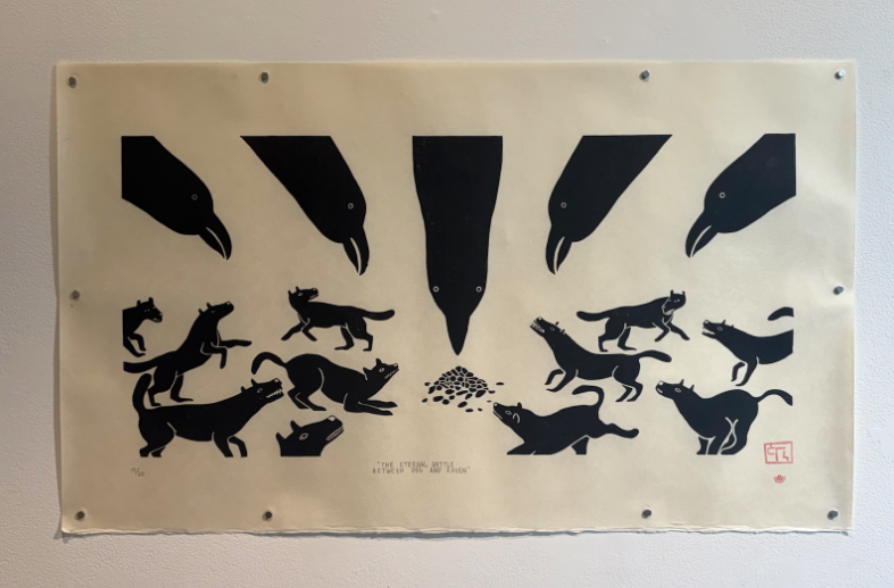
Whiteley’s prints also have a life of their own, as seen in “The Eternal Battle Between Dog and Raven.” In this work, the raven (tulugaq in Inuktikut), who has both a role in Inuit creation stories and as a “trickster” in a multitude of Indigenous tales, appears to either be giving or taking food from the qimmik. While the food appears to be grain-like per the raven’s diet, the lettering featured at the bottom of the print denotes a “battle” between the animals, illustrating a conflict of interest. One can infer that instead of offering food to the raven, the food may be taken from the qimmik without their consent. This is particularly significant considering the raven’s shapeshifting role as a “trickster” enables it to morph into human form, meaning that the “battle” between raven and qimmik is also that of man and qimmik, which can directly refer to the qimmik massacre. Although not explicitly stated, the raven’s deception may parallel the state’s “betrayal…[to] live in partnership with Inuit” and its failure to apologize for the qimmik massacre until 2024.
Moreover, the qamutik carvings are more than just tangible art; they are also vessels “of knowing.” As previously mentioned, the qamutik is a sled and thus, also has a practical purpose. The qamutik bridges art and utility as seen when Whiteley rode the sled with his cousin’s sled dog team (qimutsiit in Inuktikut) in the exhibition’s film. According to the Inuktitut glossary at La Guilde, dog sledding is “the action of mushing, or using a dog team and dog sled for transportation, entertainment, or sport.”
Without the qimutsiit, Inuit people were severed from a core aspect of their identities Whiteley illustrates how the partnership with the dogs meant security when hunting, freedom of mobility, self-determination for “men…to provide for their families,” and most of all, access to the land. Correspondingly, the qimmik massacre led to forced displacement and food insecurity.
Ultimately, “dogs couldn’t have lived without us, and we couldn’t have survived without them,” said Whiteley. “Dogs are partners, not pets …It’s a symbiotic relationship.” Whiteley additionally described how one can lose their cultural traditions if they do not practice them. This sentiment best informs the importance of Whiteley’s work to revitalize “dog sledding and that kind of partnership between dog and human.”