

Disclaimer: This article was written prior to the third debate on September 23.
The cost of groceries, access to healthcare, and Quebec’s constitutional future were prominent issues discussed during the first two televised debates of the provincial election. Throughout discussions of affordability and public services, party leaders returned to a recurring disagreement: whether another term of Coalition Avenir Québec (CAQ) government or a referendum on independence would bring greater uncertainty.
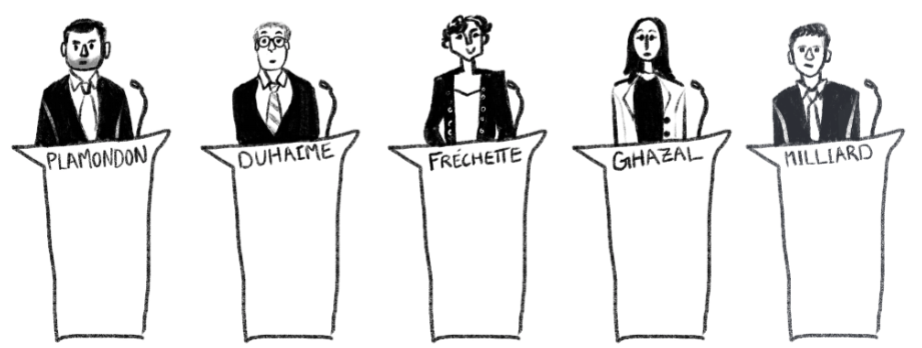
The September 15 TVA Face-à-Face brought together CAQ leader Christine Fréchette, Liberal Party leader Charles Milliard, Parti Québécois leader Paul St-Pierre Plamondon, Québec solidaire co-spokesperson Ruba Ghazal, and Conservative leader Éric Duhaime for an initial debate in French. They returned the following evening for the Noovo-Crave debate, also in French, with a third debate scheduled for September 23.
François Legault was absent from the stage, but his name was not absent from the debate. Fréchette began by distinguishing herself from Legault, her predecessor. However, her opponents repeatedly brought the discussion back to the CAQ’s past record. After nearly eight years in power, the CAQ faced criticism from opposition leaders over its management of public funds and the state of Quebec’s public services, with its rivals arguing that costly government projects had failed to deliver the improvements Quebecers needed.
St-Pierre Plamondon posited that a change of government could be a chance to reduce waste, while Milliard challenged the CAQ’s economic management. Fréchette disputed criticism from all four of her colleagues of the SIFA health-sector technology project, rejecting the cost figures raised as evidence to dispute her performance.
On affordability, the leaders disagreed over which costs the government should absorb and which revenues it could afford to lose. St-Pierre Plamondon defended removing Quebec’s sales tax, or TVQ, from used goods. Fréchette opposed this proposal, arguing that it would deprive the government of approximately $700 million annually.
Even the grocery aisle became a dividing line over the role of government. Ghazal proposed state-operated grocery stores, while Duhaime challenged the idea of government involvement in food retail, touching on his broader criticism of Quebec’s welfare model. In their opening statements, Ghazal had called for a stronger economy after what she described as poor decisions by previous governments, while Duhaime had identified the model itself as the problem.
The topic of housing also revealed differences in candidate opinions over which campaigns could realize their promises of building more homes. The Liberals’ housing plan aims to eventually build 100,000 new homes annually, through measures including wider use of prefabricated construction and faster permit approvals. However, during the TVA debate, Ghazal questioned whether the party’s proposed funding plan could support its ambitions. This exchange put the practical challenge of financing and delivering new housing on the construction agenda.
Discussions around healthcare brought up a related disagreement over the public versus private provision. During the first debate, Milliard opposed Duhaime’s proposal to expand access to private treatment by using public health insurance cards, arguing that taxpayers should be able to rely on the public system they already help fund. Duhaime maintained that the existing system could not stay the same. This disagreement continued the next night. As reported by 24 Heures, St-Pierre Plamondon argued that greater reliance on private care was not an automatic solution and advocated for strengthening local community service centres (CLSCs), while Duhaime continued to defend the private provision as having the potential to be more efficient.
The future of Santé Québec was another point of contention. Ghazal pressed St-Pierre Plamondon on how quickly he could fulfill the PQ’s promise of abolishing the agency, while the latter maintained that efficiency would not be an issue. Their exchange highlighted the practical question behind institutional reform: how soon would changes to the healthcare system actually be able to reach patients?
The Noovo-Crave debate also included a segment devoted to young people. According to student newspaper Quartier Libre, Milliard and St-Pierre Plamondon discussed youth distress, screen time, education, and artificial intelligence. When asked about taking legal action against major digital platforms’ harm to adolescents’ mental health, Milliard supported the idea, while St- Pierre Plamondon proposed examining its legal feasibility.
Even in the discussion surrounding young people’s mental health, the referendum found its way back into the conversation. Milliard suggested that a sovereignty vote could add to young people’s anxiety; St-Pierre Plamondon argued that it was a constitutional question separate from the issue under discussion.
Immigration generated a particularly sharp divide in the first debate. St-Pierre Plamondon defended the monitoring immigration levels, while Ghazal challenged his comments about second-generation Quebecers putting pressure on schools. Duhaime argued that Quebec’s capacity to receive newcomers had reached its limits, but Ghazal maintained a welcoming approach. Environmental policy also divided Ghazal and Duhaime. In the second debate, Duhaime promoted exploiting Quebec’s natural gas resources, arguing that this could replace other fossil fuels. Ghazal favoured developing clean energy instead.
On Quebec’s relationship with Ottawa, St-Pierre Plamondon said during the TVA debate that he would collaborate with Mark Carney and other provinces as long as Quebec’s interests were respected. Milliard challenged that position, although he defended cooperation within Canada.
By the second evening of debates, Fréchette repeatedly questioned whether the PQ’s referendum plans would create economic instability. Yet she herself faced questions about how she would vote in a referendum. Ghazal supported independence, while Duhaime argued that a referendum would weaken Quebec. The divisions therefore concerned both Quebec’s constitutional future and whether reopening that question should be a priority.
McGill political scientist Daniel Béland observed in his Policy magazine article that crowded stages and interruptions during debates limited how fully leaders could explain their proposals. Across the first two debates, questions about grocery bills, housing, and healthcare repeatedly became questions about Quebec’s political future. Their proposals also invited a more immediate question: what will change for the people paying those bills and waiting for care?