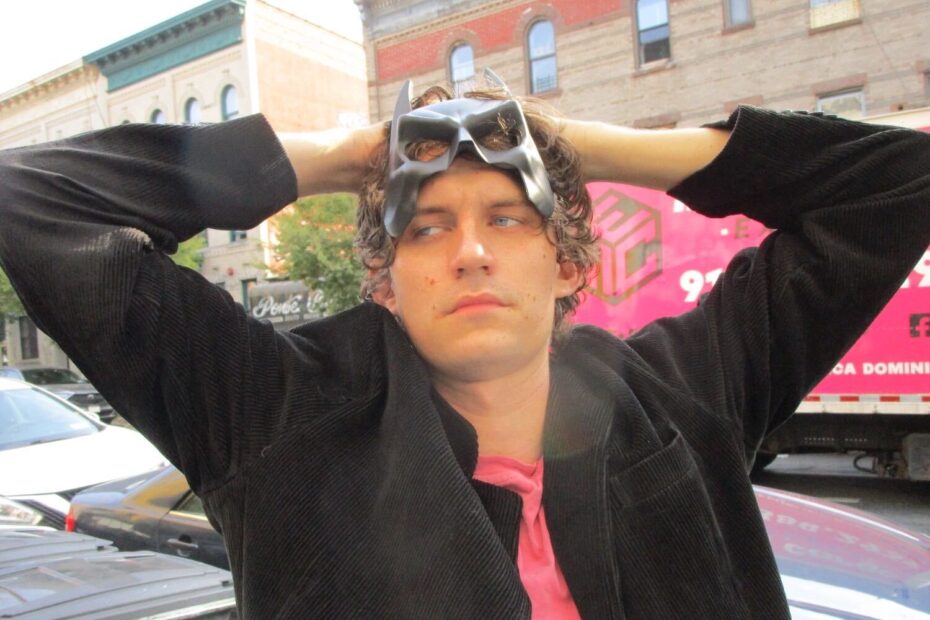
Since releasing their second album in late January, titled My Heart Is A Room With No Cameras In It, Brooklyn-based artist Julian McCamman’s new band Victoryland has been making waves in indie circles. Powered by McCamman’s captivating vocals, the alternative indie-pop/rock album has echoes of The Cure in its instrumentation. It was named Stereogum’s Album of The Week, and will without a doubt be a contender for Radio TinTin’s elusive Album of the Year.
Despite McCamman’s recent success, his path to gaining momentum in the indie world wasn’t straightforward. As recently as 2024, he was feeling increasingly stifled playing guitar in the Philadelphia punk band Blood, despite the group having released a full-length album and built a small fanbase. He took a risk by leaving the band later that year, instead moving to New York to be the frontman of his own project: Victoryland.
The ambition which led him into leaving Blood and starting Victoryland drove him apart from many of his musical peers in Philadelphia. But two years on from that move, it has become apparent that he made the right decision. Following the release of My Heart Is A Room With No Cameras In It, LCD Soundsystem’s frontman James Murphy took a liking to Victoryland, eventually giving them the opportunity to open for the legendary New York band’s North American tour. Their first stop was in Vancouver, where Radio TinTin had the chance to speak to McCamman about what some would call his selfish decision to leave Blood and found Victoryland, pursuing the goal of making “perfect” pop music.
A musician’s decision to leave their band is often characterized as ‘selfish’, and it’s easy to see how an artist could take offense at being described this way. Yet McCamman readily agreed with the label: “I like that you called it selfish, honestly… because it was. I think the inception of this project was me starting to prioritize my own songwriting over songwriting for [Blood], which had been restricting my creative urge to write true hits and accessible [pop] music.”
The abrasive punk sound of his previous band eventually became limiting for McCamman, although it took him a while to realize the appeal of a more “mainstream” outlook. “When I was younger, I really loved experimental music, and I really liked challenging myself [with it],” he recalls. “But when I got older, I think I realized that it takes a real skill to write a simple song that is really infectious.”
“I love music where every part of the song is really satisfying, and you can really do that with music. I think about that a lot — how music can be ‘perfect.’ The appeal of what he calls “perfect” music soon became a fixation for McCamman. “I got really obsessed with how people say they can’t stop listening to a song, and what goes into making [that].”
The notion of “perfection” goes against the grain of most of the independent music realm. Victoryland itself is labeled as an “alternative” band — so how could they be chasing the very “perfection” they’re branded to reject? Their answer is by aligning “perfect” with music that’s accessible, not necessarily mainstream. Making music for the masses doesn’t have to be synonymous with chasing universal appeal or losing creative nuance.
The “perfect” song à la Victoryland can still be deeply authentic, especially in its lyrical content. Using a catchy, danceable pop beat to propose deeper or more psychological themes is something they share with LCD Soundsystem. While the New York band is firmly “alternative,” it’s hard not to dance to singles like the aptly titled “Dance Yrself Clean,” regardless of your musical background.
McCamman loves this dichotomy: “My real hope is that someone is jumping up and down and singing to [our] music, and then slowly realizing what they’re saying is [actually] really gross or violent. Because that is [the] thing about pop music [that] is really interesting to me — the way people feel it before they really hear what is being said.”
The authenticity of Victoryland’s lyrics has become a core feature of their music. The words allow McCamman, a passionate songwriter, to showcase his more unsavoury tastes in a way that to him feels both confrontational and strangely inviting. “If I was to tell you some of the gnarly thoughts I have regularly, I think people would be like, ‘What the hell is wrong with him?’” McCamman says with a chuckle. “But everybody has those thoughts.”
Through Victoryland, McCamman seeks to amplify the uglier thoughts that come with being human. Singles like “Here I Stand” channel that same candour into a disregard for outside expectations, turning the abstract aversion into something blunt and immediate. In it, McCamman sings: “Here I stand / Whoever said it’s foolish / Fuck you and everyone else.”
Victoryland’s pursuit of perfection is one that not many are willing to take on, and McCamman is intent on pushing back against the indifference toward ambition that has taken hold in younger creative circles. “The poison of nonchalance and people who are ‘too cool for school’ are everywhere, especially on the East Coast,” McCamman explains, “I really hate that shit.” He pauses, then reiterates emphatically: ”I hate that shit.”
He continues: “Because if you fail and you weren’t trying to appease people, then you didn’t really fail, right? And there’s a failsafe, like, it’s like, ‘Oh, I failed? I didn’t try that hard,’” he says with a shrug. “And, well, you should try for something big and fail really hard, you know? An awesome failure is better than a safe layup. You just might as well go big.”
In terms of his creative ambitions, McCamman leaves no space for guesswork. He is continuing to strive towards making ‘perfect’ music, according to his own definition.