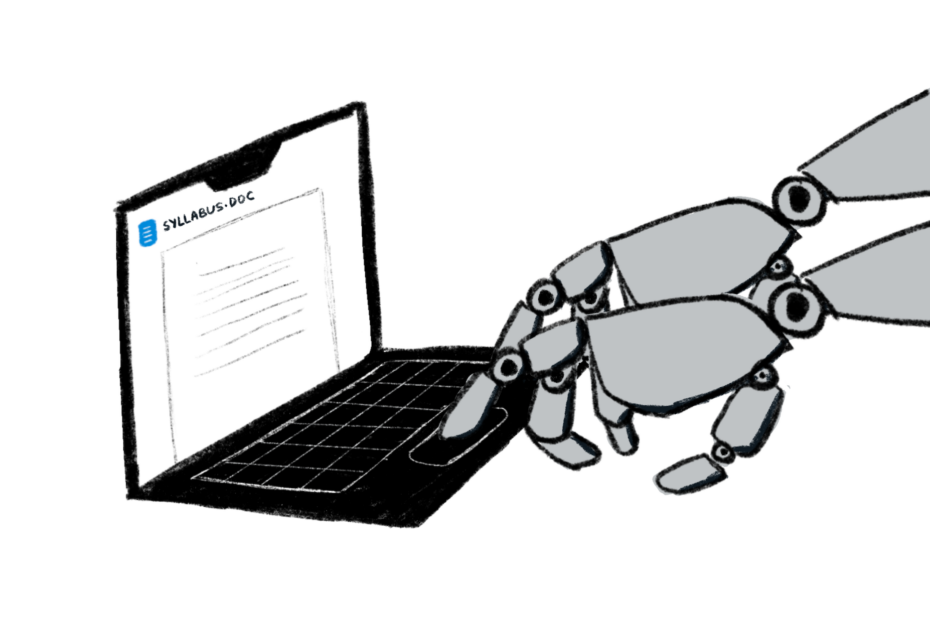
As OAP ends and the school year begins, students gear up for yet another semester filled with back-to-back papers. However, the take-home written assignments they once knew have been ditched, replaced by in-class midterms and presentations, as professors begin to opt for what they believe to be an AI-safe model. The Daily spoke with Anna Jahn, executive director for the Centre for Media Technology and Democracy at McGill’s Max Bell School of Public Policy. We talked about her professional opinion on the syllabus effect: a notable decline in in-class assessments across post- secondary institutions as a result of AI. When talking with Jahn, the Daily asked specifically how the syllabus effect currently manifests at McGill compared to past semesters and how she predicts it will look in the future.
Jahn recently published an opinion piece in The Globe and Mail, entitled: “Universities should stop treating AI as a cheating problem.” She cites a 2026 study from the Higher Education Policy Institute at Oxford, which found that 94 per cent of UK undergraduate students use generative AI to aid with school work. Moreover, KPMG Canada found last fall that 73 per cent of students in Canada now rely on generative AI for schoolwork, an increase from 52 per cent two years ago. Of the Canadian students surveyed by KPMG, 45 per cent say their first instinct is to use AI when drafting written assignments, a practice of which 48 per cent attribute to the decline in their critical thinking skills.
Academic institutions have begun providing widespread access to specific generative AI models, which Jahn described as a more coordinated approach. For example, McGill’s Max Bell School of Public Policy provides all students and faculty with access to Claude Pro. However, as Jahn wrote in her article, “[Claude Pro] is a subscription and a training program. It is not a rethink of what a degree is for.” Moreover, certain Canadian professors, for example Jonathan Malloy (Carleton) and Daniel Silver (UofT), have partially opted for assignments that require and engage with AI. Malloy and Silver have similar approaches, essentially having students use AI to produce papers or assignments and then analyze AI’s response.
When asked if she had noticed the impacts of AI on syllabi this year, Jahn acknowledged McGill’s more proactive approach this fall. However, she also stressed the absence of an up-to-date, consistent AI policy across McGill and other post- secondary institutions. Additionally, she noted a move away from take-home papers and a pivot towards in-class assessments. This is echoed in a key piece of feedback from the Max Bell Center’s cohort last year: students need to monitor their use of AI.
This summer, the Max Bell School administration, including but not limited to Director Jennifer Welsh and Associate Director Manuel Balán, presented their faculty with a framework for professors to use when drafting AI policies in syllabi. The framework provided faculty with concrete categories and language, so that these policies (no matter the professors’ individual stances on AI) can all be slightly more cohesive.
Jahn breaks down AI regulation into three possibilities. Option one is an AI-free environment with measures like in-class evaluations and digital locking softwares. Option two is a hybrid model in which students aren’t technically allowed to use AI but have no parameters in place unlike the digital locking software in option one. The school is looking to avoid his as the model as this is what Jahn describes as the “least effective.” Option three is freedom for students to use AI. What is essential is not mixing the models, but using them in tandem, as, according to The Globe and Mail, “the mass lecture model has been failing students long before ChatGPT arrived.” Though this is a newly mplemented framework, the results of which we have yet to see at the Max Bell Center, Jahn notes that professors have greatly appreciated the guidance and structure provided by the Centre thus far. When asked about different approaches to AI use across McGill’s faculties and programs, Jahn emphasized how each program has a distinct disciplinary culture and, therefore, fundamentally different modes of evaluation, with some more challenged by AI than others. The Faculty of Arts in particular, with their heavy reliance on the take-home essay, has been targeted; however, not all arts classes are equally affected because there is no unified approach to regulating AI use. When asked about this, Jahn’s response was clear: “This is ultimately where universities and professors need to step in and clarify the rules.”
Moreover, Jahn was able to tell us more about an AI policy initiative specifically highlighting Canadian students’ voices. This past spring, the Centre for Media Technology and Democracy gave voice to young Canadians on AI policy at Gen(Z)AI: Canada’s Youth Assembly on Artificial Intelligence. Over eight months, thousands of youth crafted policy recommendations concerning AI regulations in Canada and presented them in parliament. I asked Jahn what surprised her most about the responses from post-secondary participants of Gen(Z)AI. Without hesitation, she described the manner in which post-secondary Gen Z students balance hope with realism, as seen in Gen(Z)AI’s role as “the democratic voice of [a generation that has] the most to gain or lose, speaking clearly and in their own name.” According to Jahn, Gen Z cannot afford to not think about AI in the same way other generations do.
Ultimately, what Jahn drove home most was that higher-level administration needs to be specific about the main skills they’re trying to instill in their students. “The fundamental question AI is pushing on us is ‘what are the real skills and learning outcomes we are working towards and how do we…[allow] our students to explore them?’” For Jahn and McGill faculty, exploring looks like moving toward AI-safe examinations. However, this elicits another question of how students can explore newly acquired knowledge if not through cognitive exercise, research, and the process of writing. Jahn has emphasized both in her article and speaking with the Daily the necessity for McGill to formulate a comprehensive AI policy. As we begin to see the impacts of AI usage on Canadian post-secondary students and their syllabi, the Max Bell School of Public Policy has been taking initiative, creating a framework for professors to tackle the troubling waters of AI use.