

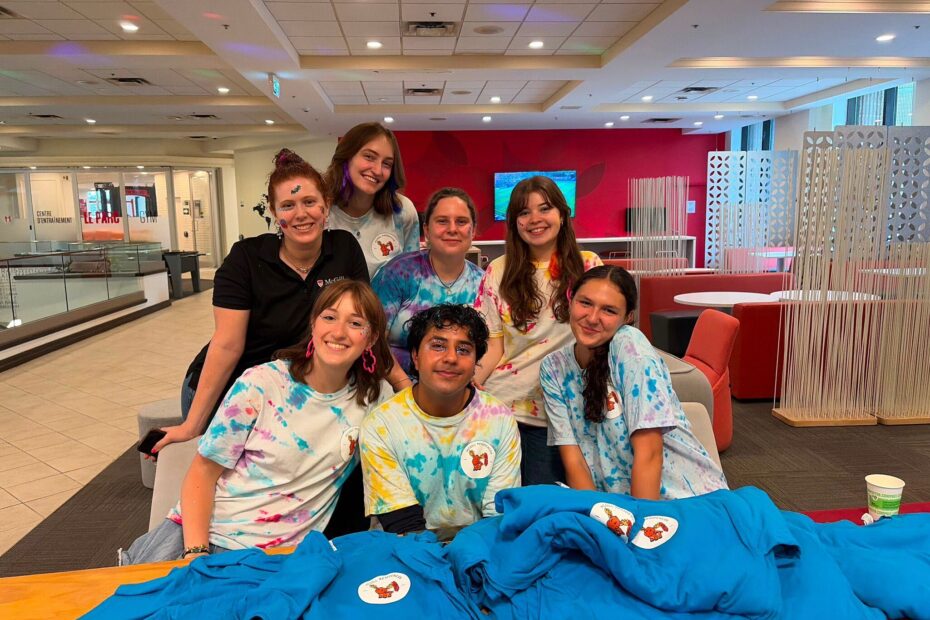
As the school year is set in motion, first years, returning undergrads, and graduate students alike flood McGill’s residences on move-in day. Behind the scenes are current McGill students known as Residence Life Facilitators (RLFs) who facilitate move-in and residence life. The Daily interviewed two RLFs who currently work at New Residence Hall (NRH) to discuss managing the stress of moving in.
This interview has been edited for clarity and conciseness.
Charley Tamagno for the McGill Daily (MD): What’s the day-to-day of an RLF like?
Ksenia Boyer Voutova (KBV):
Right now it’s a lot more intense because we’re doing Welcome Week. Being an RLF feels more like an extracurricular than a job. Because it’s part-time, I still have a busy academic and social life. When I’m working, there’s a lot of different tasks – we either have events or office hours. For the events, we plan them and have to attend them. The office hours can happen from 9 to 5 every weekday. During office hours, you work on project planning and advertisements – whether that be making a poster on Canva, making a reel, [or] replying to student questions on Instagram. We have a lot of meetings, whether that be with our manager or with our teams. There we discuss feedback and brainstorm our next events.
MD: How do the first two weeks differ from the rest of the year?
Olivia Morawetz (OM): You work pretty much full time. Usually, throughout the rest of the year, you work six to 10 hours, and then in the first few weeks you’re working 40 hours. So it’s a full-time gig.
MD: Do you feel like these first two weeks are more rewarding than the rest of the year because you’re really meeting the students? Can you see yourself having an impact?
OM: The first few weeks are definitely the best in terms of visibility. We do hall meetings, where we talk to every single student in the building, and that’s really motivating in terms of making sure that they know who we are and know that we exist. During the rest of the year, attendance really goes down, and it makes you feel like nobody wants to attend events anymore. At the beginning of the year, people are really, really motivated to go to events and meet people and see us and find out who we are.
KBV: I would say there’s still some events in the middle of the year that feel more rewarding than others, especially big ones where you go out of the residence or on trips. You feel more connected to the community.
MD: What kinds of questions are people asking?
OM: Mostly about logistics, either the rules of residence or the events themselves.
KBV: Sometimes they can ask us questions unrelated to residence life, just [because] we’re upper year students at McGill.
OM: I wish more students knew that RLFs are a resource of upper year students who can answer questions about registering for classes or homework or certain subjects. Last year in Upper Residence we did study hall events that were specifically for studying. We would post “I’m going to be at the study hall today, and I’m studying biology,” so that students who study biology can come and ask that person for help.
MD: What was your experience with Floor Fellows in place of RLFs? Do you think there really is a tangible difference between the two?
Note: Before the 2023-2024 school year, Floor Fellows were upper-year students who lived with residents year-round in residences, working more hours than RLFs in addition to being a 24/7 support system. McGill terminated the Floor Fellow program ahead of the 2024-2025 school year.
OM: It’s not just not living in residence — the job changed a considerable amount. There were some union restrictions the first year [after the switch] that made it so that we weren’t allowed to do any job that the Floor Fellows did. We weren’t allowed to put door decorations up because that was something the Floor Fellows did. [Now] it feels a lot more interactive. We have a number of required monthly events. My Floor Fellow didn’t do any events, so I never saw him after the initial meeting at the beginning of the semester. It was very hands-off. The only people that were running consistent events were the council, which I was on. RLFs are definitely more connected and
interacting with the resident community than the Floor Fellows were.
MD: Do you feel like it’s hard to odd template
actually make a connection with the community?
OM: It depends on the person. Yes, because there are specific residents or groups of residents that don’t interact with us at all, and that’s fine. But there are definitely people who I’ve found, after a few years of doing this, who will come to as many events as they can because they just like having free events that they can attend.
MD: How do you pitch events to first years, and is it important for them to attend those events?
OM: I feel like something we’ve been trying to do more recently is asking first years what things they want to see. I think asking students what events they want to see is important, and a lot of them don’t realize that they can message us and be like, “Hey, I want to do a masquerade ball,” and we’ll be like, “Okay, we’ll try and do that.”
Feedback is a really important part of the job. Even when they designed the project planning template, feedback was built into it. You have to write down feedback after every single event. They started doing the symposium last year, which is a place where all the RLFs go to present their most successful and least successful events of the year, and provide feedback on how those went. Then we could take events from other RLFs.
MD: How do you get inspiration for different events?
KBV: A lot of the time, it’s just things we want to do. We all have different hobbies, so Olivia wants to do something and then I want to do something and then we end up having two different events.
OM: Or in previous years we’ve had really good cultural diversity [on the RLF team]. We had specific cultural events because we had people on the team that were part of those communities and were able to let us know that these things were happening.
MD: Do you have a favorite memory or a favorite event?
OM: Well, we did a formal last year, which was our biggest event, and it had a really good turnout in November, which is really rare for our late events. Usually by the end of the first semester, attendance starts to dwindle a little bit because people have made their own friends or it’s exam season and they don’t want to go to things. We had a bar where we had a menu of mocktails that we made [and] we ordered 50 pounds of sushi. It was insane. I was like a waiter running around with sushi. We had a dance floor. We hired a DJ who was a student in Upper. Some guy showed up with a saxophone at one point and was playing that on the dance floor. People were attending it because of the event. Obviously, with that many moving parts, things are bound to go wrong. But the things that went right outweighed the things that went wrong by a million times, and it was a really, really successful event.
KBV: I loved going to the PWHL [Professional Women’s Hockey League] game. It was really fun because it was just different. For a lot of students, it was their first time seeing a hockey game. That was my first time seeing a hockey game. What’s good about these events is that students are able to try out new things.
MD: Is there anything else you would like to add?
OM: I love my job. I love my team.