

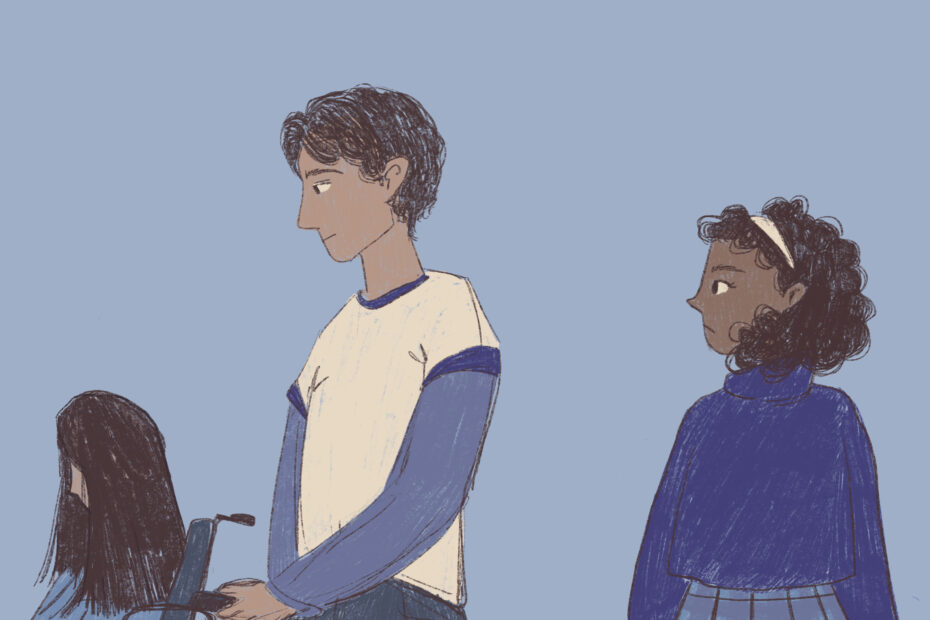
Into the Blue by Emma Brodie is a romance novel released earlier this year and has since gained much praise. Contrary to its positive reviews, this book did not live up to my expectations. The novel follows protagonists AJ and Noah as they meet, fall apart, and reconnect numerous times over the course of thirteen years. From impromptu improv classes to an unscripted television series, they work together multiple times and cannot seem to escape one another. Unfortunately, rather than rooting for these characters and their decade-long romance, I found myself hoping that they would part for good.
The book has an interesting concept, as it addresses the harsh reality of living with a terminal illness. Noah is diagnosed with Huntington’s disease as a young adult, and his diagnosis catalyzes much of the conflict in the novel as it causes him to push AJ away. While I appreciated the author’s attempt at portraying life with a terminal illness, I felt as though it was only employed superficially as a roadblock to the protagonists’ romance instead of as something essential to Noah’s character.
Rather than portray the difficulties of navigating a relationship while dealing with a terminal illness, the book uses Noah’s diagnosis to pit the protagonists against each other as they disagree about what his medical course of action should be. Noah’s uncertain future is a point of contention between him and AJ for almost the entire novel. While that conflict is understandable and realistic, it never truly gets resolved until the end of the story. The book details their on-again, off-again romance fueled by their opposing beliefs on Noah’s future. However, the story would have been much more compelling had the two protagonists navigated the conflict together, rather than let it tear them apart for thirteen years. After a while, their arguments became repetitive, causing me to lose interest in their relationship. It also felt as though neither of them grew emotionally over the course of the story, and instead remained trapped in the same mindsets they had when they first met. This lack of character and relational development left so much unfulfilled potential for mutual growth and understanding of one another. Hence, the story as a whole fell flat for me.
Moreover, despite AJ and Noah’s bond surviving thirteen years of uncertainty, their situation is not one that should be romanticized. They meet when AJ is in high school, do some improv together, and kiss once before Noah leaves town. AJ is then hung up on him for the rest of the novel—even when she is engaged to another man, and would rather watch Noah, who has become a famous actor, attend the Oscars on television than plan her wedding with her fiancé.
Second chance romances are nothing new, present in beloved romance films such as The Notebook and used to show an unbreakable love between two characters. However, this novel presents AJ and Noah’s bond as something that AJ cannot seem to escape from, even after a decade. While some may find that romantic, I certainly didn’t, and I spent most of the book hoping that AJ would finally get over Noah and move on with her life. Their relationship seemed to hold AJ hostage emotionally, never truly benefiting either character until the end of the novel.
While the romance in itself is undesirable, the book’s main problem is its writing. The first section of the novel follows AJ in the third person during the summer before her last year of high school. The writing, while meant to reflect the mind of a teenager, is at times downright cringeworthy. When AJ first encounters Noah at her job at a video rental store, she describes him as being “so big, he made the DVD case look like baseball cards” (page 12) — an unrealistic and frankly ridiculous line, which is a perfect way to summarize the writing in this novel. Noah can be stripped down to a tall, brooding type while AJ is the quirky loner who pines after him. These tropes have been overdone for decades, so to see them in such a new work — especially one that has received numerous good reviews — is strange and worrisome.
Not only did the juvenile, shallow writing provide an unpleasant reading experience, but it demonstrated the amount of effort that the author put into the development of the protagonists’ bond. On page 33, AJ describes Noah’s eyes as “not ugly” when they change colour in the sun. The lack of effort put into this line irritated me so much that I had to close the book and take a deep breath. Though cliché, this line could have depicted the intimate act of a character observing the small details about a loved one that most people might not notice. However, in this case, the author does not even bother to choose a single compelling adjective to end the sentence with, instead providing us with a useless statement that lacks substance and meaning.
There was potential for Brodie to create a powerful story about navigating romantic relationships in the face of terminal illnesses and the hardships that come along with them. As much as I wanted to love this book, I was disappointed multiple times: first by the poor writing style and then by the weak narrative. Rather than depicting how love can conquer all, this novel showed how no story can conquer a mediocre composition.