

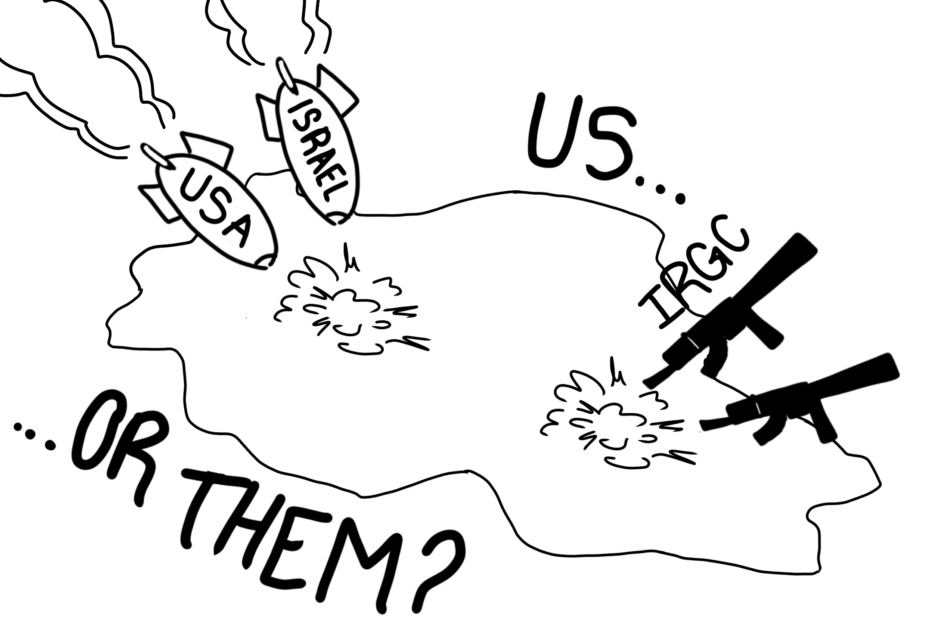
On February 28, the US and Israel launched a join airstrike attack on Iran, killing many high-ranking government officials including Supreme Leader Ayatollah Ali Khamenei. Iran quickly retaliated in a series of missile and drone strikes against Israel and US allies in the region. The war has since turned into a chaotic global conflict; political leaders stand divided, the energy market has stalled, the Gulf states suffer damage from the unprecedented attack, and Trump speaks exclusively in contradictory terms about his next move.
Meanwhile, the Iranian government maintains a near- total internet blackout throughout the country, which renders it difficult to determine how the war is affecting Iranians on the inside of the conflict. The Daily was able to get in contact with a factory manager in Iran, to recount his experiences and share his thoughts from the first week of the conflict.
“[On the morning of Monday March 2], a very, very loud sound – caused by a bomb or missile – jolted me out of bed, waking me up,” he writes. “I froze, and did not immediately go to check on the factory until about 15 minutes later. In the factory, about 80 per cent of the windows facing the explosion were broken…The factory yard was full of bomb or missile fragments, full of large metal pieces, full of various parts including vision cameras, full of crushed rubble…broken glass covered my desk.”
“I think if [the explosion] had happened during working hours, we would have had at least 10-20 people injured…the distance between the explosion and our factory was about 100 meters.”
In the following week, Saeed cancelled work for his employees, although he went to the factory every day.
“Every day and night – at 10 p.m. or 3 a.m. or 8 a.m. etc., generally at different times – I heard a sound like an airplane or a missile. With my previous knowledge, I tried to take shelter quickly, so that if something happened, I wouldn’t get hurt. It sounded about two to four times every day.”
Once work resumed for Saeed’s employees, the sentiment amid the factory was one of unrest and paranoia. “There was worry in their eyes. A few of them had turned their feelings of worry into anger or chaos. Inadvertently, their words disturbed their coworkers and caused them to grow anxious as well. Seeing the state of the situation, I decided to call off work until further notice and send everyone home.”
“Some people decided to stay, to help clean up the rubble…at 9 a.m. we started replacing the broken windows. At noon, there was another explosion and the windows broke again.”
Such destruction and paranoia is characteristic of war. As the conflict drags on, Iranians – both within the country and in the diaspora – become increasingly disillusioned with the foreign powers who came to their “aid.” Hope dwindles for regime change and improved conditions once the war is over.
On the other hand, the majority of Iranians express discontent with the current regime, and have grown desperate for an alternative. “The ordinary people have lived without any peace or prosperity for 47 years. They are tired; they are unhappy,” Saeed tells us. “But they have found that whenever they protest, they face severe crackdowns and bloodshed, while the government remains untouched. I think more than 85 per cent of the people are against the government.”
Time and time again, mass protests against the regime have been met with violent retaliation. The most recent wave of protests in January and February of this year have been recorded as the deadliest wave of crackdowns in Iran’s modern history, with many estimates of fatalities exceeding 30,000.
This is why the assassination of Ayatollah Ali Khamenei on February 28 had such a profound effect on Iranians: after decades of protests that rendered thousands dead while harbouring no real change, hope is in scarce supply. The sudden death of the regime’s most important figurehead gives a despairing population a tangible source of hope to latch on to. The overwhelming sentiment seemed to be that Khamenei’s death had freed the people of Iran, and put a definitive end to their suffering.
However, liberation did not immediately follow Khamenei’s death. In fact, what Iran saw instead of democracy was its antithesis: Ali Khamenei’s son, Mojtaba Khamenei, was appointed by Iran’s Assembly of Experts as his replacement; and the Islamic regime, although weakened, remains in power.
Weakened in terms of state apparatus, but not in spirit; since the beginning of “Operation Epic Fury,” the Iranian government has doubled down on its repressive measures and intimidation tactics. On state television, one presenter threatened that “every single” dissident will be pursued, and they will “make [their] mothers mourn.” The chief of police claimed that anyone who takes to the streets against the regime “[will not be seen] as a protester or something else; we will see them as the enemy and do with them what we do with the enemy.” Some Iranians profess that, in spite of the current airstrikes, they are still more afraid of their own government than outside forces.
Their fear is not unfounded; the Islamic regime has routinely imprisoned, tortured, and killed those who it deems a threat to its hegemony. Systemic violence is intrinsic to the government’s state apparatus.
It is true that the US-Israeli attack is an illegal one, and the continual erosion of international law is deeply concerning. It is also true that American intervention in the Middle East, such as the “war on terror” in Afghanistan and the 2003 Iraqi invasion, has an egregious track record. The US’ meddling has often resulted in lengthy, drawn-out conflicts that destabilize governments and devastate local populations. However, the present alternative for Iran – complete withdrawal of US and Israeli forces from the region, leaving the people’s fate in the hands of the Islamic regime – isn’t awfully alluring either. It is likely that as soon as foreign attacks cease to be a threat, the Iranian government will carry out mass imprisonments and executions of its internal “enemies.”
One option touted enthusiastically by the diaspora is the return of the exiled crowned prince, Reza Pahlavi. Although Pahlavi has a sizeable support base in the Iranian diaspora, and perhaps has some backing in Iran, his competency for the role is questionable. Saeed has his reservations regarding the exiled prince: “A person who has only talked and lived in luxury for 47 years wouldn’t be willing to come to Iran even if they give him the country with both hands. In my opinion, the percentage of people’s desire for Reza Pahlavi…is not even between 5 and 15 per cent.”
In Saeed’s view, Reza Pahlavi is a troublesome candidate; “Having a father as the Shah is not proof of sensibility and wisdom. If your father was wise and sensible, the events of 1979 would not have taken place. [The Shah] also had in his mind a great delusion, and wanted not only Iran, but the entire world under his feet; a delusional dream of power and global domination. Like Mohammad Reza Shah, [Reza Pahlavi] is our Trump who wants to rule the world.”
When the most viable “democratic” alternative Iran sees for itself is a relic of an archaic autocratic dynasty, it is clear that Iran is not dealt a fair hand when it comes to democracy. Grievances and suffering have compounded over decades of living under oppressive rule, resulting in progressively lower expectations and standards for change. Even when people continue fighting for a “democratic” alternative, what they come to accept as “democracy” becomes more lenient.
What results is a nation in which war sparks celebration, and the most viable form of democracy is the return of monarchy. After 47 years of violence and bloodshed, war is peace and freedom is slavery.