

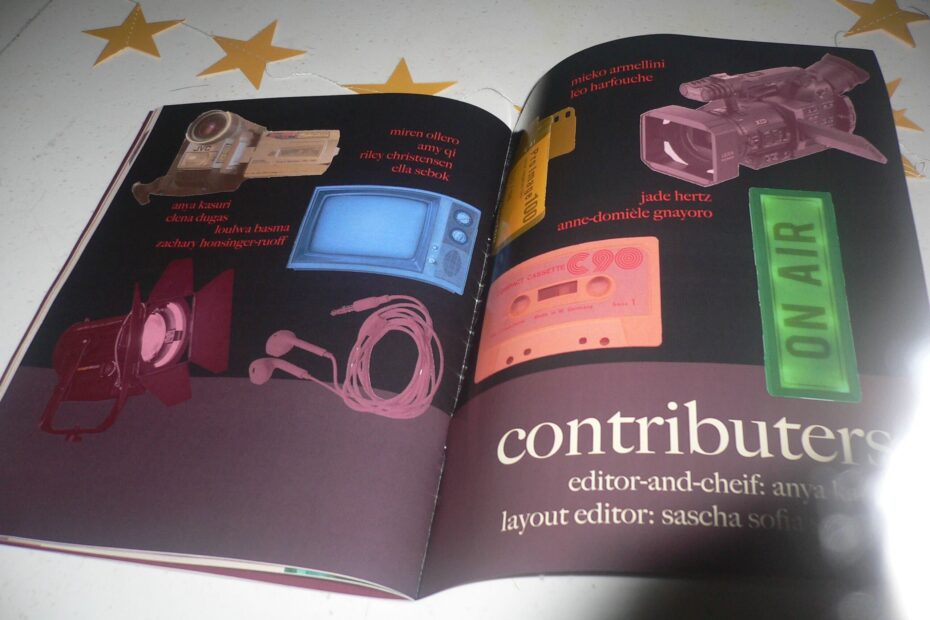
On February 24, Gerts Bar sparkled with blue streamers and star cutouts. Students crowded around the semi-circle of the bar dressed in the classic David Lynch uniform: a black suit, white button-down, all paired with a black tie. Others recreated the iconic looks of his characters, such as Laura Palmer in Twin Peaks and Sue Blue from Inland Empire. Set to the tune of a McGill student band and followed by a DJ set, at first glance, the Student Television at McGill (TVM)’s Post-Credits Magazine launch appeared half-costume party and half-creative meetup. Which, indeed, it was.
Anya Kasuri, TVM President and Post-Credits Editor-in-Chief, attended the event dressed in a sparkling gown and touted the magazine’s sole physical copy. The magazine, which she co-founded alongside TVM’s graphics coordinator, Sascha Siddiqui, encourages authors to thoughtfully analyze their favourite films. Kasuri is in her third year, studying International Development with a double minor in Political Science and World Cinemas.
In an interview with The McGill Daily, Kasuri says, “Film is the medium that influences our everyday character and aspirations.” Not only does it influence you, it allows you to understand yourself: “Critiquing film is a social activity, an intellectual engagement, and at its core, is a self-assessment of your values and beliefs…the meaning you derive from it can be really telling of your character too. ”
Her favourite part of the magazine is the graphics: “[Unlike writing, graphics] provide visuals to cinema…to perfectly complement the [article’s] argument. Sascha [Siddiqui], our graphics coordinator, did an incredible job bridging the gap … When I saw the final [magazine] it was her creativity that grounded the writing back to its roots — an appreciation of cinema.”
“Films should always be critically analyzed this way. I feel like that’s a value that I’ve derived from my film classes, particularly with Professor Ara Osterweil,” she replied when asked about the vision behind the magazine. “The process of watching and experiencing a film is not only viewing it, then going home and going to sleep. It’s about watching it with your friends, watching other people, reacting, [and] hearing everyone’s reactions in the crowd. Afterward, [the experience is about] discussing it as you understand it — because when you come out of a movie, you’re not going to know exactly what you have to say; it’s not a fully fleshed-out thought. When you spend time discussing it, you learn more about it.”
The key difference, for Kasuri, between short- and long-form analysis lies in its depth: “[Long-form analysis] offers full fledged evaluations of films’ formal elements: cinematography, mise en scene, visual tone, colour palette, acting, narrative — being able to evaluate that in a longer form analysis lets you see each film individually…and its directors’ vision apart from one another because you get into the depths of each films’ elements’ meaning[s].” To conclude: “It’s a better, more engaging, intellectual, and educational alternative to short-form media.”
However, she notes that many people forget the core of analysis: what the film wants to be. “A lot of people misjudge pieces of media by applying the same expectations to all [of them]. It’s important to judge a film based on what it’s striving to be…they all have different standards of their visual language, their pacing, their acting, their sets,” said Kasuri.
I encountered Elena Degas at a bar table next to the DJ booth, listening intently to the live band. As TVM’s music composer, she wanted to “provide insight from a musical perspective.” Writing to the Daily, she highlighted how the score was integral to the story: “Sinners was by far the film that impacted me most from the last year, and I felt that it was special in the way that the score/music was so integral to the story and the conversations that were happening around the film.”
Degas got her start in film scoring when she watched Euphoria in 2019. The music was what made her love the show; she found that it could tell a poignant story on its own.
Her favourite part of the article she wrote for Post-Credits was her analysis of the use of blues at the centre of Sinners. It gives the viewer insight into the film’s characters and their struggles. Especially the song “Pick Poor Robin Clean,” demonstrates the turn from oppressed to oppressor in Remmick, an Irishman. It opens up a “space for a larger conversation about the history of predominately Black genres of music and how they’ve evolved and continue to live on today.”
From her article: “It is immediately following [the surreal montage] scene when the people in the juke joint are faced with the vampires, who dauntingly perform an upbeat, folk-inspired rendition of ‘Pick Poor Robin Clean’ for the group.” The song is “a blues song that [embodies] someone trying to survive by picking apart and taking everything they can from a dead robin.”
For Degas, “this jolly folk rendition exemplifies the white vampires’ inability to engage empathetically and thoughtfully with the community they are attempting to infiltrate, and recalls a common pattern in genres such as blues and jazz, in which white musicians have historically appropriated and overshadowed Black artists.” Remmick’s positionality is especially striking because of his Irish heritage and experience with colonialism. His desire to completely consume the music is shaped by a selfish desire to preserve it the way he was unable to with his own heritage. However, in doing so, he reproduces colonial violence, with music becoming a tangible symbol of culture.
TVM has allowed Degas to explore her passion for the soundscape of a movie: “Film is now one of the main cornerstones of my life, I have found a huge love for making music for films at TVM, and have found a great community of other film-lovers here; I now plan on attending film school next year for sound design in hopes of a career in film audio/music!”
McGill’s distinct lack of a creative arts programme is no secret. However, student initiatives like Post-Credits Magazine are working to allow student film lovers to think critically about the art they are passionate about.
TVM will be hosting its largest event of the year, FOKUS Film Festival on Thursday, March 26 at Cinema Du Parc. For more information, visit TVM at tvmtelevision.com or @tvm.television on Instagram.