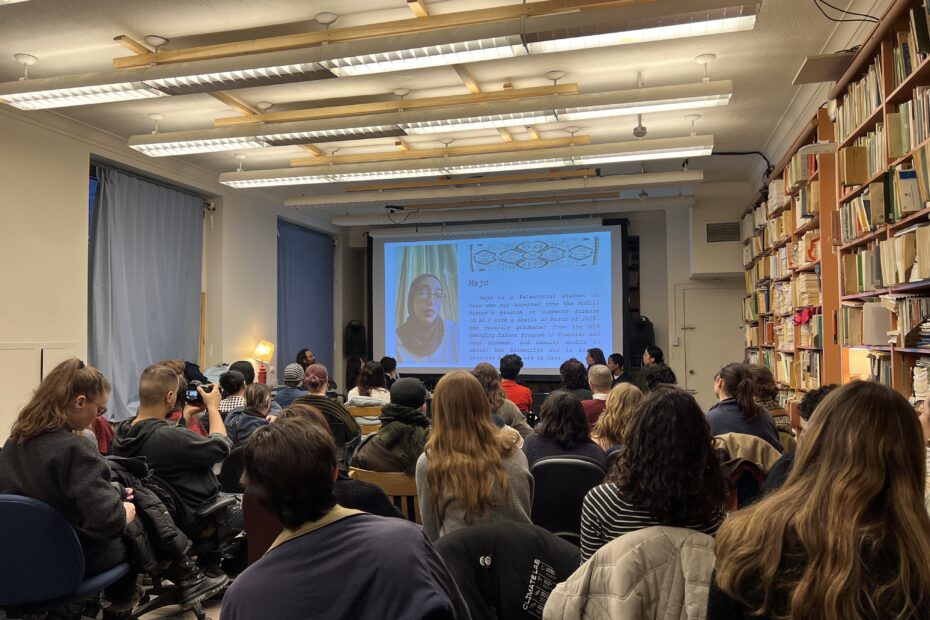
On Wednesday, February 25, 2026, a crowd filled the Critical Media Lab to celebrate the launch of Empty Seats. The project, spearheaded by a team of five students (Angela Zhai, Louise Deroi, Lulu Calame, Sahel Delafoulhouse, Zeena Zahidah,) is dedicated to raising awareness of Palestinian students who have been admitted to McGill University but refused entry due to their inability to obtain their VISAs.
According to the CBC, 130 Palestinian students admitted to Canadian universities cannot enter Canada due to related administrative barriers. Empty Seats includes written testimonies from four out of five Palestinian scholars admitted to McGill but are currently in bureaucratic limbo, unable to enter Canada; as well as testimonies from McGill faculty members and students expressing solidarity with these Palestinian students. It also includes concrete calls to action.
The project was kickstarted by an article written by Calame and Delafoulhouse in October 2025. The piece, which included interviews with McGill’s Palestinian scholars and members of the Palestinian Scholars and Students At Risk (PSSAR) organization, highlighted the bureaucratic barriers that keep admitted Palestinian scholars from attending on-site school in Montreal. The PSSAR identifies Palestinian scholars and connects them to academic opportunities in Canada. Upon the article’s publication, Associate Professor of Anthropology Diana Allan, who is also the acting faculty liaison for PSSAR at McGill, proposed broadening the project scope to better uncover and uplift these students’ circumstances in hopes of changing them. Subsequently, Professor Allan hosted a zine-making workshop in collaboration with media-maker and activist Stefan Christoff as an extra-credit opportunity for her classes, with interested students encouraged to participate in the zine’s creation. Thus, Empty Seats was born.
The zine format, commonly used for social justice, welcomes academic writing while also centering other valuable sources of knowledge like testimonies, interviews, and artworks. It is also remarkably collaborative and approachable, which was imperative for engaging students regardless of their background and experience in organizing and activism.
“It was a very McGill student-centred project,” says Louise Deroi, one of Empty Seats’ student organizers, in correspondence with The McGill Daily. Voluntary testimonies were collected from McGill students via a Google Form disseminated via social media and word of mouth, with respondents ranging across year groups and faculties. “A common theme expressed in the [student] testimonies was the disillusionment of and anger at attending a university that doesn’t do more for these students who, despite having submitted an excellent application and having been admitted, have the world pitted against them, which prevents them from being here. Putting the testimonies of the Palestinian scholars and other students and activists side by side shows the [Palestinian] students that they’re not alone; that there’s a community backing them up that desperately wants them to make it and is willing to mobilize for that.”
At the zine launch, the team screened video testimonies by Palestinian scholars Shereen and Majd (last names not given), who were respectively admitted to McGill’s Master’s programs in Neuroscience and Computer Science but remain in Gaza due to multiple barriers preventing them from receiving their visas. Biometrics, a key component of the Canadian visa application, cannot be obtained in Gaza, meaning that individuals seeking them must travel through the Rafah crossing to neighbouring West Bank or Egyptian territories to do so. However, the Rafah crossing has been closed since May 2024, making it extremely difficult for these students to fulfill the necessary steps for their visa application without external intervention.
However, in the last few years, nations like France, the United Kingdom and Ireland have enabled Palestinian students to complete their visa processes through various means, from evacuating them to neighbouring countries like Jordan to creating streamlined bureaucratic pathways. Historically, Canada has also proved itself flexible by making concessions for individuals in extenuating circumstances during the visa application process. For instance, applications for the Canada-Ukraine Authorization for Emergency Travel (CUAET) visa, temporary emergency visas which were issued to families and individuals fleeing Ukraine, waived the requirement of medical examinations and COVID-19 vaccinations.
At the institutional level, McGill belongs to lobbying bodies like U15 with mandates that encourage international talent and scholarship to drive Canada’s innovation. Moreover, McGill, registered as an active in-house lobbyist in Ottawa, meets regularly with Canadian government officials to discuss a host of notable issues including immigration. “It’s hard to access the content of these meetings, but we want to make sure that McGill is using all of its political power to make sure these students make it [to Canada],” states Deroi.
The zine’s launch hopes to spark a larger national movement to bring Palestinian scholars to Canada by pressuring the IRCC to expedite their VISA processes. “This is a Canadian issue, and is much bigger than McGill,” affirms Deroi. “Eventually, it would be amazing if other universities wanted to replicate the zine format and the project.”
McGill students can follow the Critical Media Lab to receive updates about the Empty Seats project and other follow-up events currently in the works. In addition to staying informed about Empty Seats, Deroi encourages students to get involved in the other various forms of on-campus activism pertaining to the Palestinian genocide. “Seeing these issues as interconnected and knowing that there are many different approaches to activism in support of Palestinians is very important.”
Copies of Empty Seats can be found at Cinema Politica. Any further inquiries can be directed to mcgillemptyseats@gmail.com.