

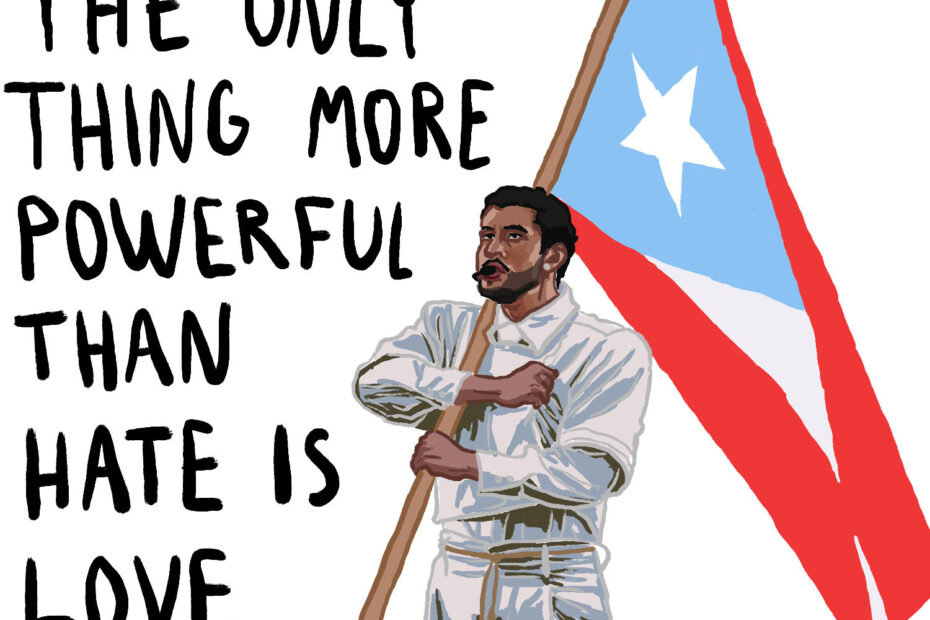
For 13 minutes during Super Bowl LX, the halftime show leaned into friction instead of smoothing it over. Bad Bunny, born Benito Antonio Martínez Ocasio, was the Apple Music Halftime Show headliner and performed nearly entirely in Spanish. At the end of the show, he shouts “God bless America” at the end, having named dozens of countries across the Americas as a parade of flags swayed behind him.
It was a deliberate reframing of what “America” can mean, delivered on one of the few stages left that still pretends to speak for everyone at once. That’s why the “Benito Bowl,” the fan nickname that spread almost as quickly as the clips themselves, became inescapable this past week. People weren’t only reacting to the performance; they were reacting to what it symbolized, and the people who got to be centred on his own terms: linguistically, culturally, and politically.
Bad Bunny’s rise to stardom make that centering feel especially pointed. He didn’t arrive in North America as a “crossover” project. He arrived as a Puerto Rican artist whose work has always proudly uplifted Puerto Rico and its unique culture. Puerto Rico’s political status makes visibility complicated on contact, as the country is not a sovereign state, but a US territory. Puerto Ricans are US citizens, but residents of the island cannot vote for president and do not elect voting members of Congress.
When halftime stopped being background noise
The Super Bowl halftime show usually aims for one thing above all: broad agreement. Even when viewers complain, the show is built to feel familiar and contain recognizable hits, universal cues, and minimal risk. Bad Bunny’s set didn’t play that game. It made Spanish the default language, Puerto Rico the centre, and “America” the hemisphere rather than the brand name. That shift alone explains a lot of the reaction cycle: celebration from viewers who felt seen, and backlash from viewers who felt the centre move without their permission.
One detail made the performance feel less like a medley and more like a statement. During the set, a couple was married on the field, and multiple outlets later confirmed it was a real, legally binding wedding. In a broadcast built around scripted spectacle, that choice landed as intimate and political at the same time: a reminder that legitimacy, belonging, and who gets to be “official” are arguments happening in public life right now, not just in comment sections.
This is what turns a halftime show into a cultural event, not just the fact that “people had opinions,” but the reasons they had them.
Puerto Rico isn’t an aesthetic, it’s the context
Bad Bunny’s Puerto Rican upbringing isn’t a footnote, it’s the core of his public identity. References in the halftime show weren’t random decorations; they were modes of insisting Puerto Rico’s belonging at the centre of the story, not on the margins.
What looked like set dressing was actually a kind of geography lesson, not the textbook kind, but the kind you feel. The show unfolded like a moving “tour” through Puerto Rican life: from a sugar cane field to a casita, then into the streets of San Juan, with domino players, block-party energy, and even a piragua (shaved ice) vendor stitched into the visuals.
That choice matters right now because it insists on ordinary Puerto Rican life; not Puerto Rico as a vacation backdrop, a headline, or an American afterthought. Sugar cane hints at the island’s extractive histories and the economic story behind “paradise”; the casita reads as continuity and home in an era shaped by debt crises, austerity politics, and displacement pressures; and the street scenes refuse the idea that Latin identity has to arrive on US television in a simplified, export-ready form.
Even the smaller gestures were calibrated. The light-blue Puerto Rican flag signalled a political lineage many viewers recognized immediately, and “seguimos aquí” (“we’re still here”) landed like a compact slogan of survival. When he spiked a football stamped “Together, We Are America,” the Super Bowl’s most patriotic object became an argument about what “America” includes and who gets to claim it. It was capped off by a billboard that read, “The only thing more powerful than hate is love,” alongside an “Easter egg” cameo that quietly nodded to diaspora memory.
That insistence carries weight because Puerto Rico’s relationship to the United States continues to be politically unresolved. As a US territory, Puerto Rico is tied to US power while lacking equal federal political representation. So when Puerto Rico is centred on the most symbolic US stage, a broadcast typically soaked in national mythology, it can’t help but read as political. Representation becomes less
“visibility” and more “reckoning”: a reminder of who is included, how, and at what cost.
In other words, the controversy isn’t that Bad Bunny “made it political.” It’s that Puerto Rico’s position already is, and has always been, and the Super Bowl simply doesn’t usually invite viewers to sit with that.
A halftime show built to be read
You don’t have to treat the halftime show like a puzzle to recognize it was built to be read. It’s a choice about audience: who is assumed to understand without effort, and who is expected to lean in.
Taken together, these choices make the halftime show feel like something greater than entertainment. They render it a cultural message delivered in the language of Bad Bunny’s characteristic effusive Latin trap: spectacle, symbolism, and the kind of visibility that becomes disruptive simply by refusing to shrink.
Resistance, in plain sight
The temptation with any “art as resistance” story is to hunt for one definitive political message and call it a day. However, Bad Bunny’s version of resistance is often quieter, and, in some ways, harder for a mainstream audience to dismiss. It’s not only what he says, it’s what he refuses to dilute. He made that refusal explicit at another high-profile event before the Super Bowl. At the 2026 Grammys, Bad Bunny used his acceptance speech for Best Música Urbana Album (for Debí Tirar Más Fotos) to denounce ICE and call for an end to what one report described as an “ongoing immigration crackdown,” punctuating it with the slogan “ICE out.”
That’s not symbolism, but a clear alignment with migrants and immigrant communities at a moment when immigration enforcement has become a flashpoint in US public life. And it sits alongside a different kind of milestone from the same night: Debí Tirar Más Fotos also won Album of the Year, marking the first time a Spanish-language album took the Grammys’ top prize.
The resistance here isn’t just “a pop star being political.” It’s a global superstar insisting that Spanish, Puerto Rico (and Latin America at large), and immigrant life aren’t side stories, even in the most mainstream room.
Backlash, then the rumour mill
Backlash was predictable. A Spanish-heavy halftime show on the Super Bowl stage, and a Puerto Rican artist refusing to soften his message, was always going to trigger the usual reactions: “keep politics out of it,” “speak English,” “this isn’t for you,” and the more familiar accusation hiding under all of that: you don’t belong here.
But the backlash didn’t stay in the realm of taste. It moved into the realm of narrative-making, constructed through the spreading of misinformation. In early February, social media users claimed Bad Bunny wore a bulletproof vest to the Grammys because of threats tied to xenophobic hostility. The rumour was investigated and no evidence was found for the “bulletproof vest” claim, explaining that his sharply tailored outfit (and altered silhouette) fuelled speculation.
The point isn’t just that “people online lie.” The rumour frames Latino visibility as inherently dangerous and controversial, transforming a historic career moment into a security conspiracy. This converts prejudice into something resembling concern. It also shifts the conversation away from the actual stakes of Bad Bunny’s work, language, belonging and power, toward whether he’s “too political” to be safe.
In that sense, the rumour becomes part of the cultural reaction: a way of policing what kinds of artists are allowed to be visible, and on what terms.
Why this lands in Montreal too
From Montreal, it’s easy to treat US culture battles as exported noise: loud, constant, and somehow always trending. But the themes that surfaced around Bad Bunny’s Super Bowl and Grammys moments are not uniquely American. They travel and translate because they interrogate fundamental questions: who gets treated as “normal,” what language gets to be default, and who has to translate themselves to be heard.
Those questions land differently in Quebec, where language is never just language, but identity, law, power, and a recurring public argument. This is a city shaped by diaspora, where belonging is lived rather than theoretical.
Bad Bunny’s journey, from a Puerto Rican artist building momentum on his own terms to winning the prestigious Album of the Year at the Grammys and headlining a Spanish-forward Super Bowl halftime show, matters because it shows what art can do when it refuses to stay in its lane. It may not be able to rewrite policy or put an end to structural abuses. But it can shift the centre of the frame, force a mainstream audience to notice what it usually treats as peripheral, and remind people that “unity” without inclusion is just branding.
And maybe that’s the most useful way to read the “Benito Bowl”: not as a victory lap, not as a controversy, but as a moment where pop culture briefly stopped pretending that belonging is uncomplicated.