

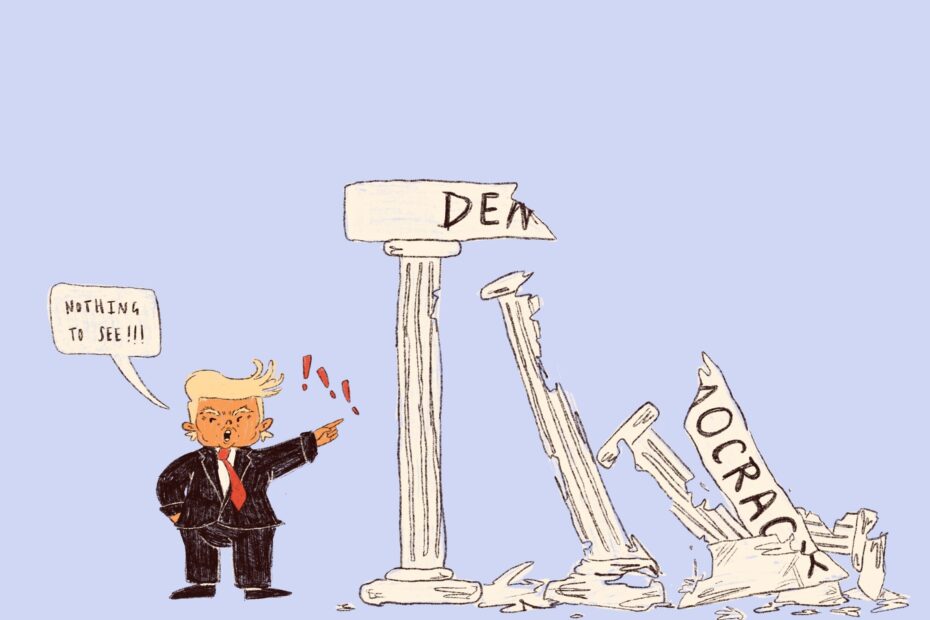
In the past two decades, the world has witnessed an unprecedented wave of democratic backsliding. Scholar Nancy Bermeo defines democratic backsliding as “the state- led debilitation or elimination of any of the political institutions that sustain an existing democracy.” Democratic nations are frequently distorted by populist leaders; elections are manipulated, heads of state engage in media censorship, protest repression, and state propaganda. Across the globe, electoral democracies like Türkiye, India, Poland, Hungary, and El Salvador have experienced democratic erosion. The political system in the United States, the former paragon of the democratic ideal, is exhibiting similar signs of strain in its democratic protections. While many scholars have recognized the changes in American politics, these patterns are seldom directly compared with those of other backsliding democracies. America’s potent democratic rhetoric has often allowed it to escape comparisons with nations like Türkiye, Tunisia, and El Salvador. However, during US President Donald Trump’s second term, the country has experienced patterns of opposition narrative suppression, militarized attacks against civil society, and a systemic weakening of judicial and legislative checks; all of which is consistent with democratic erosion and autocratic governance.
The United States has long relied on its democratic primacy as the source of its international legitimacy. In the Second World War, it was the US commitment to a moral- democratic framing of foreign policy and its vehement opposition to fascism and autocracy that laid the groundwork for its future claims to liberal supremacy and its role as an international moral police. The Cold War additionally led to an increasingly bipolar balance that placed America at the helm of democratic ideals. While the US has consistently ranked lower on democracy indices than states like Australia, Canada, and the Nordic countries, its place of economic and cultural prominence made it the democratic archetype in the global political imagination.
The repression of civil society is one of the hallmarks of democratic backsliding. As national leaders seek to expand their domestic authority, they must first squash opposing movements, creating fertile ground for expansions in executive power and removing threats to their authority. Trump’s recent responses to anti-ICE protests in both Los Angeles and Minnesota reflect this brand of targeted repression. In June 2025, Trump deployed both National Guard and Marine Corps troops to Los Angeles and the surrounding area to combat the supposed “lawlessness” and “violence” demonstrated in protests. Similarly, the ongoing ICE involvement in Minnesota targeting undocumented US immigrants, involves swathes of heavily armed and masked federal officials who use crowd suppression techniques (like tear gas and pepper spray) and frequent arrests in their campaign. ICE’s presence in Minnesota has also resulted in the deaths of two American citizens this January: Renee Nicole Good and Alex Pretti. The timelines and public documentation of both killings call the administration’s claims of self- defense on behalf of ICE into question, failing to demonstrate a substantive threat to the lives of the agents. This use of an overwhelming militarized force to suppress protesters is typical of nations experiencing democratic backsliding and executive aggrandizement, the expansion of executive authority through a weakening of checks and balances. In Türkiye, a key example of democratic backsliding, the 2013 protests over the destruction of Gezi Park in Istanbul resulted in the brutal state repression of protesters where armed forces beat and tear gassed civil society, while also burning the tents of peaceful environmental protesters. This incident spurred even more protests throughout the nation’s 81 provinces, which only led to the continued state-sanctioned suppression. Examples of this in the United States and Türkiye bear eerie similarities. These instances involve an armed and violent militant response to a group of relatively peaceful protesters. Both anti-ICE and Gezi Park protests involved mass arrests, the deployment of riot police, and the use of tear gas. Despite these restrictions, both Türkiye and the US also have constitutional protections for civilian protest and assembly. Thus, the restrictions on protests in the two nations not only reflect a suppression of the popular will but a divergence from constitutional principles, another marker of democratic backsliding. While it can be assumed that executive authorities in both the United States and Türkiye would dispute the peaceful nature of the protests, human rights organizations such as Amnesty International and newspapers such as the New York Times assert the peaceful nature of each respective protest and the often-preemptive violent response by heavily armed authorities.
The infringement on constitutional and legal frameworks is another key step bringing a state down the road to democratic backsliding. As the judicial and legislative measures meant to protect citizens are undermined, the practice of democracy will also naturally fade. In El Salvador, a key ally of the US in the fight against immigration, the presidency of Nayib Bukele has been marred with concerns of increasing autocracy, including the suspension of habeas corpus within the Central American nation. In 2022, Bukele enacted a “state of exception” to combat gang violence in El Salvador. The campaign involved arbitrary detentions and due process violations, as well as torture allegations. Notably, Bukele allowed Salvadoran forces to enter and search properties without judicial warrants. This removal of democratic legal procedures is a key check on power as it allows for third-party review of coercive state behavior. The removal of checks and balances is a crucial characteristic of executive aggrandizement and is also central to autocratic regimes like Putinist Russia or theocratic Iran. A recent ICE memo, leaked from an anonymous Congress official, reveals a similar federal directive for agents in Minnesota. The memo authorizes ICE agents to search homes with an administrative warrant. These warrants do not have judicial approval and have a lesser probable cause requirement. While the distinction between a judicial and an administrative warrant may seem semantical, it is directly contrary to the US Constitution, America’s founding document, which protects against “unlawful search and seizure” and expressly requires, “no Warrants shall issue, but upon probable cause.” Thus, similarly to the suspension of civil liberties and judicial review in Bukele’s El Salvador, ICE’s new warrant policy is directly contrary to the core legal framework of the United States, again demeaning its democratic merit.
Narrative suppression and control are another key mechanism exhibited by leaders of unstable and backsliding democracies. This practice involves the state suppression of media that reports views that oppose the state as well as the proliferation of manipulative information through state- controlled journalism, films, and rhetoric. Hungary, a nation that, according to the V-Dem democracy index, has experienced severe backsliding since 2010, provides a pertinent example of narrative suppression. In January 2020, Hungarian Prime Minister Viktor Orbán proposed reform to the nation’s educational curriculum, which aimed to encourage nationalism and erase Hungarian military defeats from textbooks. Furthermore, the new National Core Curriculum would remove authors like Hungary’s only Nobel Laureate and Holocaust survivor, Imre Kertész, from required readings, instead replacing him with antisemites and charged war criminals like Jozsef Nyiro and Albert Wass. Orbán’s policy is reflective of Hungary’s growing authoritarian bent as it encourages a selective remembrance of the nation’s history and government intervention into the propagation of nationalist ideals in the media. Trump’s recent directive to the National Park Service reflects the same type of ideological gerrymandering that typifies Hungary’s unstable democracy. In early 2026, the Trump administration ordered the removal of a number of cultural sites that reflect America’s history of subjugation toward Indigenous peoples and slaves, as well as feminist and queer imagery. The targeted removals included exhibits memorializing the slaves of George Washington, forced removals of Native Americans, and women and immigrants in Massachusetts textile mills. The Trump administration claims the removals are targeted at removing “corrosive ideology,” but in practice, they reflect the same confounding ideals that Hungary uses to hide its losses and disparage its most deserving cultural icons.
As the parallels between American domestic and international politics and nations like Türkiye, El Salvador, and Hungary, the role of the US among the paragons of democracy is an increasingly dubious proposition. We must consider that the impacts of the “democratic recession” of the 21st century may expand beyond the bounds of destabilized minor powers, former Soviet republics, or frontline nations, but to the core of Western democratic thought.