

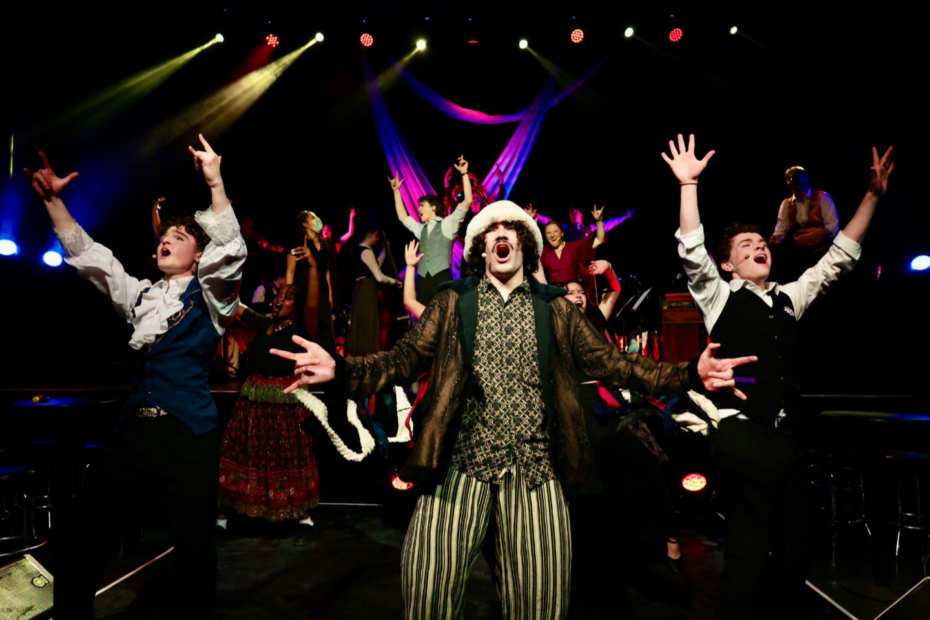
On the coldest weekend of the year, in what felt like -32℃, I had the pleasure of going to see this year’s Arts Undergraduate Theatre Society’s (AUTS) musical, Natasha, Pierre and the Great Comet of 1812. The musical was written by American playwright Dave Malloy, who adapted a 70-page segment from Tolstoy’s War & Peace (1867) into a thrilling, vibrant electro-pop opera. Opening on Broadway in 2016, the show was nominated for 12 Tony Awards that year, winning two.
The play follows the young and newly-engaged Natasha (Claire Latella, U1) and her cousin Sonya (Miranda De Luca, U3) as they arrive in Moscow while Natasha awaits the return of her fiancé from the war. In the meantime, Natasha is seduced by the charming but married Anatole (Frank Willer, U1), and is subsequently carried into a world of scandal and societal ruin. Her last hope lies with Pierre (Sam Snyder, U4), a lonely outsider who finds love and compassion for the lost Natasha. Natasha’s search for love and finding her way in the world is reminiscent of the period of self-discovery of many university students. This makes it possible to recognize yourself in Natasha, even though she is living in a different moment in history.
The show’s immersive qualities are what really made it special, especially for the select audience members who were chosen to experience dance sequences on stage with the cast. Even those sitting in the balcony were included in the performance, with the actors running and dancing up the stairs. The musical made use of every possible part of the theatre, and seeing actors singing and dancing just a few seats away in the aisles of the balcony made the experience feel immersive. This also ensured that every single audience member was in on the fun.
While the show is full of exciting and celebratory moments, there are also beautiful, somber passages. Natasha’s solo, “No One Else,” was made especially captivating because of Claire’s remarkable vocal performance. The cast’s all-around professionalism drew you in from start to finish. Not to be ignored, the incredibly talented band played center stage for the entire show with almost no break.
For audience members familiar with Tolstoy’s War and Peace, they will recognize that the passage adapted for this musical takes place in a privileged society about to be brutally interrupted by the Napoleonic invasion of Russia. There is an underlying sense of tension and impending change. AUTS’s interpretation of Natasha, Pierre and the Great Comet of 1812 was not only a ray of warm sunlight during a cold winter day, but also a piece of art that prompted audience members to reflect on their own lives as well as the world around them.
The Daily sat down with some members of the cast and creative team to discuss the production further. I had the pleasure of interviewing Milan Mivill- Dechene (MMD), the musical’s director and choreographer; Leila Khelouiati (LK), the props designer; Sam Snyder (SS), who played Pierre; and Claire Latella (CL), who played Natasha. The following interview has been shortened and edited for clarity and conciseness.
Sophia Pinzari for The McGill Daily (MD): How was it adapting a recently-made Broadway show? What did you change or keep the same from the original production?
MMD: There are really cool elements that have come to be associated with the show, like the immersive qualities and actors that are running around the entire space. It was exciting to think about different ways we could challenge staging conventions and embody the experience that Dave Malloy had when he was at a club in Russia, and there were people running and dancing around him, eating pierogi. What was exciting for me was getting to do the show with a group of younger people. Natasha and Sonya are arriving in high society Moscow, like how we arrive at university with all these high aspirations. Throughout it, we drink and party; but we can also lose ourselves, find ourselves, and grow in different ways.
MD: As one of the production members, are the props and set true to the era, or a more modernized vision? How did you go about finding the props that you need?
LK: Milan’s vision was a blend of modern and period, so it was hard to find stuff that mashed the two together. One aspect is the envelopes. Obviously, paper is very white. For older times, you need more aged-looking paper, so it’s all been tea-dyed to make it look vintage. I mostly source my props from Amazon because it’s quick, but I did go to different McGill theatre groups and the Seagull Center for Performing Arts, which had this amazing warehouse of props where I got to hang out and find some things.
MD: What was your process in finding your characters?
CL: [Natasha has been] a bit of a dream role of mine, so getting to come up with my own take on [her character] has been exciting. It’s also been fun working with the other actors, seeing their interpretations, and working out our ideas of the characters and their relationships with each other together. We get to make our own version of the show, which is really fun.
SS: I have to agree, the cool thing about Comet is it really does feel like an ensemble piece because everybody is singing all the time and is constantly on stage helping create the story… so it’s been interesting to find where your interpretation of your character fits within the ensemble. It can be easy to gravitate towards simple answers for why characters are doing things, so looking at it from a wider angle has been interesting.
MD: How has doing the musical here at school added to your experience at McGill? And how is it managing to prepare for performances while also being full-time university students?
CL: Specifically, this year, I can’t imagine not having done this show. It’s obviously been a big-time commitment, but one that I had zero regrets about. It’s a process that makes the year for me, and I don’t know what I’m going to do in February [when the musical is over]. When I have a day full of classes and then rehearsal, that’s what I look forward to. I can’t imagine McGill without it.
SS: This is my third year with AUTS, and it’s made my university career for sure. It’s unique. I’ve had the immense privilege of doing other shows on campus, but with something like AUTS, the process is so long from September through to February, so it’s been really fulfilling to be able to stick with the character and show and to be able to refine and refine. In terms of time and pressure…what a fun problem to have.
MD: Even though the show is set in 1812 Russia, what message do you think the show has for today’s world, especially for the students who will be watching it?
MMD: There are a lot of parallels between the present moment we’re living in and back then, especially in terms of political unrest. Right after the show ends, the book keeps going, and Napoleon’s invasion happens, everything crumbles, and the city is burned. So we have this tension between this really lavish lifestyle that these characters are living and everything that’s about to crumble. It begs the question of how we are spending our time and living our days. I think the way we approached this is the image of the broken time machine — we have these two time periods happening simultaneously, but the more modern elements allow us to jump into these moments with the characters easily.
SS: The source material has major themes of young love and finding purpose, and I think everyone watching will have some sort of point of connection to what they’re seeing on stage. I think most university students can lament a failed situationship or a terrible breakup, or a confusing time in their lives where they weren’t sure what they wanted to be.
AUTS ran six sold-out showings of their production of Natasha, Pierre & The Great Comet of 1812 from January 26-31 2026.