

Spoilers ahead!
The most recent addition to Rian Johnson’s Knives Out franchise, Wake Up Dead Man, shows Daniel Craig reprising his role as detective Benoit Blanc, who visits a neo-Gothic church where this film’s victim, Monsignor Wicks (Josh Brolin), was murdered. Like the two previous films, we are presented with an ensemble of characters who were close to the victim and were present at the time of his death. The ensemble consists of Father Jud (Josh O’Connor) as well as a small group of Wicks’ devoted supporters who remain by his side despite his extremist behaviour and off-putting nature.
Let’s begin with the positives. Films — especially murder mysteries — are only as strong as their characters. I believe that this film created two characters who were well-rounded; namely, Father Jud and Benoit Blanc.
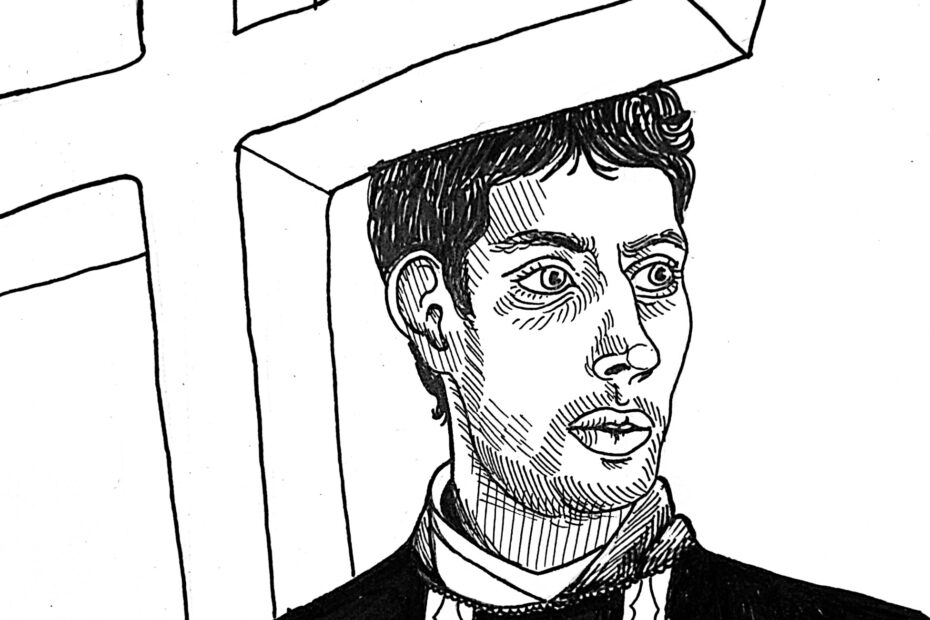
Father Jud especially is a convincing suspect the entire duration of the film: a boxer turned priest who turned to religion after accidentally killing a man. He comes to the church to revitalize it, yet he immediately distrusts Wicks. The two men don’t get along, as Wicks leads aggressive church services that effectively scare away new parishioners. Father Jud recognizes Wicks’ flaws, as well as the church’s flaws, and is dedicated to changing how things are run, even if it means making an enemy of Wicks. When Jud is accused of murdering Wicks, he still does everything he can to help those around him. In one scene, he puts the investigation on hold to talk to a distressed woman, Louise (Bridget Everett), whose mother is dying. Rather than focus on clearing his name, Jud instead spends hours talking to Louise and praying for her mother. Despite his own troubles, Jud remains a caring man dedicated to being there for the people around him. He represents the ideal hospitality of the church, accepting everyone who walks through its doors and doing his best to remain patient despite the obstacles being thrown at him.
Similarly, Benoit Blanc was also given room to thrive, as shown through his relationship with religion that develops over the course of the film. At first, he cannot understand the benefits of a religion that has a history of exclusionary practices. As the film moves forward and Benoit works alongside Jud, he begins to understand why people turn to faith in difficult times. He is present for Jud’s conversation with Louise and becomes aware of how benevolent the members of the church can be to those in need. By the end of the film he is a believer: not in God, but in Father Jud and his caring nature.
Despite the film’s success in its development of characters such as Father Jud and Benoit, it is not as successful in its characterization of the rest of the ensemble. Potential suspects are not fully fleshed out , namely Vera (Kerry Washington) and Lee (Andrew Scott). The film spends so much time and energy on the protagonists that it cast aside many of its side characters, despite the fact that they too were suspects in the crime at hand and played by various famous actors.
Namely, Vera’s storyline is never properly handled or developed, even though she was one of the few who ended up speaking out against Wicks, condemning his harmful treatment of others. Despite the gravity of this, her rebellion does not go any further, and she is never convincingly portrayed as a possible suspect. Instead, after her brief moment of defiance, she retreats into herself and is shown alone in a dark room, smoking a cigarette. Vera sitting practically motionless in this scene seems indicative of how the writers seemed to give up on her character. Rather than playing an active role in the remainder of the story, she is left in the dark, with no other purpose but to stare off into the distance. She should have been given a more meaningful conclusion, or at least a more potent contribution to the events of the narrative. While she does receive fifteen minutes of relevance when condemning Wicks, her fall from the spotlight lasts the entire second half of the film.
Lee is another character whose story was ill-conceived from the start, with his role somehow even less significant than Vera’s. Viewers are told he is a failing author who is writing his comeback novel, which is basically the only thing we learn about him throughout the entire film. Every other time he is on screen, he either contributes very little to the plot or is doing unhinged and inexplicable things, like building a moat around his house. He is not close to Wicks, nor is he given any motive that would lead him to commit the murder. In short, he does not advance the narrative in any way and is not necessary to the story.
It seems like this film created more characters than needed and did not spend enough time developing equally significant character arcs for all of them. They simply threw together an ensemble for the sake of the plot without fleshing out many of the characters into the story. The murder mystery aspect of the film was not very compelling, since half of the suspects seemed to have no clear motive and their potential guilt was seemingly disregarded by the screenwriters themselves. As much as I adored this film, it could have either spent more time developing the characters or gotten rid of some of them altogether, therefore providing the audience with more convincing suspects and a balanced story.