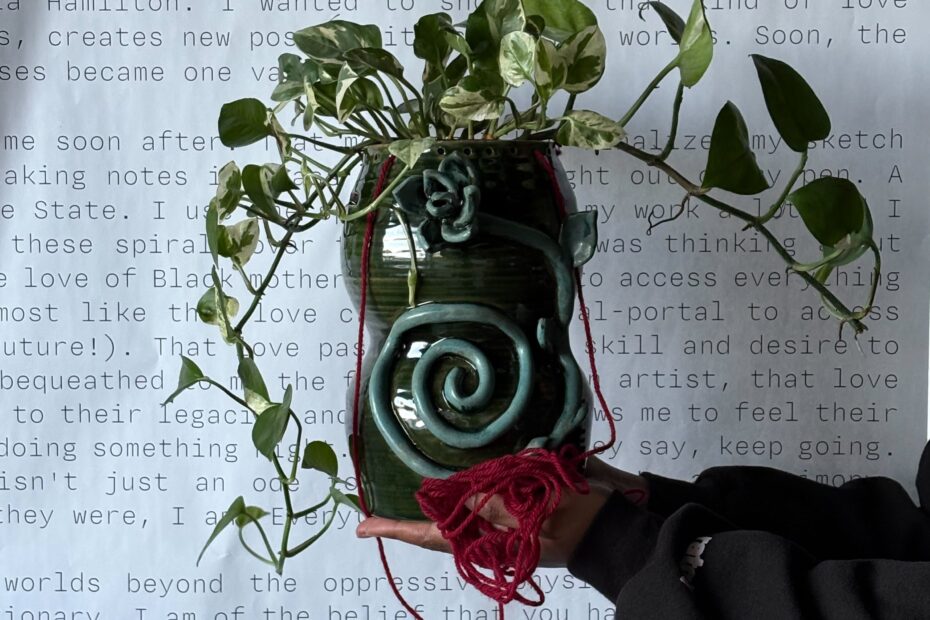
Evelyn Logan is a Tiohtià:ke (Montreal)-based artist originally from Georgia, U.S., whose work revolves around pottery, ceramics, teaching, and writing. They are also a former Culture Editor at The McGill Daily and a current team member of Scatterbrain magazine.
I first met Evelyn at a Daily outreach event in September 2024. It was my first month at McGill, and I had been eager to find a new writing community. At the office, I entered a welcoming space that would end up becoming my new little sanctuary on campus. There, I also met Evelyn. They were inviting, stylish, and had a buzz of warmth around them that made me feel as if we already knew each other. As one does after meeting someone new, I followed Evelyn on Instagram that evening and was not the least bit surprised to find out that they were an artist. Since then, I’ve been quietly keeping up with their work: liking their posts, reading their blog, going to a few pop-ups, and supporting their endeavours from a distance. But when they completed “A Portal to the Free State,” their newest ceramic artwork, I was touched so profoundly that I knew it was time to finally put on my big girl pants and reach out to them again.
“A Portal to the Free State” is one of Evelyn’s most ambitious projects yet: an earthen-green ceramic vase with a lighter, tea-green spiral at its centre. The vase sits atop a large piece of cotton with the title of the work embroidered in a fine red floss. Charms, representing the women in Evelyn’s family, surround the fabric. The piece was first displayed on December 13, 2025, at Scatterbrain’s “cocoon/chrysalis” showcase, with an artist’s statement stating that it aimed to “show the love that Black women pass on to their daughters.” Evelyn believes this love between Black women is a “kind [of love that] preserves, teaches, creates new possibilities and new worlds.” I spoke to them about how “A Portal to the Free State” can take us into one of those worlds.
This interview had been edited for clarity and conciseness.
Ingara Maidou for The McGill Daily (MD): Before we delve any deeper, could you try to explain how “A Portal to a Free State” came about?
Evelyn Logan (EL): I was taking this class called “Race, Gender, and the Practice of Power (HIST 429)” with Professor Melissa Shaw. In that class, we were examining Black women, Black marginalized people, and the way that they show up in historical records. Something that came out of that class was me realizing that there’s such a huge depth of knowledge that actually isn’t present in the archives, but that comes from my ancestors, and all the people that came before me, and that I have within me.
Something else that came out of that class was the idea of a free state. I’m not very religious, though I was raised Christian, and I think there is this idea that, with all of this insurmountable oppression that Black people face, there has to be something else out there. There has to be another space, or mindset, or way to access the loved ones that you’ve lost — but also a way to access all of that knowledge, beauty, and power that comes from being Black. So I guess that’s kind of what the project was born out of.
MD: By being a student at university and having been raised in the church, do you feel as if those structures, where knowledge is transmitted in such particular ways, influences the way you go about your art?
EL: I think for me, there is always going to be that tension there. Especially because, since moving to Montreal and starting university at McGill, I have become more disconnected from the church (but not necessarily from spirituality in that sense). So I think when I look at my art practice and the various things that I’m researching, I always want to get to other voices, not necessarily just the empirical sources. I will use Instagram, Twitter, and oral histories because there are so many barriers to higher education and to being published, or even just getting your voice out there. For me, it’s more about trying to genuinely listen, and not just hearing the loudest voices.
MD: I read your artist’s statement, where you talk about how your mom, your grandmother, and your great-grandmother all influenced this project. Tell me about these women — what are they like? What qualities of theirs did you admire?
EL: So on my mother’s side, there’s my mom Pamela, and her mother Cleo, and my mother’s two grandmothers, Meroe and Cora. I never knew my mom’s mother, as she ended up getting Alzheimer’s and then passed when I was a bit younger, but I’ve learned so much about her through this project and by asking my mom everything there was to know about her. Cleo was a schoolteacher, and she was very involved in the community. My mom recounted all these times where Cleo would drag her to the elders in the community to visit them, talk to them, or cook for them, and how my mom would help set up her classroom. Cleo was extremely loved and well-known in her community because she was very involved. Another thing that stuck out to me about her is that she was a seamstress. She sewed so well that she would often sew not just for my mom, but also for other mothers and children in their community in Maryland. That really stuck out to me because I’ve always wanted to learn to sew.
Cleo’s mother was Meroe, and Meroe was alive during sharecropping. She wasn’t a sharecropper, though. She owned a store, which was kind of crazy because at that time most Black women were doing domestic work, or they were working in fields, or maybe they were teachers. My mother’s other grandmother, Cora, was a domestic worker. She worked throughout Mississippi nurturing people, taking care of kids, et cetera.I guess something that I got from all of them is this teaching spirit, which at first I was very proud of. Then for a while when I thought back, I didn’t know if I should be as proud of it, because teaching was one of the only jobs that Black women could do back then. But now I’m like, “Yeah, should I be proud of that!” because to have gotten that skill and that passion passed down…that’s special.
MD: Why ceramics and tangible art?
EL: I started doing ceramics when I was in early middle school because I wasn’t very into sports. I needed an after-school activity, and I had tried painting, but I didn’t like that and I wasn’t very good at it. So I was like, “Let me try this.” Um, or not me, my parents were like, “You’re gonna try something else.” I think it kind of stuck with me, especially because [making] ceramics is such a process. — you start with wedging your clay, and then you’re putting it on the wheel, and then you’re shaping it and centring and doing all these other things. What’s so important for me about tangible art is the touch. To form something like that from your brain… it takes quite a while to be able to make what you envision. But I love the experimental aspect of it, and I love the tactility. I was in a period of my life that was already quite rough. Then we went into COVID, and I felt very isolated as well. So being able to have something that was just mine felt so special and unique to me. I just fell in love with the idea of being able to make something, which I didn’t have in any other part of my life. Even when I was feeling so shit, if I just had my headphones on, and was just touching the clay, I could be chasing that moment where I would be pretty much centred. I would centre with my eyes closed, because it helped me focus on the feel. I guess it’s almost like prayer…I’m not religious, but I’m still very spiritual, and it’s almost like prayer.
MD: One thing I’ve always enjoyed is how much you bring us along in the process of your work, for example with the unglazed pieces you often post. Those photos always gave me a bit of a whimsical and youthful feeling, a bit like watching clay-motion animation. So when you referenced Nathalie Batraville’s face jugs as one of your inspirations, it all started to click for me, this love for the imperfect. Therefore, I wanted to ask: what called you to document the process of making your art, and not just the final product?
EL: Well, that’s what I love the most about it: the documenting. Also, I love Natalie so much. She’s so talented. I’m a good glazer, but I’m not good in the sense that when I’m making a ceramic piece, what is in my head will just come out, which is very frustrating. So I always joke and say that, when I glaze a piece, it’s ruined. But that’s not actually why I don’t post my finished pieces. It’s just that I like the process so much better. I’d been doing ceramics for a long time before I decided to make it a career, and for a while I just got really caught up in having pieces done immediately. I feel like when you start producing content, you always have to be having something new come out that’s finished and good. And I didn’t want myself to stay in that mental hole, because I was totally in the hole. So now I’m trying to get myself to focus on the process, which also helps me get better. I’ve noticed I get so much better when I can focus on that. I find the process much more enticing now than a finished product, because there’s just so much more that you learn and so much more beauty in the process.
MD: Where do you throw? Could you tell me a bit about your studio?
EL: Studio 3 Tables. It’s the best space ever. It’s in this old mattress factory, and it’s an all BIPOC studio, which is super important because pottery is so white. I think most of the art world is white, but pottery is so white. So it was crazy for me to have found this space on Instagram.
When I joined 3 Tables, I mentioned how I was interested in teaching, and the owner set me and another person up to teach, and they mentored both of us. That was such a good experience. I had my own class this past fall, and I was just beyond happy. Everybody’s so sweet, and it’s just so special because we love this specific craft and we’re all friends. I’m still getting to know everybody because I haven’t even been there for a year yet, but it’s so warm and fuzzy. It’s also been so inspiring, because everybody is so talented. And I feel like every time I step into this space, I’m ready to learn.
MD: Talk to me about your previous ceramic sculpture series “HeLa”, inspired by Henrietta Lacks’ contributions to cancer research. Did that series influence “A portal”?
EL: I always wanted to do a project about Henrietta Lacks. How many lives is she saving all the time? How much money are these pharmaceutical companies making? Her family’s not seeing any of that. At the time that her biography (The Immortal Life of Henrietta Lacks) was written, her family was living in poverty. That’s so fucked up. That’s why I wanted to make a project about her. And then when I got the opportunity to do “A Portal”, I was thinking I’d continue not only the work that I was doing in that class, but also building upon the “HeLa” series. I want to keep making people think about Black women in a different way.
MD: I feel that Black identity and perceptions of Blackness operate in such a dynamic way. What differences have you noticed between navigating the world as a Black person in the U.S. compared to Canada?
EL: In Georgia, where I went to school, I was considered “lame” because I was just very nerdy. I loved what I was doing, but I was so lame. Then, when I came to McGill, all of a sudden everybody thought I was really fucking cool. They think I’m the coolest person ever, and they all want to be my friend because I’m so cool, which is just because I’m Black. Here in Montreal, if you’re Black? You’re cool. But in the States, especially in the south, there are so many Black people that you can be lame, you can be cool, you can be nerdy, or all these different things.
Going into McGill, I told myself:, “I’m gonna make all of the Black friends.” But I really struggled because I didn’t feel like I connected with Black Canadians. And when I would meet people who were from Africa, or Francophone countries, they would ask, “Well, where are you from?” I would say, “Georgia,” and they would be like, “No, girl, where are your parents from?” Then I would say, “Ontario and Maryland.” And they’d ask, “Why don’t you know where you’re from in Africa?” And I just said, “Oh, slavery.” It just felt like people here were Black in a different way that I hadn’t really interacted with, because even though I knew a lot of people in the States that were first-generation or second-generation African immigrants, they still saw themselves as Black American and not necessarily, like, Nigerian-American. So it’s different.
MD: In your artist’s statement for “A Portal”, you describe learning how to have faith in the idea of another plane or world. For yourself, what does this “Free State” look like?
EL: When I think about it, practically, it’s just a world where you’re not forced to choose against your morals. I broke my laptop, but I don’t want to buy a new one because it’s an Apple laptop and I don’t want to support all of their mining practices in the Congo. But if I need to write an essay, I can’t write it on my ass, you know? In a world where people who look like us — Black people — are suffering and constantly discriminated against, it’s even hard to find a way around that without creating more harm. So, I picture a world where you can just live and not harm anyone, where you don’t have to be anxious or stressed, and nobody is policing you, and you’re not policing yourself. What do I think it looks like in a fantastical way? It’s just lots of green things, and you can just be. There’s universal income, and there’s universal healthcare, and you don’t have to worry about your body or what you need to do to make it work. You can just live.
I struggled with writing the artist’s statement for “A Portal”. I’m worried that I wrote it in such a way that I wasn’t conveying that I believed things can be changed. The fact that I can even have this idea means that things can change, and it also means that you can change them for yourself and for your friends and family. So I didn’t want it to sound too imaginary. I didn’t want to fuel any kind of nihilism, but I also think it’s very valid specifically for Black people to have. What I wanted to infuse in the project was that while you’re reflecting on the people that came before you, and you’re getting to that place and revelling in the fact that you came from something, you can take that power and create your free state. Not just so that you can access that free state from far away, but so you can bring it here. You can bring it here. So yeah, I guess that’s what it looks like for me.
More of Evelyn’s work can be found on their website or their Instagram pages: @ev_irl & @studios_irl