

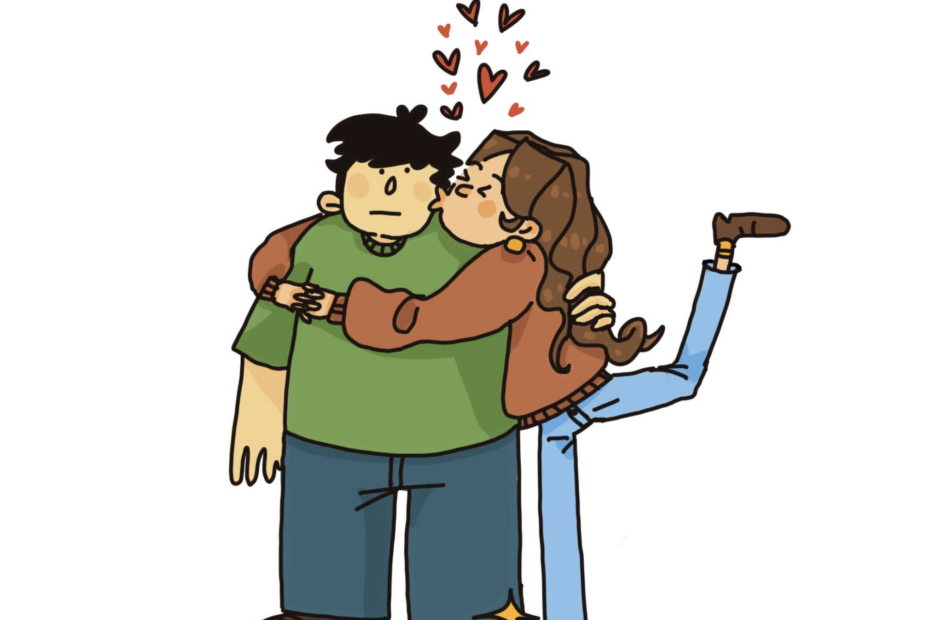
Chanté Joseph’s “Is Having a Boyfriend Embarrassing Now?” has, for the past couple months, been the topic of discourse both in-person and online. In the British Vogue piece, Joseph explores the subject of boyfriends and their modern roles in relationships, especially the role they now play on social media. Heterofatalism, a term described as a “general disappointment with the opposite
sex,” is a root cause to the modern belief that boyfriends cause more harm than good. Throughout her article, Joseph observes that, among single women and those with significant others, there is a belief that having a boyfriend is something to feel guilty about.
While she suggests that boyfriends are widely seen as embarrassing, the true focus of Joseph’s article is that heteronormativity is being challenged in the modern day – causing the concept of the boyfriend to now be fragile. This is because women don’t need to center men to succeed anymore.
Historically, being tied to a man was considered desirable for women. Others looked at you with great accomplishment for having a husband or a boyfriend. On the other hand, if you were a single woman, people pitied you. Take a look at Sex and the City; the entire show is about single women who are constantly being looked down upon by other couples and always in search of a new relationship. The goal of a long-term relationship rules the main characters’ lives.
Romantic relationships have long been deemed necessary to live a fulfilling life; craved because of the comfort of mutual dependence. On the one hand, Joseph mentions that being single, though, should be treasured because it allows for more independence than being a woman in a relationship. On the other hand, it’s not that a woman cannot be independent while she’s in a relationship. She should have the autonomy to do what she wants, including being in that relationship. Yet, it’s also important that we recognize that many women now have the privilege to achieve what they want without the imposed necessity of a romantic relationship.
During most of the 20th century, a woman would have needed to be married to have access to fundamental rights in the United States. For example, it was only with the Equal Credit Opportunity Act of 1974 that an unmarried woman in the United States could open a credit card in her own name. In addition, unmarried women did not have access to birth control until the 1972 Supreme Court case Eisenstadt v. Baird. In other words, rights we now take for granted were not accessible for single American women before the 1970s.
Across the world, countless women still lack access to these basic rights. Millions of women do not have the right to participate in society without being bound to a man. In Afghanistan, women’s access to healthcare is dwindling. Hologic’s Global Women’s Health Index determined that “relatively few Afghan women reported getting tested for high blood pressure, diabetes, cancer or sexually transmitted diseases or infections (STDs/STIs) in the 12 months prior. In fact, no Afghan women — zero respondents — said they had been tested for any type of cancer in the past year.” Additionally, in 2021, Taliban authorities made it mandatory for women who are travelling more than 48 kilometres be accompanied by a male guardian. These women suffer from a lack of care and autonomy in controlling their own health in comparison to the Western women. Instead, their health is at the responsibility of the men who surround them. This is also true regarding their economic independence, as less than 7 per cent of Afghan women have a bank account. The United Nations estimates that, worldwide, 43.7 per cent of women “lack decision-making power over their sexual and reproductive health and rights.” In many countries, not just Afghanistan, women are being denied their rights and have to depend on a man to survive. Joseph’s original article questions women’s reliance on men, and allows us to address the cultural differences and privileges that come with being single and being able to denounce having a male partner. However, the power to decentralize men is not something that every woman has had or will have the privilege of doing.
In a world where we are continuously fighting for our rights purely because of our gender, at the very least, it’s comforting to know that women, more so in privileged areas of the world, don’t have to be associated with a man to succeed. If you have or want a boyfriend, there’s nothing wrong with that. As Joseph made clear, having a boyfriend is only embarrassing if you center your life around him. Moreover, being a single woman is something that is now treasured rather than looked down upon. According to Joseph, being single isn’t an achievement, nor does it “affirm your womanhood” anymore. The status of being single is being reclaimed, and is now associated with freedom and choice.
To continue on Joseph’s point about centering one’s life around a man, whether single or in a relationship, a woman can be male-centered, which is the primary condition being criticized in her article. Being male-centered may consist of solely posting your boyfriend on your social media, making decisions based on the needs of men, or consistently seeking male validation and attention. It can become a problem because, as one Medium blogger put it, needing a male’s approval for your decisions “puts your self-esteem in someone else’s hands.” In relationships specifically, being male-centered is when a woman “constantly puts her partner’s needs and desires ahead of her own.” It’s harmful to her autonomy, outlook and participation in relationships.
But instead of blaming women for this mindset, we should blame how patriarchal society has
conditioned women to believe that they need a man to live happily. While being male-centered is a condition that can be avoided, it’s not easy when society is pushing you to get and keep a man romantically in your life.
It shouldn’t be inherently embarrassing to have a boyfriend, so long as he does not become the center of your world. Thus, the current shift away from boyfriends stems from an active attempt to decentralize men. Unfortunately, this debate still centers men, because while we are talking about the decreasing value of the boyfriend, we are simultaneously faulting women for being with men. If we want to truly decentralize men, we need to move away from the concept that a man is needed to make your life better whilst also not making them the center of our conversations.
Having said that, we can still recognize that many single women are now much more capable of claiming their independence compared to our past counterparts. While this doesn’t cover all women in the world, as many are still stuck depending on men, it is still a reflection of our changing society and the questioning of heteronormativity and the patriarchy.