

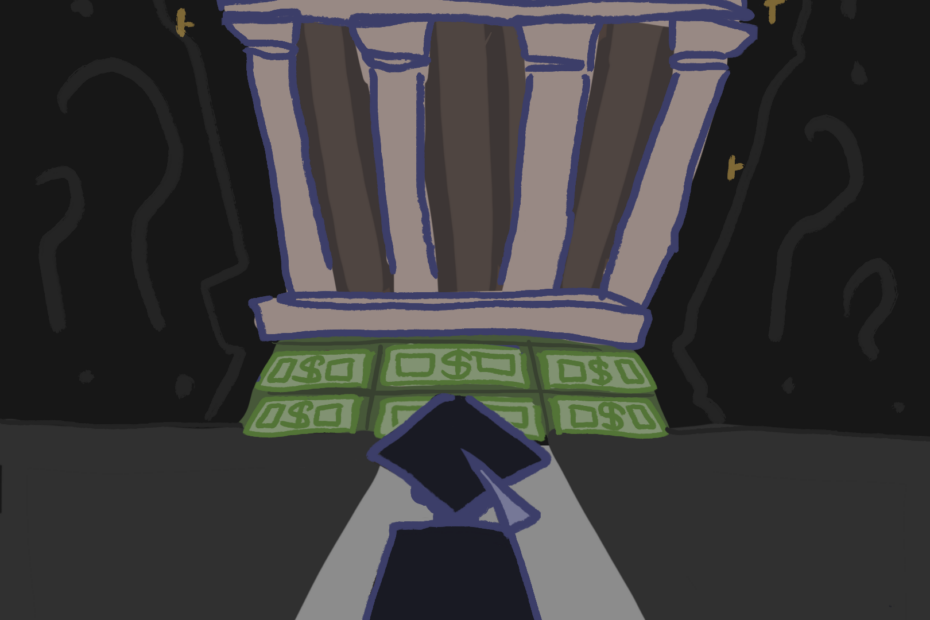
For many undergraduates approaching the end of their degrees, the question of graduate, medical, or law school has shifted from a personal consideration into a shared social expectation. It surfaces in casual conversations, family check-ins, and the quiet comparisons students make while watching peers announce acceptances, internships, or job offers. “What’s next?” is often asked with harmless curiosity, but it can land like an evaluation — one that assumes a good student should already have a clear answer.
That expectation is partly rooted in reality: further education is common, and it is often associated with increased opportunity. Statistics Canada’s National Graduates Survey (Class of 2015) reports that 40 per cent of graduates pursued further post-secondary education after graduation. When a large number of your peers choose to keep studying, it becomes easy for graduate school to feel less like one option among many and more like the default route for anyone trying to stay competitive.
At the same time, the financial stakes of continuing on are harder to ignore than they used to be. The same Statistics Canada infographic notes that among graduates who did not pursue further education, half had student debt at graduation, with an average debt of $24,000. When debt is already present, committing to additional years of tuition, fees, and living expenses can feel like stepping deeper into a seemingly endless financial tunnel.
McGill’s own tuition information reflects that rising- cost context, stating that Quebec’s basic tuition rate for 2025–26 is expected to increase by up to three per cent in the following school year. Even if the exact figures vary by residency and program, the trend is clear: education is becoming more expensive, and living costs are rising alongside it. For students who are already stretching budgets, or whose families cannot subsidize extra schooling, graduate studies may be a long- term investment that feels financially out of reach.
Even for students who can afford further schooling, the modern case for graduate school isn’t simply that more education equals more success. The value of an additional degree depends on each student’s circumstances, including the program, the field, and the funding available. Graduate degrees are not universally well-funded, and the opportunity cost can be substantial: years of tuition and living expenses, years spent away from full-time earnings, and, in some cases, time spent in precarious roles that do not guarantee stable employment afterward. Even in fields where a graduate degree improves long-term prospects, the payoff can be uneven, delayed, and closely tied to factors outside a student’s control.
Still, for many students, the appeal of graduate school goes beyond prestige. Graduate programs can offer structured training, specialized expertise, mentorship, and access to professions that are closed without advanced credentials. Employment outcomes can also look reassuring in the aggregate: the same Statistics Canada snapshot reports employment rates a few years after graduation of 91 per cent for bachelor’s graduates and 94 per cent for master’s graduates. For students in fields where advanced credentials are essential, the benefits can be concrete rather than symbolic.
There is also the emotional reality of graduate school, which often gets smoothed over in the glossy version of “the next step.” Graduate training can be deeply rewarding, but it can also be isolating, competitive, and mentally exhausting. A recent Nature feature revisits the longstanding concern about graduate mental health, pointing to research suggesting master’s and PhD students have reported anxiety and depression at higher rates than comparison groups. That does not mean graduate school is inherently harmful, but it does complicate the idea that it is always the safer or healthier option for an uncertain student after college.
If graduate school is not automatically the solution to uncertainty about what comes after graduation, why does it so often function like one? Part of the answer is cultural: in many academic environments, having a plan is treated as a marker of responsibility and maturity, while uncertainty is seen as a flaw. Students who apply to professional programs are praised for being “driven,” while students who want time to work, rest, or explore may be suggested to explain themselves. The result is a sense of superiority attached to certain post-grad paths, where the most concrete plans, the ones that fit neatly into a title, are treated as more serious than others.
Another part of the answer is fear: not necessarily of work itself, but of making the “wrong” first move. When advice from parents, peers, and even instructors boils down to “just get a job”, graduate school can look like a structured alternative with a clear timeline and a recognizable label. For some students, that structure is genuinely helpful. For others, it becomes a way to postpone uncertainty, an expensive pause button disguised as productivity.
Adding to that uncertainty is a job market that feels less predictable for graduates regardless of whether they pursue further education, especially as AI reshapes how “entry-level” work functions. Some of the first tasks to be automated or accelerated by AI have been the very tasks that used to help new graduates get a foothold: drafting, summarizing, basic analysis, research support, administrative work, and early- stage content production. The World Economic Forum has highlighted concerns that AI could narrow entry-level opportunities by changing what employers need from junior hires and by shifting which skills are prioritized. The International Labour Organization’s 2025 update similarly stresses that one in four workers globally are in occupations with some degree of exposure to generative AI, and that most jobs are likely to be transformed rather than eliminated outright. In practice, that means graduates may face a moving target: credentials matter, but adaptability increasingly matters too, and even “safe” career tracks can change shape faster than students can plan around.
The pressure around planning is also not evenly distributed. Students with financial cushioning can treat graduate school as an exploratory option, a chance to pivot or specialize without catastrophic consequences while those without that cushioning have to treat it as a high-stakes bet. International students face an additional layer of unpredictability, as education decisions are tangled with policy shifts, paperwork, and changing requirements. Canada’s study permit cap and the related provincial and/or territorial attestation process has added another moving piece to an already high-stakes decision, increasing uncertainty for many prospective students about timing and eligibility. Even when policy discussions are framed around system capacity, students can be left feeling that long-term plans are increasingly subject to forces outside their control.
This is where the debate becomes bigger than individual preference. The question is not only whether graduate school is “worth it,” but also whether it is reasonable to expect every graduating student to have a fixed post-graduate plan in a world where costs are rising, pathways are less linear, and external conditions can reshape possibilities quickly. When certainty is demanded in unstable conditions, students may feel pressured to project it: applying to programs they feel lukewarm about, presenting tentative decisions as final, and keeping their uncertainty private. A more realistic culture would hold space for different timelines and alternate definitions of success, without treating one route as inherently more legitimate than others.
With that in mind, graduating students should be encouraged to think ahead. The real issue is the tone of that encouragement: whether it sounds like support or surveillance. “What’s next?” can be an invitation to reflect instead of a demand to prove one’s worth. When the conversation becomes a test, it encourages fear-based decisions. But when it stays as an unbiased check-in, it helps students make choices based on best fit, resources, and their long- term well-being.
Graduate school should remain one option among many, neither a default badge of ambition nor a cautionary tale. The most honest approach is also the most human: recognizing that planning is a process, that uncertainty can be daunting, and that a life after college does not have to follow one approved script to be legitimate.