

Content warning: mentions of sexual assault
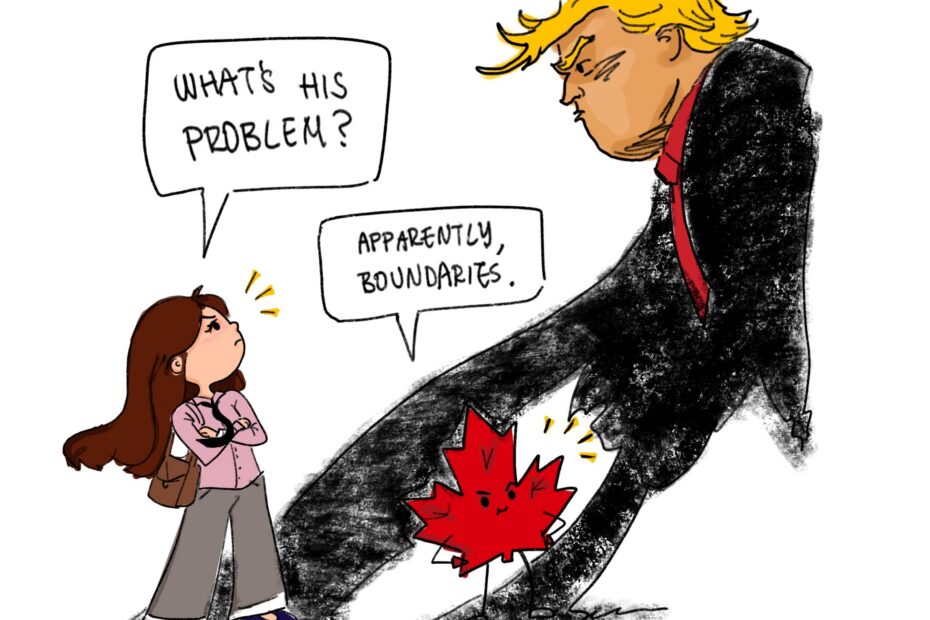
In an essay opposing the Canada-US Free Trade agreement of 1987, writer Margaret Atwood wrote “Canada as a separate but dominant country has done about as well under the US as women, worldwide, have done under men; about the only position they’ve adopted toward us, country to country, has been the missionary position, and we were not on top.” Notably, Atwood expressed similar ideas in her 1972 guide to Canadian literature Survival, in which she posits Canada as a metaphorical rape victim of the United States. Exposed to Atwood’s writings in lecture this past week, I was shocked at their continued applicability. As the trade war between the two nations continues to make headlines, and Trump himself faces new sexual assault allegations, I start to see that Atwood was on to something very real and continuously relevant.
On October 25, at a campaign rally in Port Huron, Michigan, Trump said the trade war would end “soon.” Trade with Canada has been one of the Republicans’ sorest spots in the polls, and an issue that many American voters have at the forefront of their minds as they head into the upcoming midterm elections. A Pew study in July 2026 found that 60 per cent of Americans disapproved of tariff increases, while only 37 per cent approved. At the campaign rally in Michigan, Trump described Canada as “willing to give us anything at this moment.” This past summer Trump also said, “We don’t need anything that Canada has…but they need everything that we have.” The note of sexual dominance in Trump’s language is palpable here.
While Trump’s history of sexual assault remains either a point of indifference or disillusionment for many of his followers, it has never had nearly as large an impact on Trump’s popularity as any economic policy he has implemented. It is public knowledge that 28 women have accused Trump of sexual assault or rape since the 1970s into the 2010s; including his first wife Ivana, who claimed in their 1989 divorce deposition that he had physically and sexually assaulted her, and writer E. Jean Carroll, to whom Trump was found liable for $5 million in sexual abuse and defamation damages in 2023, and another $83.3 million in further defamation charges in 2024. Trump is also accused of significant involvement in Epstein’s child trafficking network, with sources such as CBC reporting that his name is mentioned at least 1,500 times in the initial files, and sources including The New York Times reporting this figure as being closer to 38,000, when the search terms were extended.
Many of us have also seen the abhorrent video from Access Hollywood in 2005 in which Trump says, “You know I’m automatically attracted to beautiful women… I just start kissing them. It’s like a magnet. Just kiss. I don’t even wait. And when you’re a star they let you do it. You can do anything … Grab ’em by the pussy.” As uncomfortable as it is to contend with this quote, when read closely, it bears uncanny resemblance to Trump’s ways of speaking about Canada. The American President views both women and Canada as fragile, weak, boundaryless, belonging to him, for his ravaging. Trump has shown us time and time again that he simultaneously views women’s bodies as property for his taking and he views Canada as a geographic version of the same thing: his for the taking, on his terms.
Not only in Trump’s language of abuse, but also in his language of minimization and retaliatory disparagement, can we draw parallels. In December of 2024, as tensions and counter-tariffs rose from Canada (we were, it turned out, not the pushover he had expected), Trump began referring to former PM Justin Trudeau on occasion as “Governor Trudeau.” This demeaning nickname hauntingly mirrors Trump’s behaviour towards the women he wishes to discredit. Historically, the American President has responded to accusations of sexual assault by refuting the alleged-victim’s attractiveness, and thus claiming a lack of interest. When journalist Natasha Stoynoff alleged that Trump had pushed her against a wall and forcibly kissed her in 2005, the President was quoted as saying “[t]ake a look. Look at her. Look at her words. And you tell me what you think. I don’t think so.” When Jessica Leeds claimed that Trump had violently molested her in the first class cabin of a 1970s flight, Trump called this “fiction,” adding that “[b]elieve me, she would not be my first choice. That I can tell you.” Though these acts of minimization may seem to exist in separate spheres, I see Trump’s intentions as one and the same. Any one who publicly challenges his violence and/or his attempts at control is to be met with degradation and humiliation. Trump gets what he wants, or else he pretends it was not worth wanting in the first place. We can also draw parallels between sexual violence and geo-political menace in the narratives which Trump weaves around his victims, wherein he positions himself as the injured party. At this same campaign rally in Port Huron, Trump claimed that for years, Canada had been “ripping” the U.S. “off” via trade. In September, Trump said “[Canadian] leaders have taken advantage of our stupid leadership for many, many years. They felt emboldened….They act like they’re totally innocent. They’re not. They were very bad. But now they’re being taught a little lesson.” In a similar vein, Trump repeatedly describes his female assault victims as attention seekers set on destroying his reputation. Of E. Jean Carroll, Trump said in 2019, “Shame on those who make up false stories of assault to try to get publicity for themselves, or sell a book, or carry out a political agenda.”
As we have seen, there appears to be no video that can resurface, no picture that can be released, no assault Trump can commit on women that can seriously affect him in the polls. It is not a lack of information, but rather a complete and utter lack of integrity on the part of his supporters. There would be no logic in these women trying to destroy Trump with made-up claims – it does not work. They have no motive other than justice. You do not get praise and fame for accusing one of the most powerful men in the world of sexual assault. E. Jean Caroll understands this all too well. In her memoir, What Do We Need Men For?, Caroll wrote, “[w]hy I haven’t I come forward before now?…Receiving death threats, being driven from my home.. .only to see the man turn it around, deny, threaten and attack… doesn’t sound like much fun.”
As certain tariffs on paper and machinery products from Canada recently rolled back, and Trump makes promises of the end of the trade war, his fear of losing his grip on his domestic political standing in the midterms is palpable. I only wish Trump’s fear was as palpable in response to a proportionate backlash towards his sexual misconduct — a backlash that never manifested into something strong enough to truly frighten him, reinforcing Trump’s belief that women are his for the taking with limited consequences, if any. Atwood argues that Canadian culture is steeped in its victimhood as a result of America’s economic and cultural domination, which in turn fosters a culture of artistic freedom. What art will future generations be producing, what culture is fostered in America, where women watch their rapist elected into power? Both Canadians and women at large have a history of finding cultural roots in defending one’s self, but we also deserve the liberty to find cultural roots that are not rooted in the violence perpetrated against us. Our lives, our culture, our words deserve to be defined by more than our victimhood.