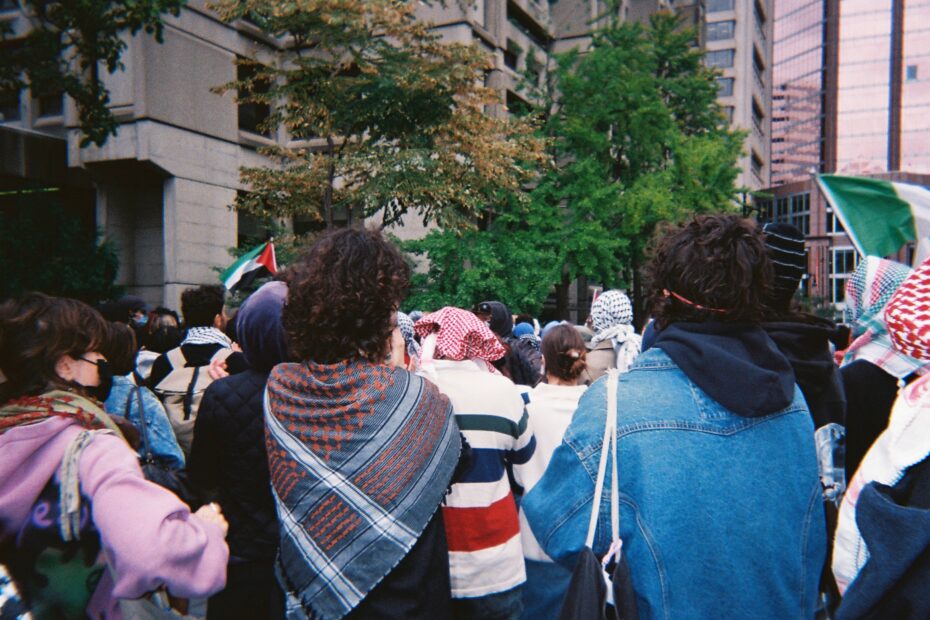
Almost a year ago, 20 departments at McGill organized strikes with four main demands: the administration’s divestment from weapons companies involved in Israel’s ongoing genocide in Palestine, full disclosure of McGill’s financial holdings, the dropping of charges McGill has brought against pro-Palestinian student activists and demonstrators, and cutting all ties in its research partnerships with corporations, institutions, or donors that engage in providing military assistance to Israel. Between November 17 and 21 of 2025, student organizers across the various departments underscored the importance of collective movement, mirrored by the student action that resulted in McGill’s divestment of institutions complicit in South African apartheid in 1985 and the 2023 divestment from fossil fuel companies. Not all undergraduate student associations were able to pass a motion to strike. The Political Science Student Association, for example, needed a constitutional amendment explaining how a general assembly would be called, which led to delays in the organization of a strike.
This year, students are mobilizing again. A petition outlining a motion drafted by McGill student Summayya Kheireddine has been circulating online in student networks. The motion calls on SSMU Senators to advocate for McGill’s exchange program with the Hebrew University of Jerusalem (HUJI) to be “neither renewed nor reinstated.” The petition needs 500 signatures for the motion to be presented at an SSMU General Assembly. Kheireddine told the Daily that “The timeline [to draft the petition] is tight. First, you have to decide what to focus the petition or motion on — this took months of Access to Information (ATI) requests, with considerable delay on McGill’s end. Then you have to write the motion itself, making sure it’s well-researched and substantively founded. Once it’s ready, you submit it to SSMU, where it undergoes further scrutiny to ensure it complies with their governance structures and the law…Once your motion is added to the agenda and SSMU handles its internal process, you start convincing people to actually attend the General Assembly and vote yes. ”
One student organizer told the Daily, “Academic exchange programs with Israeli institutions are designed to give students a curated, positive experience of Israel, whitewashing its occupation and denial of Palestinian rights. HUJI is not just a passive party to this whitewashing: it is deeply entangled with the Israeli military and actively supplies the Israeli Occupation Forces (“IOF”) with material support.” Since 2019, the Hebrew University of Jerusalem has offered the Havatzalot Program, an exclusive three-year double bachelor’s degree with the Israeli Defence Forces to train students to acquire roles in the Israeli Military Directorate. The program has students choose a first major in either Islamic Studies or Middle Eastern studies, and a second in mathematics, economics, philosophy, or computer science. According to The Jerusalem Post, the program additionally offers “basic combat training, officer training, and training in military intelligence and leadership.”
In 2010, McGill strengthened ties with the university to promote future “collaboration and exchange.” McGill and HUJI have since offered an exchange program between the universities for undergraduate and graduate students wishing to study abroad. According to the motion, the universities signed their most recent agreement in 2017, and it is set to expire in 2028. The motion also states that the universities are required to negotiate renewal terms nine months prior to the expiry of the current agreement, which would be by late 2027.
While the exchange program fact sheet for the 2026-2027 exchange year is available on the McGill Abroad website, the page notes that “Travel to Israel is currently not permitted as the region is a Level 3: Avoid non-essential travel on Canada’s Travel Advisories. As per McGill’s policy, students are not allowed to travel to Level 3 and 4 destinations.” The Daily has reached out to the student coordination advisor for clarification on the current status of the program yet has received no response at the time of writing.
This recent petition mirrors the McGill’s Association of University Teachers (MAUT) endorsement of an academic boycott of Israeli institutions signed last October. A statement from the University senate following this resolution stated that, “As indicated, the resolution does not constitute an official University position. It does not affect McGill’s policies. The University is not reconsidering its existing partnerships with any institutions at home or abroad.” While Kheireddine told the Daily that the current student motion is not connected to the MAUT’s boycott, “both efforts draw inspiration from the Palestinian Campaign for the Academic and Cultural Boycott of Israel (PACBI), initiated [by Palestinian academics in the West Bank] in 2004 to contribute to the struggle for Palestinian freedom, justice, and equality.”
Kheireddine calls upon McGill students to participate in the petition and pending motion as well as hold the university accountable for their complicity. “[Our] privilege comes with a responsibility to our fellow students: to uphold and defend the right to academic freedom, particularly when that right is being systematically denied elsewhere. When an institution maintains ties with a university implicated in genocide, operating in part on illegally occupied land, and closely tied to the IOF, that relationship becomes part of a broader question of academic freedom and institutional complicity. As students, we aren’t separate from our institutions, and we aren’t separate from our responsibility to question and challenge the relationships they maintain.”