Exploring what it means to be an artist, by artists
Warning: spoilers ahead.
Interviews have been edited for clarity and conciseness.
On Wednesday, March 26, 2026, the Strand of the Night Theatre’s production of The Seagull, by Anton Chekhov, opened in Moyse Hall. The following evening, I had the opportunity to attend the show and interview the cast; as well as Henry Kemeny-Wodlinger, director and founder of Strand of the Night Theatre. Kemeny-Wodlinger established the theatre company in 2022 to provide young, emerging artists with a platform.
The Seagull takes place at the Sorin estate, where family and friends, many of whom are artists, gather every summer. Over time, scenes of the quotidian reveal a set of complex relationships and struggles that pose disconcerting questions about what it means to be an artist and a human being.
“This play, not to be too reductive, is very much about unhappy people,” I began. Kemeny-Wodlinger leaned back and laughed, “But there’s also very much a comedic element to it. So I was wondering how you balance these seemingly contradictory points?”
“The way that Chekhov does unhappy people: they’re very ridiculous. They’re very, very serious about everything they say, and there’s so much passion in everything they say,” replied Kemeny-Wodlinger. He added that on opening night, the audience laughed more than he thought they would at the uncomfortable moments, perhaps purely out of discomfort. Kemeny-Wodlinger elaborated, “[Chekhov] tears down those traditional, uncomfortable or cathartic places. And if it’s an uncomfortable moment, it’s really uncomfortable because there’s a kind of raw violence happening.”
When asked how he got involved in this particular production, Kemeny-Wodlinger recounted his experience with The Seagull, which he had seen for the first time in 2023: “It was the first play that I ever saw where I felt like the characters were saying things that I thought sometimes […] A lot of the characters were artists who were about to go out into the world, about to start making art, and that really connected with me because I feel I’m at the same stage myself. From there, I got really interested in this specific translation of the play [by Simon Stephens].”
As a native Russian speaker who has read the original non-translated text, I was curious about the contemporary nature of the chosen translation. Kemeny-Wodlinger spoke on his choice: “It’s a modern translation set out of time. It’s not really in the original late 19th century, and it’s not extremely modern […] it’s very alive, and it strips away all of the place.” Besides the mention of horses and carriages in Act 2 and Act 4, the play was successful in creating an immersive, timeless setting.
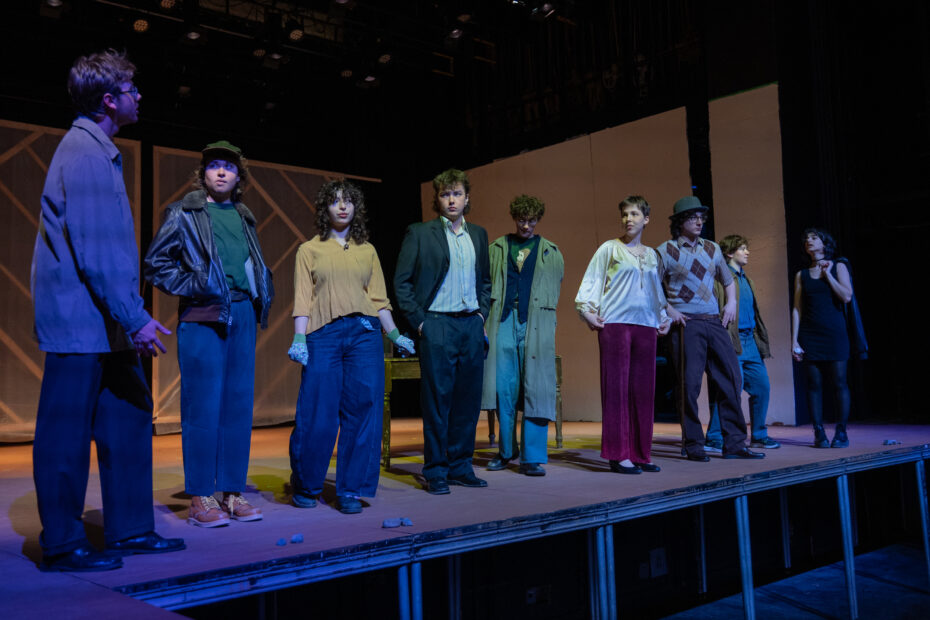
“Some characters dress like they’re from the 80s. Some of them dress like they’re Gen Z. It’s a bit all over the place. And somehow, I feel like it comes together,” said Kemeny-Wodlinger, adding that in working with the costume designer, Sylvia Dai, “there was a certain time period that was the most effective for conveying a character.” This primary focus on the “aesthetic” is evident in Irina’s 50s/60s colorful outfits which are, in my mind, somewhat reminiscent of Emily Gilmore; as well as in Marcia’s 80s leather jacket and emo-inspired look, which ties into the original text’s description of her wearing all black due to her unrequited affection for Konstantin — the protagonist — and detachment from her father Leo (Luca McAndrew).
What I found especially striking about the costumes was how often they changed.
“There’s 36 costumes in the show, one for each character in each act,” says Kemeny-Wodlinger. In Act 2, the characters all either shed layers of their Act 1 attire or put on lighter summer outfits, corresponding to more emotionally vulnerable scenes where the characters remove some of their mental armor. The one exception is Konstantin (Kit Carleton), a young, struggling playwright who is in love with Nina (Noa De Gasperis), the neighbor who has a difficult home life and dreams of being an actress. Konstantin wears the same outfit for the first three acts of the play: jeans and a trench coat. Perhaps this stagnant wardrobe reflects Konstantin’s inability to adjust his perspectives on life and art until years have passed, when Act 4 is set.
Meanwhile, Nina’s clothes become darker and less carefree as the story and her illicit relationship with Boris (Sam Snyder) — a writer in his forties who is in a relationship with Irina (Celeste Gunnell-Joyce) — progress: she begins with her hair down — clad in delicate white dresses, transitions to a blue and white checkered frock, and finally, in Act 4, dons a black turtleneck, jeans, sneakers, and a trenchcoat, with her hair up in a ponytail. Interestingly, the trenchcoat she wears is Konstantin’s, which, according to the script, he has worn “for the last three years.” Whether this wardrobe choice is meant to imply that Konstantin gave his jacket to her, she took it, or that its meaning is more symbolic of how her mindset has shifted to reflect his more cynical one is not entirely clear. Additionally, the modern sneakers Nina wears hint at a shift away from a stereotypically feminine passivity reflected in her dresses, as she takes charge of her life.
Incidentally, the costumes were certainly not reflective of late 19th-century Russia. The modernization of the text, and the anglicization of character names made the production inherently Chekhovian. Historical context and setting matter quite little in Chekhov’s plays, where the universality of the human experience, and especially human suffering, is foregrounded.
This production excelled at bringing that humanity to each scene and character. Irina, for instance, is a famous middle-aged actress and a blatant egotist. Obsessed with retaining her beautiful, youthful image and celebrity, she constantly sabotages her relationship with her son, Konstantin. While her character is amusing, one would assume by these characteristics that she is villainous; yet, Gunnell-Joyce’s Irina is anything but. There are but a few scenes where Irina explicitly expresses vulnerability or affection, such as when she begs Boris not to leave her for Nina or when she bandages Konstantin’s injured head. Nevertheless, these moments are some of the most powerful. Perhaps even more impactful is how the insecurity and humanity displayed in these scenes are subtly expressed in Irina’s character throughout the play. Even though I was familiar with the characters beforehand, I was still greatly impressed by how difficult it was to hate Gunnell-Joyce’s Irina.
While the play could have opened with a bit more energy, it quickly picked up with Carleton’s powerful opening dialogue. Many characters have striking dialogue, made even more compelling by the actors’ choices. One particularly memorable moment was Boris and Nina’s conversation in Act 2, where, as Kemeny-Wodlinger says, “they each exchange very vulnerable monologues about what they want out of life and their fears.” Boris opens up about his obsessive-compulsive behavior, which taints his work. This neuroticism is brought to life on stage through the physicality of Snyder’s performance. Snyder explained what drew him to this character: “He’s a bit of a tough guy to figure out. He goes through a lot of twists and turns, and there’s some complexity there.”
Shea McDonnell, who plays Hugo, shared a similar sentiment in navigating the intricacies of his character. While McDonnell described Hugo as “a well-established doctor” who displays “arrogance” and “very high self-esteem,” he clarified that Hugo is also “not fully secure inside, [and] could be very anxious about certain things.” This insecurity was most openly displayed in McDonnell’s scenes with Pauline, Marcia’s mother (Naomi Decker). Unhappily married to the estate manager Leo, Pauline has a secret affair with Hugo. McDonnell elaborated on this dynamic: “that really is where those cracks begin to show in his relationship, because he’s a very strait-laced, kind of very clinical person, but his big vice is really sex, and […] every time that she tries to make it more serious, he shuts it down and gets really nervous.” At the end of Act 1, McDonnell also brought this vulnerability to the surface when comforting Marcia (Ellie Mota).
Even Peter (Griphon Hobby-Ivanovici), the elderly owner of the estate and brother of Irina, whose main role seems to be comic relief, is anything but two-dimensional. As he grapples with old age and regret, I could not help being touched when Hobby-Ivanovici wistfully delivered the line: “I want to live.”
While this is a dialogue-driven play, especially given that Chekhov provided minimal stage directions, some of the most powerful moments are found in its silences. Boris and Nina share multiple searing stares: the first when they initially meet and shake hands for notably longer than necessary; and again in Act 2, standing at opposite ends of the stage after Boris jokingly mocks her. Additionally, Nina gazes out beyond the audience numerous times: in Act 2, for instance, she smiles off into the distance.
Perhaps most notably, the play is bookended by parallel silent moments. As the play begins, the entire cast walks down the aisles. They freeze in place, spaced out along the rows of seats, and look around at the audience, breaking the fourth wall. Similarly, when Hugo utters the last words of the play, the entire cast, sitting around the dining table on stage, turns their heads to look beyond the audience, falling motionless. This ending’s power is strengthened by the parallel nature of the scene, and its impact is solidified by the meta-quality that rearticulates the play’s themes.
The self-referential aspect of The Seagull is also delved into through the play’s exploration of the human desire to narrativize “disparate events,” as stated in the media release, as well as each of the characters’ unique relationships with art.
When asked where he stands in relation to the different ideas about art offered in the play, Kemeny-Wodlinger answered that he was not entirely certain, but that he agreed with Konstantin’s sentiment at the end of the play: “I often try to mimic a certain genre or a certain form, but what’s the most powerful to me is something that comes from just deep within that. It just naturally flows out of you as an artist.”
Despite addressing these rather abstract concepts, the production manages to keep the play rooted in a sort of ambiguous reality. The set, designed by Claire Labrecque, plays a big part in this. Vines line the front of the stage, and patches of vegetation sit stage-left up front and stage-right in the back. My personal favorite feature of the set is the plastic pink flamingo that appears amidst the plants at the start of Act 2. The real world seeps in again during Act 4, when rays of sunlight shine through the window of the door Nina enters from stage-left. Though some scenes are set indoors, this natural element remains ever present, perhaps calling on a connection between literal nature and human nature.
Another fascinating element of the set is the shrinking of the stage as the temporary back wall is pushed forward with each act. This choice increasingly adds tension to each subsequent scene while also seeming to signify the claustrophobic oppression many characters experience in the Sorin estate.
The background noise, designed by Kyla Resendes, also plays a big role in the set design. The sounds of unintelligible muttering, chirping birds, running water, and instrumental melodies are interspersed throughout the production; sometimes helping to physically place the characters, sometimes intensifying emotional scenes.
Another memorable auditory feature of the play was the overlapping conversations heard while characters moved off stage or out of view. In Act 2, the group is heard leaving the Sorin estate, their voices dissipating as they walk further from the stage; and in Act 4, the family is heard once again, eating and laughing in an unseen room stage-right while Konstantin and Nina reunite. The latter scene creates a stark contrast between the happy obliviousness of the off-stage dinner and the emotional turmoil on-stage. Nina’s separation from the bliss beyond the wall is further emphasized when De Gasperis presses her tear-stained face against the door separating her from the meal and Boris, who left her disillusioned but still lovestruck after ending their affair.
From set design and costumes to stage directions and dialogue, the well-thought-out intricacies of the Strand of the Night Theatre’s production of The Seagull combined to create a profound exploration of the human psyche.