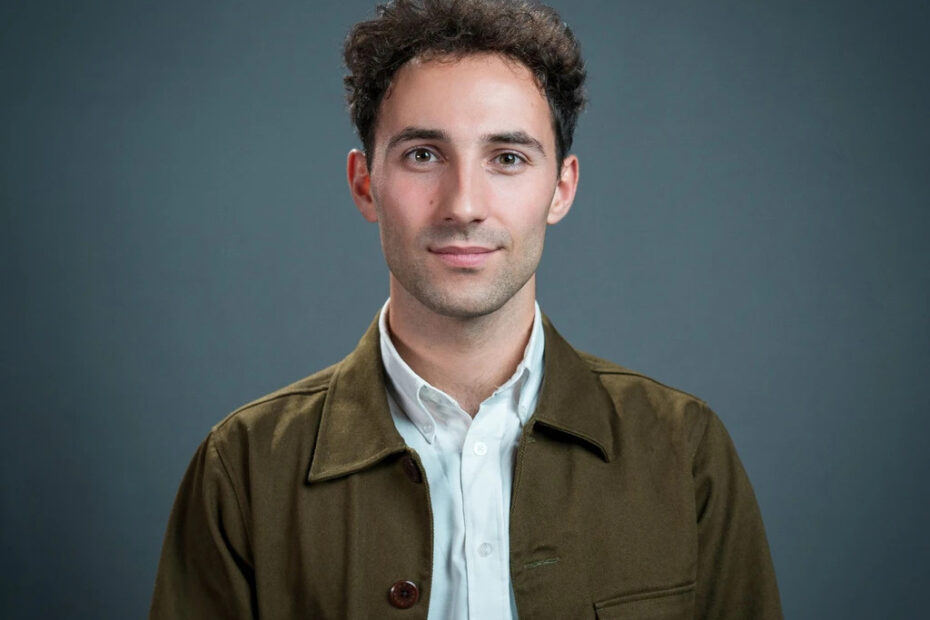
On March 11, Professor Maria Popova coordinated a zoom call with Luca Léry Moffat, an economics reporter for The Kyiv Independent, for her Politics of East Central Europe class. The students convened to ask Moffat about his experiences working in Ukraine and his perspective on the present state of the Russo- Ukrainian war. Moffat graduated from McGill in 2022 with a BA in economics and Russian. The McGill Daily had the opportunity to conduct an extended interview with him, particularly about the role of journalism in the war.
This interview has been edited for clarity and conciseness.
The McGill Daily (MD): After graduating from McGill and entering the workforce, you didn’t originally anticipate becoming a journalist. In what ways did your education at McGill and prior experience in economic research prepare you to become a journalist?
Luca Léry Moffat (LLM): To maybe give you a bit of background, in my third or fourth year, I got really into economics. I was doing a different major, did ECON 416 that was about topics in economic development, and sort of fell in love with it and decided to switch to the honours program. By the end of my third year, going into my fourth year, I was pretty set on applying for economic research. As I said in the lecture, I applied to a bunch of different pre-docs; most of which were very academic.
Then, of course, I went on to get this job at a think tank. It was a kind of pre-doc as a research analyst, but it was at a think tank, so [it was] less academically focused. Policy is a bit different from academia. It’s more about being a messenger between academia and policymakers. So, as an economist, I was reading lots of academic stuff, policy papers, and then trying to communicate it clearly to another audience.
I think it was actually during my first job when I picked up a lot of the skills that I needed in journalism: the ability to read a lot, synthesize that information, spin a story, figure out what the most important story is, and what the key messages you want to get across are. Something else I got from my first job was a network. So, I started building a network in Brussels, and those people have become invaluable in [my] pivoting to journalism because being a journalist is basically knowing lots of people and getting them to tell you stuff. I mean, that’s literally all it is – anyone could do it.
I would say that one thing that I got from McGill in the economics program was the ability to use data. I think that has given me a real edge in my journalistic career because not many people can make a graph. Data visualization is something which journalism is really shifting towards. People don’t have [long] attention spans anymore, so we like to see pretty graphs and pictures while scrolling through these interactive articles. The ability to code and knowing how to use an Excel spreadsheet was very attractive to prospective employers. I’d say that’s something I got from McGill which really helped me.
MD: You mentioned that you were also a graduate of POLI 331. With regards to knowledge concerning Ukraine, Russia, and their histories, what piqued your interest in Eastern European affairs during your undergraduate degree or even when working in economic research?
LLM: I was talking to Professor Popova about this – I loved my time at McGill. I had amazing professors, learned so much, and got a really good quality of education. Having said that, I feel as though I was taught economics and Russian both quite badly. I don’t think that’s McGill’s fault, I think that’s just education in the West.
On the economic side, you learn all of this economic theory which comes from the 1970s and 80s. But you don’t really look at finance at all even though finance has, over the last 40-50 years, become such a crucial part of the economic system. International financial flows have real ramifications for the economy, whereas that’s not integrated into a lot of the economic models that we study. On the Russian side, we were studying all of this literature without looking at it through the lens of colonialism. I think in the West, the idea that Russia is an empire is sort of a bit of an odd one when you’re first confronted with it. But actually, it’s one of the last standing empires from this massive period of colonialism. The US still exists, but many of the others have kind of disintegrated, or are now a shell of their former selves. I would study Russian literature and I remember studying, for example, A Hero of Our Time by [Mikhail] Lermontov, and at no point did I stop to consider, “Why is there this Russian guy in the Caucasus? What is he doing there?” Well, of course, it was part of this expansion of the Russian Empire. So, that’s just something which I’ve sort of reflected on since leaving McGill.
In terms of what piques my interest in Eastern European affairs, I think it was classes like POLI 331 or HIST 226, which were about the Balkans, Greece, and Turkey throughout the 20th century. What I found so interesting about it was how it’s really complicated – borders changed all the time throughout the 20th century, and people moved. After World War I, borders moved and people stayed where they were. After World War II, borders pretty much stayed where they were and people moved. There’s so much packed into European history, which is really difficult to unearth because it’s complicated. The Russian, poli-sci, and history classes I took at McGill started to shed a light on that, or even just scratched the surface of those really complicated events. And it left me hungry for more.
MD: During the Zoom call, you mentioned that you often feel conflicted as the journalistic field often emphasizes objectivity and neutrality, while the reporting you do and the publication you work for are staunchly supportive of Ukraine’s sovereignty. How do you navigate this conflict and adhere to journalistic integrity while fighting for a cause you feel so strongly about?
LLM: I find no trouble navigating it whatsoever because I think many things can be true at the same time. I’m staunchly supportive of Ukraine. I believe the facts clearly show that Ukraine is in a war for its own existence, that this is a war for two competing visions of society: one is dictatorship, and one is democracy and liberal values, and I am more partial to the latter.
At the same time, I believe that Ukraine has a lot of work to do when it comes to implementing certain reforms. Some articles I’ve written have been sharply critical of the government. In other articles, I have been less critical or even praised the government. I’m not writing op-eds. I’m a reporter, so I’m interviewing people, I’m putting in their quotes, and I’m telling the story. I [will] always try to tell a story that I believe is factually accurate and where I’ve quoted people in the way that they would want to be quoted.
At the end of the day, Ukraine is fighting for a future where it’s a democracy and it has its own sovereignty. Freedom of the press is a key tenet of a democratic, rules-based, sovereign state. So I think as a reporter, it makes complete sense that I’m writing articles which [can be] more critical of the government.
MD: To my knowledge, you are proficient in Russian and currently learning Ukrainian. What has the process of learning the Ukrainian language been like for you, and what is it like to report for a primarily English-language newspaper when English is not the official language of Ukraine?
LLM: First of all, learning Russian [at McGill] was amazing because I had incredible professors. I have to shout out Maria Ivanova, I think she’s still there, as well as Daniel Pratt, and a few others. Having had a series of other language teachers since who weren’t so good, it made me appreciate how incredible [my McGill ones] were. At McGill, the quality of education in the Russian department was really phenomenal. I’m really nostalgic about it.
The process of learning Ukrainian started when I arrived here on the 17th of April, exactly 11 months ago. When I first arrived, I figured that my Russian would be reasonably helpful, even though I understood that people were speaking less Russian nowadays because they’re being invaded by Russia and also wanting to put [the] Ukrainian [language] into the limelight. Kyiv used to be a very Russian-speaking city up until the full-scale invasion in 2022, but has [now] massively pivoted to Ukrainian. You still hear Russian around quite a lot, but out of respect I wanted to learn Ukrainian. For me, it was very clear that a lot of people didn’t want to be spoken to in Russian. As a way of just being respectful, I wanted to learn Ukrainian.
What I think the most crucial element of learning any language is completely immersing yourself. It’s been very humbling because learning a language from scratch is not easy. Ukrainian is a very difficult language. It’s massively helped me to have such a good quality of education at McGill on the Russian side of things because they’re both Slavic languages. Even though they’re very different, lots of the grammar is the same, [and] lots of the endings are sort of similar. Not having to start from scratch on the grammar side has been really helpful.
MD: How have you perceived reporting from journalists in Ukraine on the Russo-Ukrainian war to be different from reporting published by Western media?
LLM: I’m thinking of a time when I went back to the UK last summer, and we had a big gathering [with] a bunch of McGill alumni. I brought back a bunch of caps with the Ukrainian flag on them to give to some friends. Someone said, “Oh, you’re the one who’s working as a journalist in Ukraine,” and made a joke about not being neutral [in the war] because of my friends who had these caps on. I think there is a desire amongst some reporters, and a desire in the public rhetoric of the West, to believe that this war is political and that you can be neutral in it.
What was always clear to me but really crystallized when I arrived in Ukraine was that this war is happening because of Russia’s intent to erase Ukrainian statehood, erase the Ukrainian language, and to absorb Ukraine as part of Russia. Putin has some really peculiar historical fantasies which all mainstream historians reject entirely: that Ukraine isn’t a real place and that it’s the Bolsheviks’ fault that Ukraine exists. The reality is that Ukraine is a real place. It has people who really care about their country, [and] demonstrably so because there are 900,000 people in the army. There are hundreds of thousands who have been injured or have died defending their country. There are so many Ukrainian civil society activists who care about their language. You see Ukrainian flags everywhere. People have backpacks with Ukrainian ribbons.
Ukrainian society is complicated. There are lots of different perspectives within the country. But I’m actually rather impressed by the homogeneity in supporting Ukraine, Land] not wanting [it| to be part of Russia, especially in a country that has a long history of entanglement with Russia. Given everything that I’ve just said, it’s pretty easy to define this war as a genocidal war because it is an attempt to erase a nation. And that is the definition of genocide.
In the Western media, this is not always made explicit. I think it should be made explicit. This is essentially an anachronistic empire. If you know anything about history, you can see this [repeating]. I mean, it rings throughout the ages. If you look at recent history, you can see Georgia in 2008, which Russia invaded. You can see Crimea in 2014. You can see interference in Ukrainian elections in 2004 [and] 2005 (the Orange Revolution).
Western media sometimes doesn’t always do a good job of portraying that. But for me, those are the facts and a journalist’s job is to report the facts. And it’s very difficult for me to see it from any other perspective. I love hearing other people’s views, even if I find them abhorrent sometimes. I really enjoy trying to understand where people come from. For me, it’s so clear that the facts are [that] this is an imperialistic, genocidal war.