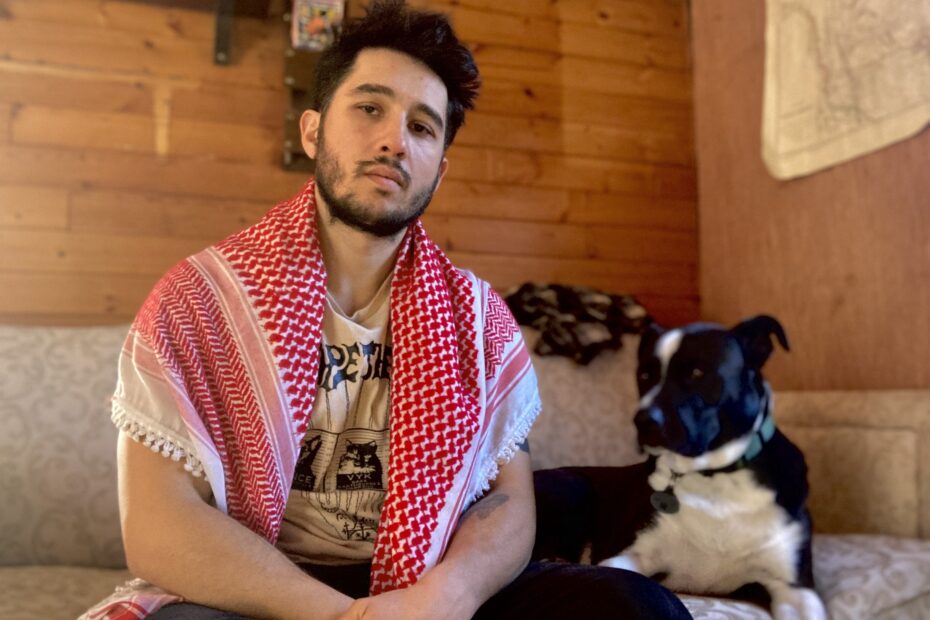
“You never know if you’re going to be in the news or not that day…if [the IOF (sic., a pejorative term for the Israeli Defense Force)] will try to pull a trigger.”
In October 2025, Giancarlo Cininni packed his bags and headed to Ramallah, in the West Bank of Palestine. Cininni worked as a volunteer for the International Solidarity Movement (ISM), a Palestinian-led movement founded in August 2001. The ISM’s main objective is to provide support for Palestinian resistance against apartheid through direct action including protests, disruption and on-the-ground volunteering. In addition, they documentation of current event in Palestine such as journalism in the form of photos and volunteer testimonies.
Cininni is a freelance journalist based in Halifax, Nova Scotia. Having studied journalism at King’s College during the Gaza genocide in 2023, he wrote a piece for The Dalhousie Gazette criticizing the events that led up to October 7th. As a millennial in his 30s, Cininni vividly remembers the 9/11 incident, and the global “war on terror” that ensued — something he couldn’t help likening to the ongoing genocide in Gaza more than 20 years later.
“9/11 didn’t have the same historical context in the same way that October 7th did,” he clarifies. “But the way the media was just gathering the troops essentially, and trying to get everybody in line, and was spreading hate towards a specific group, was similar to 9/11,” Cininni noted in an interview with the Daily.
“I would say October 7th was probably worse [in regard to scapegoating] because the context of the Hamas attacks was very much in line with [resisting the oppressor]. There was the Great March of Return in 2019 and other struggles. Anybody with a brain would be like, ‘[Gaza’s resistance] is a powder keg waiting to explode’. It’s only a matter of time. And there’s strategic significance to the actions on October 7th, what with the normalization happening.”
Cininni’s piece sought to give the public some type of context on what the state of Israel is doing in Gaza, and how their actions amplified the violence that occurred on October 7th.
“Most Canadians are probably not well-versed in the complicated histories of Israel and Palestine,” he wrote. “Which makes our population an easy target for the management and manipulation of public opinion via unbalanced coverage. This involves several factors — Israeli lobbyists, Western governments, and news media.”
The piece goes on to give clear statistics provided by the United Nations, from 2008 to 2020, comparing the number of Palestinian casualties with Israeli ones. The numbers show a clear disparity.
“United Nations Ambassador for Palestine, Riyad Mansour, responded to much of the world’s reaction succinctly,” writes Cininni, “saying, ‘History for some media and politicians starts when Israelis are killed. Our people endure one deadly year after another.’”
A year into the genocide, a collective feeling of despair and depression was felt amongst activists, as the possibility of a ceasefire seemed farther than ever, and death tolls rose every day. That’s when most people would either opt out of doing anything at all, letting helplessness take the reins, or try even harder to find a tangible way to help. Cininni chose the latter.
“I didn’t hear about ISM before,” he told The Daily. “About a year into the genocide, a lot of people felt this kind of collective depression of hearing about another genocide happening, specifically a Western-backed genocide, which means that we’re all kind of culpable, like our societies are very much more culpable. In this case, there are conditions as to why we might feel more culpable than other things, because it’s your governments that are actually actively arming [Israel’s] government to do these actions. And so I did feel that there was a sense of powerlessness.”
Cininni then stumbled upon an interview on the left-wing podcast TruAnon with Daniel Santiago, a US citizen who was shot by an IDF soldier in Nablus, while volunteering with Faz3a, a Palestinian-led initiative providing on-the-ground civil protection from Israeli violence based in the West Bank.
“When I listened to that episode, I was like, wait, you can actually go down there. You can actually do stuff, you can have an action,” he says. “You can actually do something against this [genocide]. And even though it’s the West Bank, it’s not in Gaza; that’s a different type of activism that you will have to participate in that’s a lot harder to get, but in the West Bank, there’s still a lot going on. Israel has no rhetorical justification for what it’s doing in the West Bank. There is no Hamas there. What are [the IOF] doing? Why are they terrorizing a civilian population that explicitly just wants to live a normal life on the land that they have lived in for generations? What’s the justification there? Why?”
“And so I heard about this [opportunity] and I kind of find it funny, because I think that a lot of people would be like, what you heard this guy got shot doing it and like, that’s what made you go, but for me, it was just like, oh, here’s an opportunity for direct action, and as someone who’s kind of skeptical of a lot of Western activism, I find it’s harder to find stuff that is actually super practical.”
Cininni applied to join Faz3a. But by the time his application went through, the organization had ceased its operations and was not taking on any more volunteers. That’s when Faz3a referred him to the ISM.
“I emailed [ISM] in early winter of 2025,” he mentions , “and did my onboarding in a hotel room in April, while I was in Newfoundland with my girlfriend. It was like two hours, and during those two hours, you learn about what [the organization] does, and some of the risks [of being a volunteer]. There’s a lot of talk about the cultural sensitivities that you have to be aware of. [The Palestinian people] are not looking for Western cultural kinds of colonialism. They’re not looking for Western feminism either, which could be something that happens in [other] Muslim countries. Essentially, they’re saying that you have to know what you’re here for. Palestinians are actively asking Westerners and people from all over the world to come here to show solidarity. Presence. They’re asking for our assistance and for our participation.”
Cininni told the Daily that the onboarding process was heavy with information as a way to triage the volunteers and assess who was willing to stay on. Once the ISM presented a clearer idea of the mission, they dove into the training sessions. One was virtual, and the other on the ground in Ramallah.
“By October, I flew to the Levant,” he added. “I flew to London, then to Jordan, crossed the border, made it into Palestine, and I did my training in Ramallah, which was pretty heavy and detailed. They were like two eight-hour days, and one happened to last 12 hours. We were all in a group house, sleeping on mattresses on the floor.”
Along with the onboarding and training sessions, Cininni’s experience with the ISM also included lessons on what to expect once he was on the ground and how to be prepared for any scenario. As activists volunteering for a Palestinian-led organization, they were not the most well-liked in the West Bank by the Israeli Occupation Forces.
“I had to learn a lot about phone hygiene,” Cininni says. “How to use Signal, how to use encrypted software to message each other, how to use aliases. We had to learn how to make ourselves as untrackable as possible. I learned a lot about weapons, tear gas, and what weapons might be used, what to look for. You want to look at a soldier’s hand, if the safety [on their gun] is on, if they’ve got their finger on the trigger. That is the extent of the violence there.”
Cininni went on to commend ISM’s consensus-based process, thinking of it almost like a direct democracy. Dynamic, intra-group discussions, and encouragement to share ideas were key to making their mission a success. It helped with the learning process, Cininni found, and bonded the volunteers in the face of serious risk of injury.
“The thing is, you don’t know what it’s like out there. It’s like a lottery,” he says. “One person from Canada had her ribs broken by the IOF…I was not subject to any violence because I was lucky, but I did see some people get grabbed at a protest in Nur Shams Camp in Tulkaram. At one point at this protest, the IOF came from behind and took some international [volunteers] and basically brought them to their side, checked their passports, went through their stuff, and interrogated them.”
While the ISM does assess and take into account one’s risk tolerance to protect its members, volunteers have no absolute guarantee of safety.
“It’s not every man for himself, because as an organization, we have each other’s backs,” Cinninni says. “But I would say, you can’t really [proclaim] you’re in an organization because Israel doesn’t really want us there. It puts a target on your back eventually. Israel does not want human rights activists there.”
In spite of the dangers he faced, including almost being held at gunpoint, Cininni looks back quite fondly on his experience in the West Bank.
“I’m a pretty seasoned traveller,” he says. “I’ve been to four continents, and I found that the Palestinian population was the most accommodating. It does not even compare. They go above and beyond, they are so generous, so nice to talk to, and so friendly. I had nothing but good experiences with Palestinians.”
He praises Palestine’s beauty, from its land to its people, while also appreciating the community he built there with his fellow volunteers, and the sense of accomplishment he felt.
“It’s very nice to feel like some activism is actually making real strides and real difference, and people are working together and not splitting up and policing each other too much,” he says. “Which I think is what we hear regularly through the media. It seemed like people were really active and tried to work together and have a good time, and I think it’s one of those paradoxes, where everything’s so stressful, everything’s so bleak.”
A volunteer’s attempt to make the best out of a stressful, dangerous situation bears a striking resemblance to the Palestinian reality. The country is beautiful, full of kind, generous people, but the looming occupation deprives them of all the joys their surroundings bring — and so Palestinians make the best with what is offered.
“It’s pretty inspiring to see that there’s a lot of people who do care, in the face of everything,” Cininni adds, “and are willing to go to this extent, to fly to a pretty dangerous place and to do this kind of work. It gave me a lot more confidence in a lot of ways, and it made me personally want to do more of this type of work.”
The International Solidarity Movement is always looking for volunteers from across the globe. A registration form can be found on their website.