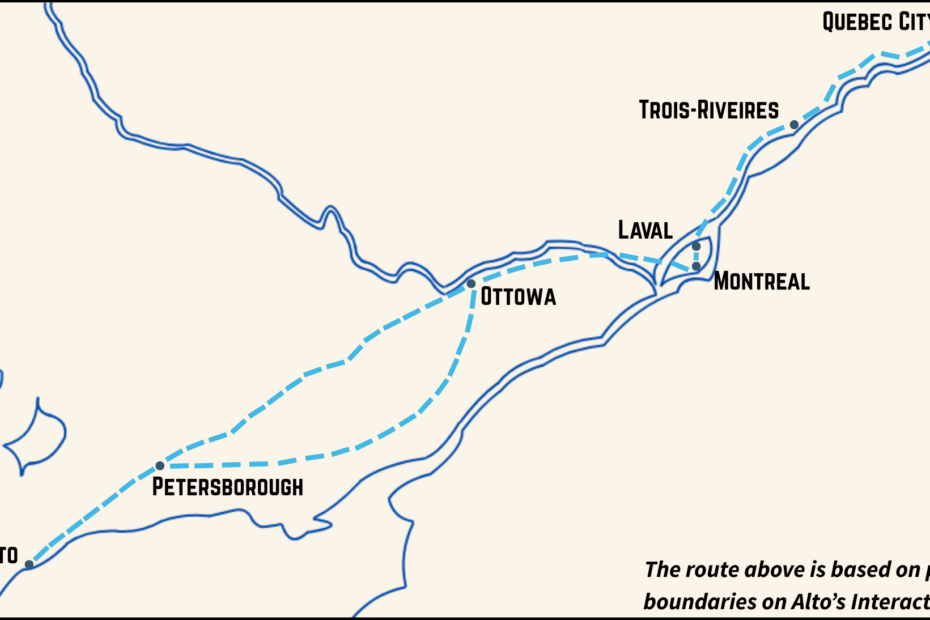
On February 19, 2025, Prime Minister Justin Trudeau announced the high-speed rail line (HSR) project that will run through the corridor between Toronto and Quebec City. Currently, it takes a little over five hours to reach Toronto from Montreal. Using HSR trains travelling up to 300 kilometers per hour, the commute will be reduced to three hours.
Now that Justin Trudeau has stepped down from the position, current Prime Minister Mark Carney will be in control of this nation- building project. The HSR was mentioned in Carney’s Canada Strong plan and is ostensibly a goal for Carney’s time in office. Trudeau’s administration brought up several large-scale infrastructure and resource projects, such as the Northern Gateway and Energy East pipelines, without taking any action so far. Now, Carney’s administration has inherited this burdened reputation of unfinished projects. However, American President Donald Trump’s tariffs and his bold stance on Canada’s sovereignty should provide additional motivation for Carney to complete this project. The United States has been Canada’s biggest trading partner for years, but this change in relationship means there is a need for the nation to strengthen pre-existing markets to be able to sustain itself.
Alto, the company behind the HSR, believes the project will be able to offer accommodation for Canada’s rapidly growing population. In addition to faster travel, over 50,000 jobs are expected to be created via the construction of the HSR. The company estimates that Canadians could save up to $570 million in travel efficiency, besides reducing carbon emissions by transitioning to an electric rail system. Furthermore, they claim that the project will contribute an annual $35 billion to the country’s economy.
However, before even beginning construction, the HSR’s design phase alone could last up to four or five years. Accounting for planning and design, the rail line is not projected to be fully operational for another eighteen years. The heavy time investment required by the project is just one of the concerns that Canadians have been voicing around the HSR.
Many farmers question the company’s level of consideration for the long-term impacts of the project on the lands and communities that will be affected by its construction. Similarly, a group known as Alt-NO has formed in opposition to the proposed HSR line. They’ve created a GoFundMe for donations used to spread awareness on Alto’s project. They write, “The Alt-NO committee, composed of citizens, residents and businesspeople, landowners and farmers, has formed to oppose the proposed high-speed rail corridor project being developed by Alto, a federal Crown corporation. We are non-partisan and our opposition is founded in our concern for the serious and irreversible impacts this project would have on farms, natural habitats, and communities in Ontario and Quebec along the proposed routes. This is a 90 billion dollar folly at taxpayer expense.” Members of the group have been expressing concerns with the ramifications of Bill C-15 and its effects, including the expropriation of land, the lowering of property values, and the potential to block residents from their property for the period of construction. Alt- NO are in favour of abandoning the project entirely and focusing instead on pre-existing infrastructure.
Additionally, several online groups have also voiced disquiet over the project’s environmental impacts. A group of ecologists from Carleton University recently signed off on a Facebook post warning against the loss of natural habitat they believe the HSR would cause and questioning whether Alto had a plan to mitigate environmental harm.
Despite public opposition, the planning phase of the HSR project is currently underway. During this pre- construction period, representatives from Alto have been visiting cities and towns for “public consultations” to answer citizen and media questions about the new rail line. Additionally, the company says they plan on conducting field studies and have begun technical design work on the infrastructure.
Alto states that they have “signed several collaboration agreements with Indigenous communities” to mark their progress in “building strong partnerships.” In October 2023, when Alto was working on a High Frequency Rail (HFR) project, the company published a “What We Heard & What We’re Doing” report, which demonstrates an effort to bring Indigenous voices into their project. In this report, Alto acknowledges the involvement of Indigenous people as “essential to its success.” Through the report, Alto gained a concern for Indigenous peoples’ engagement in the project, awareness of economic considerations, and respect for Aboriginal and treaty rights while the HFR project was in motion. Now that the company has transitioned to an HSR project, its ideals have not changed, but there hasn’t been a report released yet. Iori:wase, the publication for the Kanien’kehá:ka or Mohawk Nation, writes that the “Mohawk Council of Kanesatake (MCK) Acting Vice Chief Brant Etienne said the council has not signed up for any of the consultation sessions as of yet.” Nothing is planned, but that’s not to say consultations between Alto and Indigenous groups will not happen.
While Alto has successfully gained federal approval, citizens in the region where it plans to build remain uneasy about the HSL project.