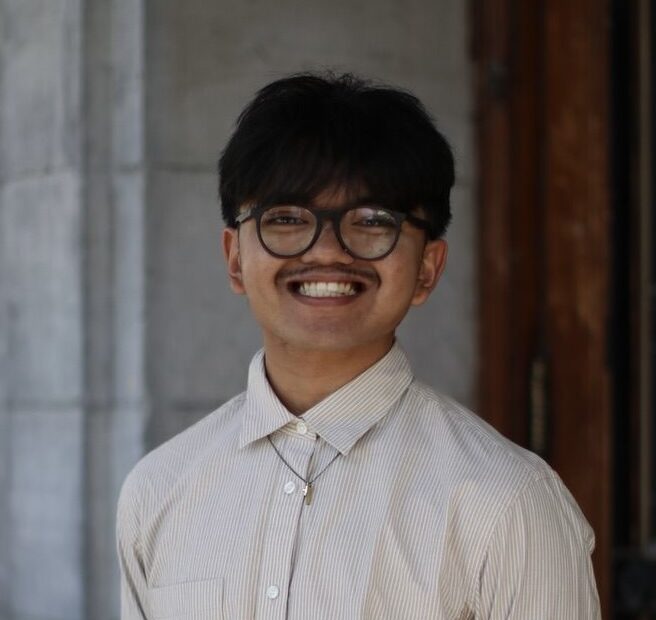
On February 26, the Arts faculty’s student body elected their new Arts Undergraduate Society executive members: Keith Baybayon for AUS President, Jane-Andrea Kwa Mbette for Vice President Internal, Janya Rajpal for Vice President External, Lucy Crowther for Vice President Academic, Peace-Tai Thomasson for Vice President Communications, Inès Wolff for Vice President Social, and David Luzzatto for Vice President Finance.
Over the reading break, I had an in-depth conversation with Baybayon on his motivations to run, his campaign strategy, and his upcoming plans for the 2026-2027 academic year.
This interview has been condensed and edited for clarity.
Sena Ho for The McGill Daily (MD): What motivated or inspired you to run for AUS president? What experiences or moments throughout your time at McGill led you to this decision?
Keith Baybayon (KB): came to McGill with background in student government, because I had served as a student trustee for my school board in Toronto. So I had already done a lot of advocacy work, such as recognizing the pride flag [and Pride Month in my Catholic school board, etc. I had been in important operational and standardized meetings with the school board, which gave me the experience I wanted to take forward at McGill University. I think student advocacy is very important because we’re at a very unique standpoint in our lives, where the systems in place constantly affect us, and we have the least representation at these decision-making tables. Growing up with that mindset, I’ve always wanted to fight for my peers.
I first got involved with the AUS in my first year as a committee’s volunteer, through the Arts Student Employment Fund Committee, as well as the Valedictorian Selection Committee. I wanted to test the waters a little bit of what student government was like in this new environment – because, [Montreal] was just completely different: a new language, new government, etc. I later was elected as Arts Representative to the Student Society at McGill in my second year. That got me more familiar with the environment of how student government actually works. I’ve come to really love the Arts community, because I feel we’re so unique. We have so many different disciplines, and so many different programs under our portfolio, to the point where it’s so diverse – it’s so full of life. And that’s why I wanted to continuously expand my horizons within the AUS and explore more positions to get more involved with the art student perspective at these decision making tables.
Once I leave McGill, I want to, and hope to, leave the Arts community better than I found it.
MD: Was there anything that you observed while being an Arts Representative or Arts Senator, that institutionally you wanted to change as president?
KB: One thing I definitely wanted to change was the structure of power that was distributed within the SSMU I feel like it was just a bit imbalanced. You have, for example, the Legislative Council in which you have all the elected representatives from different faculties. But then you have the Board of Directors (BOD) who have the last say in a lot of the things we try to pass at Legislative Council. I feel like the distribution of power was very imbalanced [because the BOD were elected for different positions that don’t necessarily represent every single faculty, point blank.
Right now, we’re in a review period for the Student Society of McGill University Constitution, which I’ve been able to take part in. There was also the recent plebiscite released to the Student Society [asking] who should have the power of operations. The results [displayed a preference for] Legislative Council over the BOD or the executive committee. I hope to see that implemented very soon. What I’ve been wanting to focus on when entering the Arts Representative role is changing up operations to ensure that whoever gets these positions is elected by the students.
MD: Are there any initiatives in which you are planning to enhance Arts student life and community on campus?
KB: I hope to continue my advocacy work from my role as Senator into my presidency. A lot of things that we at the Senate Caucus focused on has been the Policy on Assessment of Student Learning. The policy was implemented just last year, and because it’s so new, there aren’t really strong mechanisms in place to hold those responsible for enforcing it accountable within their classrooms.
This policy is so important because it protects a lot of rights for students. For example, PASL requires that assessment methods, including their structure, weight, and due dates, be outlined in the syllabus, which raises questions about practices like pop quizzes. Under this policy you also have the right to receive feedback from your assignments or assessments. So I want to create a mechanism in the Faculty of Arts, where we can track violations of this policy. We need to make this clear amongst our faculty, professors, and students, so that they can report these violations, [observe how trends are increasing, and [learn] how to mitigate them.
I see the future of working alongside the Vice President Academic, Lucy, and our senators, who are interested in working on this mechanism. Another thing I’d like to focus on is the state of learning at McGill. A lot of students are very vocal about how these classes with hundreds of kids are just not conducive to learning. Whereas, for example, the Education Student Senate has been a leader in assessing the state of learning for students through capstone projects and experiential learning experiences that I would love to see in the Arts. So, I want to work with the Office of Arts Education on that end to identify the best pedagogical practices for our faculty.
Another aspect on the operational side is accountability. My campaign focused a lot on keeping executives and any student elected positions accountable to their responsibilities and our recently amended AUS Constitution makes it easier to achieve that. I don’t want to take a punitive approach to keeping people accountable. I want to take a more collaborative approach. So I focused my campaign on co-creating an accountability plan with executives, departmental executives, and students of the Arts Faculty to see how we can keep ourselves accountable to our responsibilities and pitches from the beginning of the year.
I want to kind of take some time from now up until September to create a plan in which we can keep ourselves accountable, whether that means identifying what our specific focuses are for the year, alongside our mandates within our positions, [or] doing midterm check-ins, which we already do in Legislative Council, but also making that more public and visible to the general student community.
MD: Switching gears to another tenet of your campaign: student internships. I’m wondering, what steps are you planning on putting in motion to give students better access and opportunity to internships? Considering the present economy and job market, in what ways does the AUS plan to support Arts students financially and in their career prospects?
KB: There’s going to be a lot of collaboration on that for sure. We have our Vice President External that’s in charge of partnerships and postgraduate opportunities. But I don’t want to solely focus on just postgraduate opportunities. An important partner that we have is the Arts Internship Office (AIO) – they provide a lot of opportunities for our students already. I want to make that more visible [since] McGill is notorious for having so many things going on, but students just aren’t aware about them. It could be through a centralized database within the AUS or an internship event where partners of the AIO can come to the AUS to talk.
On the internal side of things, we actually have the Arts Student Employment Fund. This is an opportunity for students to get work experience, like research on campus alongside a professor. This can be very intimidating, I’d say, especially for first or second years who don’t really know much about the processes of requesting for research opportunities. I really want to demystify the Arts Student Employment Fund for students to simplify that process for them, and work with VP Academic on that end.
Another thing I’d like to really promote is cross-faculty opportunities. I feel like we shouldn’t leave ourselves to just the Arts when, for example, the School of Population and Global Health have so many opportunities under their belt, and are constantly promoting it to different faculties. Last semester, I did a Department of Equity, Ethics, and Policy internship. My project was stationed at the Department of Integrated Studies of Education in the Faculty of Education where you have so many different departments working together. I see the power in collaboration, I see the opportunities found in other faculties, and we need to work with each other.
With the upcoming President’s Roundtable of the different faculty presidents, I’d love to garner their knowledge and also their expertise in how we can provide more opportunities for all students using our resources.
MD: What were your main goals during the campaign process to get your message across to students?
KB: To simplify, I had a really fun time doing it just because it’s an opportunity for the students to get to know me. For me, it was more [focused] on authenticity because I’ve been with the AUS for a while now. I know a lot of people can vouch for wanting new leadership, but what was a very important pillar for myself was institutional memory. Over three to four years at the AUS, I’ve seen so many different initiatives and projects take place – I’ve seen a lot of things fail, too.
I was able to work with that in my campaign because I was focused on what’s happened in the past year and how we can improve things for the coming year. I wanted voters to see that the AUS should be a space in which they feel comfortable learning and being in; it should be a society that functions, works reliably, and follows through on their commitments, not just making huge promises during the elections. My platform focused onaccountability, student rights and advocacy, and community engagement. An important thing for me was making accountability a very central expectation because it’s really tough not having any visible outlets for students in the General Assembly. One big frustration I’ve had over the years is that sometimes governance [is not] accessible to students. So that was a very important priority of mine – I wanted students to feel less disconnected from the student society. Whether that means more town halls, more roundtables with, for example, the President and VP Academics to talk about PASL, the Policy and Student Assessment and Learning, or VP Finance to study the finance mechanism for the Financial Management Committee.
Another thing in my campaign was empowering students to build community under the AUS. Over the years, you start seeing the LUTHOUL in voting increase. During my Arts Rep year we had 13 per cent turnout, while this year we had almost 18 percent. Another one of my pillars was to reduce the barriers to student initiatives under the AUS. Making it easier, for example, to start clubs, which you don’t have under the AUS. It could be a future endeavor that is possible after consulting departments, students, and executives.
MD: A more lighthearted question – in terms of your campaign, you had a very clear branding. How did you envision that? Did you come across any obstacles or road blocks throughout that brainstorming process?
KB: I feel like my campaign brief was just an accumulation of everything that I’ve experienced at McGill in the past three years: every conversation, debate, project I’ve taken on, motion I’ve written, etc. Everything kind of led up to that moment because all of these ideas were not created from thin air. It’s been built upon those that came before me.
I’ve shown a lot of appreciation, and I will continue to show a lot of appreciation for the past presidents. I’ve worked with each of them, and I’ve seen their leadership has accumulated over the years too. This year, I just wanted to take that opportunity to show that collaboration is really possible. This platform was really built on the students, because, like a lot of the pillars I’ve mentioned, they were also in consultation with departmental executives or even just my friends, gauging their interests and thoughts.
With my branding and messaging, that was just like my own little twist to it. I’ve seen so many fun, creative things happening online. I remember I did a dance to Sabrina Carpenter’s “Man Child,” because I just woke up one day, saw it on TikTok, and thought ‘let me do this.’ So I called my friend and we did it right there. I felt like taking a fun twist to things was very important for my campaign, because that’s who 1 am.
MD: Are there any future projects or initiatives planned that you want to mention?
KB: I am very excited for my executives – we have so many amazing individuals in these positions, and they’re going to have their own passion projects, too. I’m very keen to support each of them. The president’s role is very all-rounded. I feel like when people see it at first glance, they think, ‘Oh, you’re just the spokesperson and on the operational side of things.’ I want to ensure that the AUS is in a stabilized state so that you can actually do what you want to pursue. Without transparency or accountability, the AUS can fall short on their promises just because we don’t have the internal structures in place. So that’s been a very important focus of mine for these next few months.
Afterwards, I’d love to be able to see all of their projects come into action too [as well as any students that want to do a project with the AUS. I’ve emphasized an open door policy a lot in my campaign. A student can book a meeting with me and I’ll be happy to talk to them. I want to foster that sort of environment within the AUS as a whole.
The prospective executive team will not officially take office until May 1, and are currently undergoing a period of transition from the current AUS board.