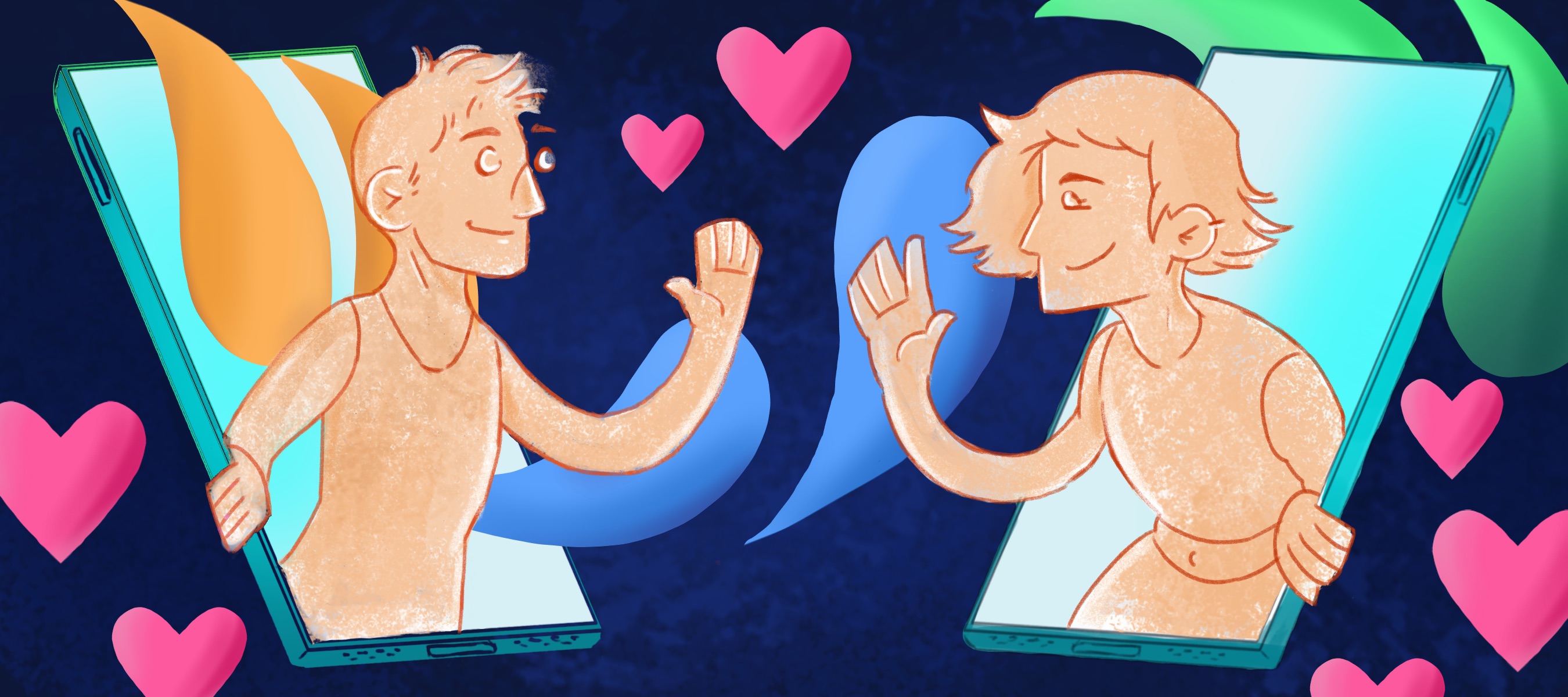
Hinge, Tinder, Grindr, Bumble. Among others, these names have become all too familiar to us. From TikTok POVs to the anecdotes passed around our social circles like ghost stories, dating apps have slowly but surely become an integral part of our generation’s dating landscape.
I never thought I would get on the apps, more specifically Hinge. However, seeing an Instagram post about “dating as an anthropological study” during a reading week trip to a city where I knew nobody and nobody knew me made for a little too irresistible of an opportunity. A moment, or a month, of weakness? Probably. But here is the truth: tell the Culture Editor to approach a situation with anthropological curiosity, and you’ve got yourself a perfect storm.
I won’t bore you with too many details of my time on Hinge, which I deleted after just a couple of weeks. All things considered, the experience was ripe with personal insights. I could go into so many things: the astounding number of men in my DMs proclaiming their adoration for anime and/or K-Pop (I am Chinese-Vietnamese) or the humbling experience of swiping on people to have them not swipe on you, resulting in an ego death by a thousand cuts. All of these are meaningful, and maybe I’ll write about those another time.
The main point of this piece, however, is the viscerally dehumanizing experience of being on a dating app.
At some point, swiping becomes mindless. You might start out looking through someone’s entire profile, pictures and prompts and all, then coming to as holistic of a yes/no as you can given the limited information you have about this person. Hundreds of profiles later, though, you’ve seen enough. Just the first photo, maybe the second, suffices to make a decision. It even becomes a game: my roommate called it “playing Hinge.” We’d sit together, gazes fixed on my phone screen, and swipe through tens of people at a time. It was quite hilarious how our reactions started to sync: “nope”, “next”, “hmm”, “not bad”, “maybe” and only the exceptional yes, like seeing a unicorn on McTavish.
Realizing the ridiculousness of this cycle was kickstarted by an experience many dating app users will know too well: chancing upon the Hinge profiles of people I recognized from real life. I found my neighbours, a friend of a friend’s ex, familiar faces from the gym and my walks to and from classes. I stumbled upon the guy I had made out with at Frosh in first year, and the freshman I had turned down at the club a few weeks prior. The sheer dissonance between the persona on their profiles and the people I knew them as was so bizarre. I pushed that strange feeling aside. Maybe it wasn’t that deep. I kept swiping.
The incongruence between the way people presented themselves online versus in person slowly began to solidify. I realized that somewhere within 20 kilometers of me, likely at that very moment, someone was probably swiping on me. They were also probably forgetting the few details they had learned about me in that very same second, my face blurring into just one of thousands in a continuous, unfeeling swipe. I couldn’t even blame them: I was doing the exact same thing. Each of us equally the perpetrators and victims of our mutual judgement.
Finally, I happened to walk past one of my failed Hinge talking stages on the street while he was with a friend. In the split second in which I passed him and heard him speaking, I realized that he had a thick European accent that took me by surprise since he had never mentioned it. Not that the accent mattered, but it caused something to suddenly click in my head: how could I have known? Though we’d had a decent back-and-forth in our Hinge chat, and I had seen his profile, there was no way I could have known about his manner of speaking.
It seems banal, but it truly dawned on me then that all these profiles were those of real people, evidenced by the people I knew who I’d seen on there. They had accents, mannerisms, tics, etc. They had interests, fears, beliefs; pasts and presents and futures. They, like me, were more than just their three best photos and three wittiest prompts – a fact that we had all failed to attend to. At that moment, I felt ashamed. How could I, the anthropologist in this study, have missed the humanity at the core of it all?
This prompted further introspection on my end: who was I? Was my profile at all representative of who I was, or just a carefully projected image of what I believed to be the most desirable parts of myself?
Dating apps actively encourage the treatment of oneself like property, then like a business. Our bodies become objects we must nurture to attain peak performance. We see this in self-care culture, “gym bro” culture, the increasing normalization of cosmetic procedures. Of course, there’s nothing wrong with taking care of your body, but the exponential growth of health and beauty industries speak to the value of one’s body as a material possession; whose function is no longer just to keep you alive, but to be “the best it can be” (whatever that may mean).
Thereafter, we advertise this prescribed standard to others, turning ourselves into “businesses.” Dating apps are a prime platform for this. We peacock the best versions of ourselves – the digicam photos or the nonchalant one-liners – through our profiles, hoping that others will take notice. There is a means-end dynamic at play that leads to our self-objectification, where we strip ourselves and others of the human experiences and character traits that make us, us. When someone matches with the highly manicured version of ourselves, do they really match with us? And is that the kind of connection we even want in the first place?
This is not to say that one cannot find love on the apps. I know loving, long-term couples who have met there. This is also not to sound like an anti-dating app prude; I have, after all, been on them. I take issue not with the apps themselves, but the cultures they perpetuate: ones of disillusionment and boredom with actual people or, rather, their online caricatures whom we take as their wholes when they are merely slivers. Of the disillusionment with genuine connection itself, shown in how we are often encouraged to act in ways otherwise unnatural to how we would usually form close bonds with someone: only responding after x amount of time, playing “hard-to-get”, or “playing the game”, so to speak.
Sure, in our current dystopia of a dating scene, apps expand one’s pool of potential partners. But the way we carry out this social expansion leaves so much to be desired. For why do we treat ourselves like products to be bought, casting our net wider to attract more consumers – I mean, potential partners? Social media and ubiquitous digital connectivities mean that so much choice is available to us at all times. But once again, if we really have so many choices, why do so many of us struggle to get off the apps? Does anyone on the apps really want to be on them? Ultimately, what good is there in scrolling through a thousand faces of eligible singles in our area if it means eventually desensitizing ourselves to the hearts and minds behind them?
Reflecting on my successful romantic endeavours, I cannot confidently say that, had we come across each other on a dating app, we would have swiped on each other. This is not to mean that attraction is absent, only that it grows; with proximity, with time, in the getting to know. And isn’t that the beauty of connection? Letting someone surprise you?
So, as obvious as it may sound, be open. Be open to dating outside of your type, perhaps people you might not otherwise think twice about. Be open to being curious, though of course with caution. Free yourself from the limited choices on the apps (which represent, actually, a minority of the single population) and open yourself up to the world around you. Genuinely, try dating as an anthropological study: not in the active pursuit of something, but simply to get to know another person. Join a club, chat up someone in your conference, whatever. Maybe you’ll learn more about yourself in the process. You really never know!
But okay. Even if you are on the apps (absolutely no judgement), it’s a given that you only have so much to work with profile-wise. In that case, fill your profile with things that showcase who you are authentically, not just the parts of yourself that you believe to be the most desirable. More matches don’t necessarily mean better ones. Moreover, at least if you’re looking for genuine connection, approach your interactions with the sincere intention of getting to know the other person. What’s the point of playing games if the goal is to attract someone who doesn’t play them? Be open not just to others, but to being unapologetically yourself, free of the filters. The rest, I believe, will follow.
It seems cheesy, maybe even dumb; an empty platitude that offers no real help at all. You might even roll your eyes — I get it, I’ve been there. But truly, in the question of how to access the love that seems to be everywhere but also increasingly out of reach, I posit that you, perhaps, are the answer.