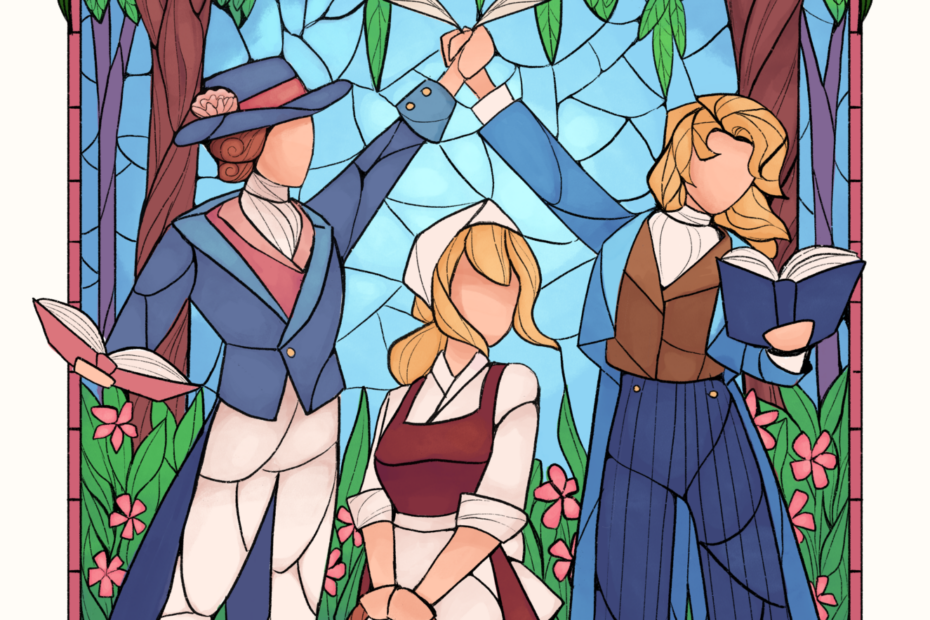
“Love is a duty, it is no wonder they are all so miserable,” sighs the titular character from Gilbert and Sullivan’s Patience.
After a long awaited two-year hiatus, the McGill Savoy Society has made its grand return to the Moyse Hall Theatre, performing Patience; or, Bunthorne’s Bride. With a company of over 60 performers, musicians and technical creatives, the irreverent 1881 comic opera is given new life and reads as strikingly relevant today as ever — underscoring that Patience makes perfect in this romantic absurd comedy, opening February 13 to a wonderfully-timed Valentine’s Day weekend.
The piece recounts the evergreen plot structure of a love triangle between simple milkmaid Patience and the two superficial, artistically minded muses — Bunthorne and Grosvenor — who pine after her. A bitter satire on the Aesthetic Movement that was sweeping Europe at the time. Championed most famously by Oscar Wilde, the movement was a reaction to the moralism of art at the time, expressing the idea that art had inherent value even as superficial beauty, independent of social, political or ethical significance. The piece takes on newfound meaning with the rise of the performative male archetype, asking audiences to reinvestigate the timelessness of man falling victim to his own follies. For Artistic Director Michael Quinsey, “[Patience] is more than just about the Aesthetic Movement, it’s about fad chasing. It’s about pretense which is very human.”
Nathaniel Jablonski, who plays Patience’s childhood love interest Grosvenor, expands on this idea by talking about the way modern masculinity responds flexibly to affirm the status quo of the time: “The ideas of masculinity are constantly in flux — the traditional masculinity of military men are played for laughs as uncultured, contrasted with the nouveau of masculinity which is artistic, dreamy, sensitive and literary.”
He highlights that much of the commentary presented in Patience is represented through genderplay and how the modern man adjusts his performance of masculinity in favour of reaffirming the status quo. He adds that many operas like Patience play with the weight of navigating a hostile world where “very strict social codes are taken to the extreme bitter end,” often to absurd theatrical consequence. “People act completely nonsensically, they’re trying to make sense of the world. They’re trying to survive their lives under these codes and that’s part of the humour. How absurd it is that love must be considered either unselfish or selfish to be considered real,” Jablonski reflects.
Ana Neocleous, music director, speaks to the enduring relevance of Gilbert and Sullivan today. In particular Neocleous focuses on the unique space comic opera occupies in the public imagination which makes it especially equipped to tackle the subject of affect: “People have more preconceived notions on opera than many other performing art forms. These miscomprehensions came from the 19th century and are bound up in the serious work environment realized under a maestro conductor. It’s super high art! […] [Opera] has taken so many different forms from intellectual art to low-brow comedy, Gilbert and Sullivan is an artifact more accessible than most people think. There’s nothing high art about this, and there’s something nice about embracing it for what it is. The operas of Gilbert and Sullivan provide this unique opportunity to revisit that and play around.”
Though Bunthorne and Grosvenor carry much of the comedy in this piece, Patience, played by Helayna Moll, is the play’s emotional and philosophical anchor, serving as the voice of reason. Speaking to Patience’s fixation on moral love, Moll says, “She is obsessed with morality: when her friend Lady Angela ‘says you have to love, it is your duty to love and it must be unselfish,’ she believes her. It reflect the beliefs of the time and the demands placed on women.”
In her recharacterization, Moll sought to re-engage Patience as a character that approaches the institution of love with skepticism: “[Patience is] treated as this dumb blonde, but she really achieves everything she wants withou compromising on her beliefs. I believe she is really smart.” She points in particular to Patience’s Act Two Aria, “Love is a Plaintive Song,” noting that she approached this moment as a turning point, questioning why she is expected to appear happy when as the lyric suggests, it is “everything for him, nothing at all for her.”
Though the male lead Bunthorne acts as a caricature of an amalgamation of Aesthetic Movement figureheads, it is Oscar Wilde that Patience is most often culturally identified with. Depicted alongside Wilde in satirical magazines is the lily which becomes a prominent symbol throughout the opera. As pointed out by Professor Maggie Kilgour in the program’s “Note on Aestheticism,” the lilies reference the Matthew 6:28-29 of the New Testament wherein “Christ praises the flower for its beautiful uselessness: ‘Consider the lilies of the field, how they grow; they toil not neither do they spin: And yet I say unto you, that even Solomon in all his glory was not arrayed like one of these.’” Though the Aesthetic Movement’s rise was attributed heavily to Wilde’s contributions, it was also his trial for indecency that suffocated much of the movement’s cultural inertia.
Quinsey says, “A lot of things are said about being true to yourself in relationships. There’s this idea that you should love a certain way or not because it might be selfish, but in the end, you have to ask yourself if you can be happy.” Likewise, Matthew Erskine, who plays Bunthorne and has been a part of the Savoy Society for eight years, speaks to finding that happiness in loneliness: “This is the exceptional, unprecedented [Gilbert and Sullivan] opera where someone ends up alone. Bunthorne ends up alone, and it’s funny, but I like Quinsey’s direction with his lily. He looks pensively at this symbol of poetry and Aestheticism and he tosses the flower, accepting that he doesn’t need to be aesthetic, [and] that it’s okay to be single.”
In all its romance and absurdity, the production marries biting social commentary on Aesthetic affectation with a modern sensibility that feels sincere and approachable. The McGill Savoy Society embraces Patience’s tongue-in-cheek spirit with confidence, delivering a production that could only be made by a team that is unafraid to love their work as selfishly as necessary. As the show ultimately reminds audiences, we owe it to ourselves — and to others — to fall madly in love with who we truly are.