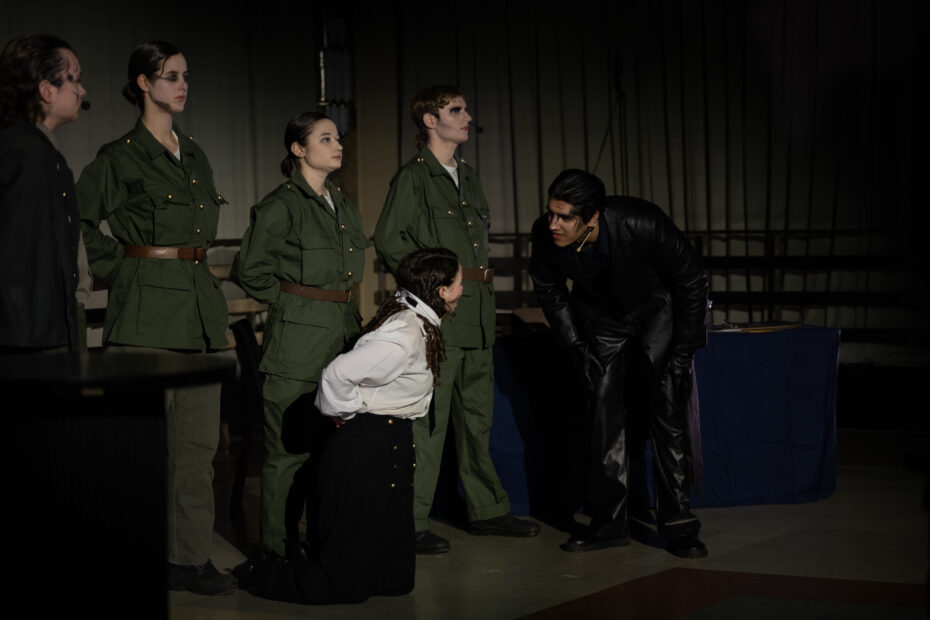
Sophocles’ Antigone is a play for our time. In the wake of civil war, Creon, the newly self-appointed King of Thebes, issues an edict forbidding anyone to bury Polynices, brother to Antigone and Ismene, who fought against Creon’s winning side. More loyal to the laws of the gods and the needs of nature than to this sacrilegious edict from a tyrannical ruler, Antigone buries Polynices anyway and faces the consequences: death by abandonment through solitary confinement, where she is, in Luce Irigaray’s words, “deprived of the air, the sun, and all the environment necessary for living.”
Against the contemporary backdrop of rising fascism and suppression of activism, Antigone embodies the resolve and courage demanded of us today. Her unjust punishment, too, exemplifies the sort of repression that unfortunately dissuades many from following in her footsteps. Antigone has been widely regarded not only as a paragon of civil disobedience in general but also, more specifically, as a role-model for climate activists. Montreal’s own offshoot of the international climate activist group Last Generation has dubbed itself “Le Collectif Antigone.” This is a play with an important message that could resonate with viewers, one that is increasingly important for us to hear.
The McGill Classics Play’s “daring new iteration” seems, on some level, to understand that this is a play for our time. The adaptation, directed by McGill student Madelyn Mackintosh and alum Caroline Little, based on a new translation by Adam Zanin, certainly seems to have Donald Trump in mind. Creon wants to make Thebes great again. He is troubled by and seeks to vanquish the enemy within. In the second act, as the people start to turn on him, a soldier cries “I didn’t vote for him!”
Adapting the play for Trump’s America could be interesting. In truth, I happen to think that such an interpretation would, failing truly extensive and off-putting revisions to the dialogue, be too flattering to Trump and his ilk. Say what you will about Creon, but at least he can string a sentence together. Melania, unlike Eurydice, does not appear to have any sympathy for dissidents and Haemon is far more human than any of the Trump sons. Thus, when the McGill Classics Play’s production did obviously allude to Trump, I had to laugh at how absurd it is to live in a time when the “leader of the free world” is even more despicable than this villain of ancient literature.
However, rather than committing to making such a comparison, this staging is instead set “amid the rising authoritarianism of the 1930s.” Although the art deco set design confuses the analogy, the delivery of Creon’s monologues (pre-recorded and piped in such that Creon himself just stands, mouth unmoving, in front of a microphone a few times an act) is clearly meant to recall the aesthetics of Hitler’s speeches.
This confusion of contemporary (and 1920s) America with the Third Reich is, I think, in some ways meant to be the point. The takeaway of this production seems to be that Trump = Creon = Hitler. And insofar as we, the members of the audience, are not Antigone, we are the everyday Germans whose complacency allowed for the horrors of the Holocaust – although, in light of Hannah Arendt’s influential view of the Holocaust as a manifestation of the banality of the evil, this message is somewhat undercut by the choice to put all but the play’s “good guys” in ghostly face paint. Insofar as we understand Trump’s America to be devolving into a simple reiteration of Nazi Germany, we are, too, the Americans who “didn’t vote” for Trump, but who are doing nothing to stop him.
This choice of takeaway irks me. It is certainly true that many, if not all of us are complicit in a great many horrors. But as Trump’s cronies murder modern- day Antigones in the street and people increasingly compare Trump to Hitler, there has been growing discourse about how inapt this particular comparison is. John Meyer has recently argued that if you’re searching for a European fascist on whom to model Trump, Francisco Franco is your man. More compellingly, many point out that America in fact has its own long history of fascism. The Nazis were themselves inspired by this history. W.E.B. Dubois implied as early as 1935, in his Black Reconstruction in America, that “the white supremacism of Jim Crow America” was fascist. Two years later, Langston Hughes stated that “we Negroes in America do not have to be told what fascism is in action. We know. Its theories of Nordic supremacy and economic suppression have long been realities to us.” We might then worry that the compulsion to compare Trump to European dictators flows out of an unwillingness to look America’s own history in the face. Trump isn’t Hitler and he’s not Franco – his fascism is homegrown. In trying to say so much, this production thus fails to say anything especially compelling, flattening all particularity.
All of this said, this production had some real potential. Aniela Stanek’s portrayal of Antigone is excellent. The sister dynamic between her and Neela Perceval- Maxwell’s Ismene is very compelling, as is the choice to make Ismene as sympathetic as this version does. Nikhil Girard’s Creon, unmoving soliloquies in front of the mic aside, is solid. Nicholas Cho manages to make Eurydice surprisingly sympathetic even despite the character’s “moral blindness and outright complicity” with Creon. Megan Siow’s handmaiden and Sarah Shoff’s Tiresias are both important grounding voices.
Aside from the bloody and fiery spectacle that follows the death of the titular character, Griphon Hobby-Ivanovici’s Haemon, the most central and impassioned voice of reason, is the highlight of the second act for me. We can’t all be Antigones and we shouldn’t all be Ismenes. But many of us can, I think, aspire to be Haemons: loving and fiercely supportive of the few who, like Antigone, have an almost inhuman ability to stay committed to their principles against all odds. Loving them not in spite of this commitment, as with Ismene, but because of it.
Brendan Lindsay’s sentry is funny and charming – the comedic highlight of the show by a mile. Although making Sam Snyders’s magical bartender Hades himself leans a little too Percy Jackson and the Olympians-coded for my liking, especially in a production that already has so many moving pieces, his winkingly irreverent delivery is a welcome source of levity. Luca McAndrews’s advisor really shines in his fearful reactions to Creon’s increasing rage in the second act.
If I have more to say about the acting in the latter half, that’s largely because I was only able to see the actors’ faces after I moved into a seat that had been vacated during the intermission. While the original play is in part a call for tradition and ritual to be respected, this production for some reason – perhaps to leverage the art deco interior design of le 9e – foresook the tradition of the stage itself, thereby making it impossible for most of the audience to see anything. That this choice, and so many other confused adaptational choices, was made is a real shame, especially given that the cast, for all I could see, seem to have given such strong performances.
If this review is perhaps a little polemic, that is in part because this adaptation had such promise and because the choice to stage Antigone today is such a good one. But I love Antigone precisely because of its particularity. In G.W.F. Hegel’s influential analysis of the play, in fact, Antigone’s deepest crime is arguably that she preserves her brother in his particularity instead of allowing him to become just another anonymous corpse. It therefore saddened me to see this adaptation strip the play of what I take to be one of its greatest strengths. That Antigone is timeless does not mean that adaptations of it should pull aimlessly from so many historical contexts. In doing so, this adaptation loses much of the complexity that is so important for developing a robust understanding of the play, of the history of fascism, and of the workings of contemporary fascism.