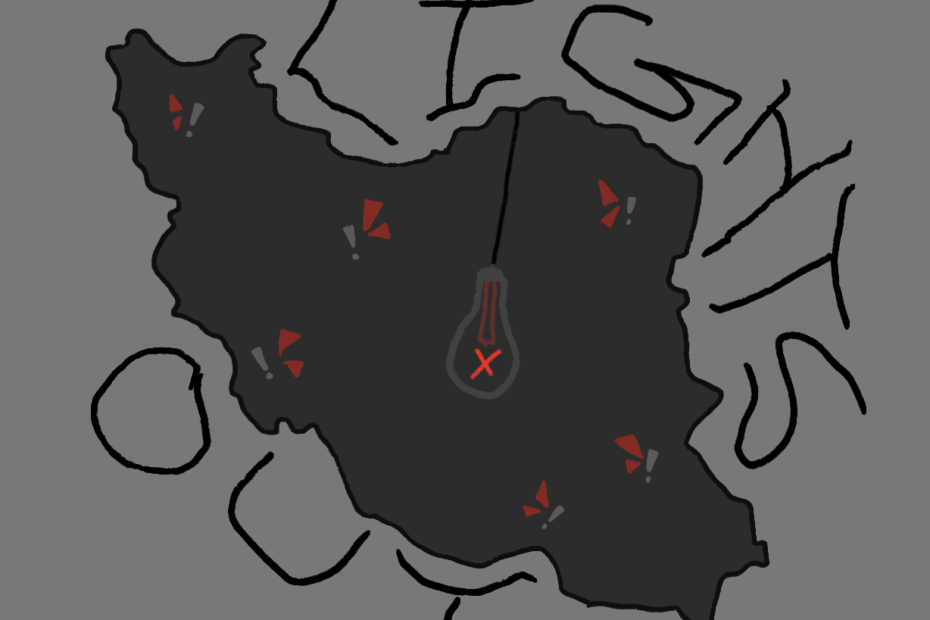
As protests spread, Iran has isolated the country digitally, leading to contested casualty counts
On January 8, Iran went dark. Internet monitors recorded a near-total nationwide shutdown, an abrupt collapse in connectivity that has continued into its third week, with only minor flickers of traffic and tunneled VPN use. The blackout has become one of the state’s central tools for controlling what the world can see.
This matters because when visibility is restricted at this scale, the story of a crisis gets written differently. Facts travel slower, casualty claims get harder to verify, and the state gains time and space to shape the narrative before evidence can circulate.
The internet shutdown began as the protests that erupted in late December swelled into one of the most serious uprisings against Iran’s leadership in years. What started on December 28 as a movement where Iranians proclaimed their anger over soaring prices and the plunging currency quickly turned political. Since then, the country’s unrest has largely been communicated to the world through foreign media reporting and human rights organizations. Footage is rarely shared, and official statements often contradict independent accounts. In the gaps between those fragments lies the central question: what can we actually confirm about what’s happening in Iran right now?
From economic spark to political rupture
Multiple news outlets trace the protests’ spark to economic collapse. The devaluation of the rial and the rising prices of everyday goods has made daily life unsustainable for many households. Early demonstrations reportedly began with shop closures and street protests in Tehran’s Grand Bazaar, then spread beyond the capital.
Following the 1979 Revolution, major protests have often risen initially as a frustration over a specific issue, before escalating into a nationwide movement. For example, the disputed 2009 presidential election and allegations of vote-rigging, rising fuel prices and economic hardship in 2019, and the death of Mahsa Amini in 2022 all eventually developed into broader social demands over changes in governance, rights, and the legitimacy of the state. Human rights organizations, including Amnesty International, have described the scale of this unrest as the largest nationwide protest wave since 2022, emphasizing that the ongoing blackout makes independent verification of events and casualty figures far harder than in a normal reporting environment. On January 8, as demonstrations intensified, Iran imposed the nationwide communications blackout, limiting external reporting ever since.
What’s happening on the ground, and why numbers are contested
Three things can be said with confidence based on the convergence of reporting by major news outlets and human rights organizations. Protests occurred across the country, the state responded with repression, and the scale of deaths and detention remains deeply disputed, partly because the blackout makes verification extremely difficult.
Reports describe mass arrests, limits on large gatherings, efforts by authorities to restrict documentation and shape what information can be shared, and accounts of families receiving little or no information about detained relatives. The Center for Human Rights in Iran has reported forced confessions, limits on legal representation, and concerns about an escalating risk of executions for detained protesters.
HRANA (Human Rights Activists in Iran) has also published rolling tallies of casualties. In its January 25 update (day 29 of protests), HRANA reported 5,848 confirmed deaths and 17,091 deaths “under investigation,” alongside 41,283 arrests*. Still, even these figures, and other independent counts, remain difficult to verify fully while the internet blackout limits documentation and outside reporting. This is exactly why the numbers are being contested: in a shutdown, the usual pathways for confirming casualties –– such as local journalists, hospitals, public records, open communication, and video verification –– either disappear or become dangerous to use. When evidence can’t move freely, the state gains an advantage not only in policing the streets, but in controlling what becomes provable. The result is a crisis where uncertainty isn’t just a byproduct of chaos; it becomes part of the landscape of power, because contested numbers delay accountability and leave room for official narratives to dominate.
Iranian officials, meanwhile, have framed the unrest as foreign-backed destabilization and have referred to demonstrators as “rioters,” alongside warnings about punishment and asset seizures. On January 21, Iranian state television issued the first official death toll from the protests, reporting that 3,117 people were killed, a figure widely described as “lower than activist and rights group counts.” In spite of independent estimates varying dramatically, UN-linked statements emphasize that the true toll could be far higher than what Iran’s authorities have publicly acknowledged. In an interview published on January 26, the UN Special Rapporteur on Iran, Mai Sato, described the discrepancy between governmental and independent figures and warned there could be tens of thousands of victims, noting the blackout’s role in obscuring evidence and enabling coercion around casualty narratives. The UN’s broader human rights apparatus has also characterized the crackdown as potentially the deadliest since the 1979 Revolution and has stressed evidence collection for accountability.
The blackout as strategy, not symptom
Internet data strongly suggests the shutdown was deliberate: connectivity dropped sharply on January 8 and has remained severely restricted. But even a near-total blackout isn’t absolute. Starlink terminals, along with other smuggled satellite devices have offered a thin, uneven workaround for a small number of people, and recent reporting says SpaceX waived subscription fees for users in Iran while authorities attempted to jam signals and identity devices. This patchwork connection matters because it highlights what the blackout is designed to do: make communication scarce, risky, and unequal, so the flow of evidence becomes harder to sustain at scale. Thus, Starlink has become one of the main ways footage and testimony escape the blackout for those who can access it. At the same time, the satellite remains illegal inside Iran, and reports have described serious risks for anyone caught using it.
The practical effects are immediate. Protest coordination becomes harder. Independent journalism becomes close to impossible. Evidence of abuses becomes harder to share. Families struggle to locate detained relatives. And international pressure, often fueled by images and documentation, becomes easier for the state to dismiss as misinformation.
How we know what we know in a blackout
In a normal “breaking-news” environment, a reporter might determine casualties through hospital access, local journalists, mobile footage, official records, and on-the-ground observation. In Iran right now, the blackout collapses that system.
As a result, the strongest verification tends to come from three overlapping streams. The first is internet and network monitoring, which can confirm the blackout itself and shifts in connectivity. The second is human rights documentation, such as Amnesty International, UN bodies, and human rights organizations, which tracks arrests, patterns of abuse, and testimonies, often with careful caveats. The third is major international reporting that can corroborate events across multiple independent channels and, sometimes, verify footage through fthe orensic methods.
Social media also matters here. TikTok, Instagram, X, and Telegram channels become important, as these spaces showcase on-the-ground evidence firsthand. However, in a blackout, social media also becomes a space where misinformation spreads the fastest. Old videos recirculate, locations are mislabeled, and timelines blur. Therefore, the responsible approach when engaging with the movement digitally is to tentatively treat most viral posts as leads, until verified by multiple outlets or corroborated by human rights monitors.
What happens next
Making predictions about the future of Iran can be risky in a situation this volatile, but a few short-term scenarios appear plausible. Sustained repression and tighter surveillance could push dissent into quieter forms, including work stoppages and strikes, short-lived flash gatherings, nighttime rooftop chanting, or symbolic acts like public memorials and slogans, which are harder to police at scale. Renewed protest surges are also possible if economic shocks intensify, especially if the public feels the state response has not addressed underlying grievances.
An escalation of pressure from the international arena is another potential risk. Tariff threats, sanction enforcement, and military posturing could harden Iran’s stance and reinforce the state’s claims that unrest is foreign-driven, while also worsening economic pressure on ordinary people. At the same time, international accountability mechanisms may expand. The UN Human Rights Council’s renewed fact-finding mandate signals a growing effort to preserve evidence, even if immediate enforcement remains limited.
International accountability often begins with documentation. Fact-finding mandates can preserve testimony and evidence and map patterns of abuse, which can later feed into targeted sanctions, domestic prosecutions under universal jurisdiction in some countries, or broader transnational justice processes if political conditions change. Immediate enforcement may be limited, but the record matters.
The central truth at this moment
Iran’s protests and crackdown is not just a political crisis, it is also a crisis of visibility. When a country of over 80 million people can be pushed into near-total digital isolation for weeks, the struggle becomes not only over streets and prisons, but over what can be proven, what can be denied, and who controls the story.
That is why the blackout matters as much as the protests themselves. It shapes what the world knows, when it finds out and how easily footage of abuse can be erased –– if it can be documented at all.
*According to news outlet Iran International, deaths have surpassed 36,500 –– making this the deadliest waves of protests in Iran’s modern history.