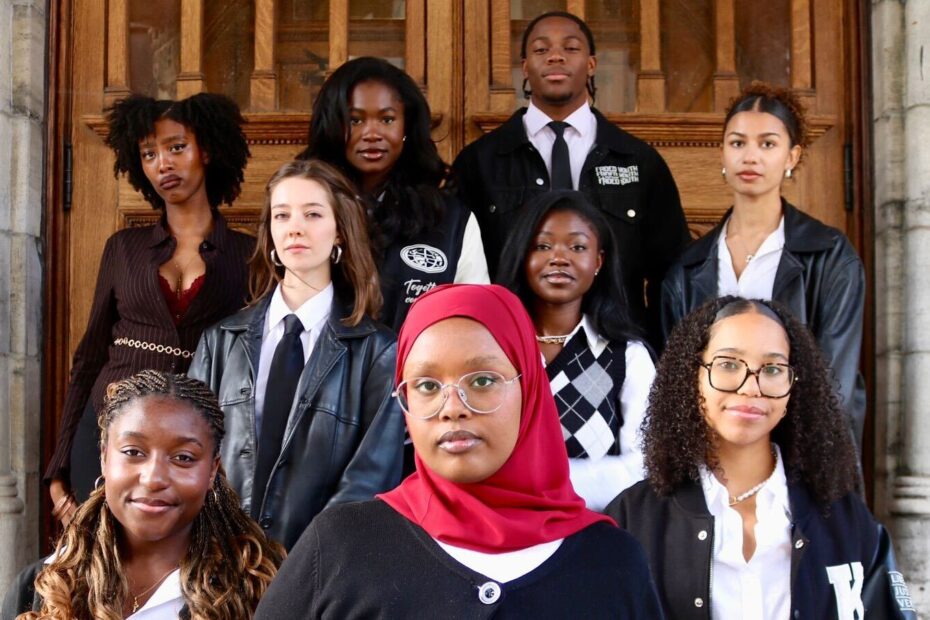
Named after the Swahili word for freedom, the UHURU Journal, run by the McGill African Studies Student Association (ASSA), is an academic journal celebrating and uplifting African-centric stories in both research paper and creative formats. These include those that not only commemorate Africa’s rich histories, but push the boundaries of dominant narratives surrounding the continent and its diverse peoples.
Founded in 2019, the journal published in the spring of that year before taking a hiatus from 2021 to 2024 due to pandemic constraints. However, in the spring of 2025, it was revived with the theme “Beyond The Single Story: Africa’s Diaspora and Diverse Realities.” The 2025 edition includes a gallery-esque exhibition complete with readings of poetry, artworks, and authentic Ghanaian food. This year’s edition of the journal will centre around the theme “Afrofuturism: Envisioning The Futures We Create.”
For our Black History Month issue, The McGill Daily spoke with ASSA President Zahra Hassan Doualeh, ASSA VP Academic Henry Maidoh, and ASSA VP External and UHURU Editor-in-Chief Shanna Coulanges. We discussed UHURU’s role in shifting the needle on African narratives, and their greater hopes for the journal as part of a larger vision of Afrofuturism.
This interview has been edited for conciseness and clarity.
Isabelle Lim for The McGill Daily (MD): Tell me about ASSA and the work you do as an academic student organization.
Henry Maidoh (HM): We are an undergraduate association aiming to elevate the African Studies program and department. We foster connectivity between African Studies students and their professors, and raise general student body awareness of the program and its various curricular and extra-curricular opportunities.
Zahra Hassan Doualeh (ZHD): As members, we sit on committees with the African Studies faculty that inform the faculty members and the administration how the program can be improved and what students want to see more of. That is what we do more on the academic level.
MD: McGill is one of the few universities in Canada with a unique African Studies program. How do you think the African Studies option is valuable, and how do you think current programming could be diversified or improved?
ZHD: I think McGill has this specific advantage of being an English institution in a majority French-speaking province. That linguistic aspect puts it in a very advantageous position, considering that a lot of the African population of Montreal is from North Africa; while a lot of African scholarship focuses on sub-Saharan Africa, which is mostly English-speaking. McGill is informed by both languages as it has bilingual scholars and faculty members with experience in different parts of Africa. Uniting these two creates something that’s never been done before, which is where our strength lies.
Afrofuturism is not just about innovation, technology, and startups. It is also about looking inwards. It’s about historical imagination, and Pan-Africanism is a big part of that. We are a collective. There would never be us without each and every single one of us, you know? That’s why I think the work being done at McGill is unlike any other institution.
HM: In general, we want to give students the ability to engage with African literature and elevate their own experiences with African realities not only localized to the continent, but also pertaining to the African diaspora and relevant global communities. While a lot of the content in the African Studies program is very valuable, I don’t feel like it’s as forward-thinking as it could be. While you can’t know the future without knowing the history, I still believe having more courses centred on the now and the future [would be valuable] for youths to apply that knowledge to the present. The future is Africa, after all.
MD: The theme for UHURU’s 2026 edition is “Afrofuturism: Envisioning the Futures We Create.” What was the thought process behind the theme? Compared to last year’s, which focused on individual narratives, how did you choose to widen the scope from the narrative to the collective?
Shanna Coulanges (SC): I’m especially drawn to the second part of the title: Envisioning the Futures We Create. It carries a deeply mobilizing force, one that calls on all of us to imagine and actively build [into being] what has yet to come. Too often, Africa has been framed through narratives of reduction and constraint, as we explored last year. This year, we open a new conversation, one without limits or restraint. Ultimately, we hope this issue stands as a testament to ambition, boldness, and creativity, an invitation to learn, explore, and give form to futures not yet uncovered.
ZHD: When you look at the themes, they’re sort of a continuation of one another. We started by going against reductive narratives. Now, Afrofuturism is about showing [our] potential and everything that is being done. If you perceive it that way, it is like a timeline. So who knows what next year’s [theme] is going to be?
MD: UHURU uniquely welcomes both research and creative submissions. What narratives do you hope to uplift with this approach?
HM: Well, with a name like UHURU, who do we leave out of freedom?
ZHD: Accepting artworks is part of decolonizing scholarship. There are many kinds of expertise, and many ways of sharing that. A lot of our stories cannot simply be told through the rigid framework of a scholarly article.
SC: It’s about transcending the frontiers of communicating a powerful message. UHURU has, in my opinion, a dual mandate: to provide a space for Afro-descendant voices to be heard, but more importantly, to narrate plural & unapologetic experiences of Africa & Africans. Allowing for creative submissions is not motivated by a simple whim to add colour, but by the desire to provide a new layer of depth, understanding, and ways of perceiving the reality of the African continent.
MD: This year, UHURU is collaborating with other Black and African organizations as part of the journal’s outreach. Tell me more about those collaborations as well as how those tie into your aforementioned mission of elevating Pan-African experiences.
HM: We’re building a lot of partnerships at the moment. We have one with Sayaspora, which works on giving more African women and girls opportunities, which really coincides with UHURU’s project. We’ve also been able to get involved with the Black Law Students’ Association (BLSA) and the IDSSA’s Candid conversations podcast [interviewer’s note: episode still pending] to speak on behalf of UHURU. Notably, the McGill marketing team contacted us for an article, which appeared on their newsletter, which is sent out to everyone, and on their news page. That was huge.
There’s more to come, for sure. I love the fact that we’re able to engage with multiple like-minded organisations and groups to show that it’s possible to start an initiative that’s focused on Black and African students.
MD: In this sense, do you think that UHURU has transcended its status as a student journal to encompass something larger?
HM: For sure. The journal was a foundation for bringing more awareness to African Studies. In doing so, though, we’ve also been able to create a movement by mobilizing a bunch of people — even outside of the country, let alone just [at] McGill. But there’s still a long way to go, so I wouldn’t say we’re a fully-furnished movement just yet.
ZHD: I mean, I see it as a collective. From the get go, we didn’t want to limit the scope of this journal to simply the African Studies program, because we would have been limiting the impact that we could have. The goal is to create a community that is greater than just the couple of students who produce this journal. Bringing in Sayaspora is a huge thing because it’s well-known within the Black community in Montreal, but it isn’t just limited to Montreal. Frankly, the idea of the collective is so art-based as well, which also makes it more inclusive.
MD: All this: to what effect?
HM: To show that African Studies isn’t just for Africans, it’s for everyone. And that being knowledgeable about it isn’t and shouldn’t be disproportionately attributed to one group of people.
MD: Finally, what does Afrofuturism look like to you in your own life?
HM: Agency.
SC: Afrofuturism to me looks like agency in all its forms and shape. Reclaiming power in spaces where Africa had been treated as passive rather than [the] holder of its own destiny.
ZHD: Once, a journalist asked Senegalese cinematographer Ousmane Sembène, who made films for Africans about Africans, how he felt about how his films were perceived in France, and he said, “Europe is not my centre.” I grew up in a family that never saw the West as the centre, so coming in [to McGill] and meeting people who thought differently was quite a shock. So for me, Afrofuturism gives some people a peek into what my life has been like. Africa has always been my centre.
UHURU Journal’s fifth edition “Afrofuturism: Envisioning The Futures We Create” is accepting academic submissions until February 23, 2026, and creative submissions until March 1, 2026, for launch in April 2026.