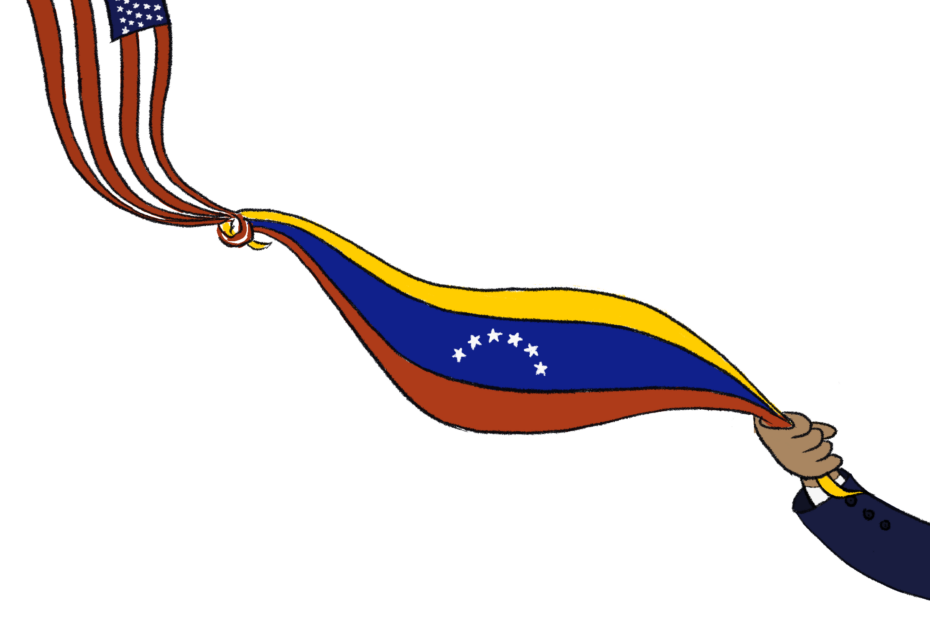
On January 3, 2026, United States President Donald Trump announced in a Truth Social post that the US military forces carried out strikes in Venezuela and captured President Nicolás Maduro and his wife Cilia Flores, flying them out of the country. Within hours, diasporic celebrations were visible far beyond Venezuela’s borders, especially in Doral, Florida; a Venezuelan hub nicknamed “Doralzuela,” where expatriates gathered, waved flags, and praised the operation as the long- awaited end of an authoritarian era. An era which was marked by systematic repression of political dissent, arbitrary detentions, documented abuses, and by a national crisis that has driven millions of Venezuelans to flee abroad.
Behind the scenes, this reaction is not hard to understand. For years, many Venezuelans abroad have described exile as a permanent state of suspended life: careers restarted, families split, and a homeland that feels simultaneously intimate and unreachable. When Maduro was captured, the celebration was not simply political; it was cathartic, an assertion that impunity for alleged state repression and serious human rights abuses is not inevitable.
However, almost immediately, the story was filtered through the attention economy: a flood of posts, some genuine and some fabricated, competed to frame the event in various ways. Some claim it was liberation and long-delayed accountability, many said it was an illegal ‘kidnapping’ and sovereignty violation, others called it a security-and-drug operation. A few posts even layered on oil-motive claims and conspiracy narratives that muddied verification. By January 5, major media outlets and fact-checkers were reporting on and debunking AI- generated images and repurposed videos which falsely presented Maduro in custody or crowds celebrating in Caracas. In other words, both the jubilation and the backlash were real and so was the manipulation of each across platforms online.
Courtroom images, diplomatic backlash, and the legality problem
On January 5, Maduro and Flores appeared in a Manhattan federal court and pleaded not guilty to charges including narco-terrorism conspiracy and weapons counts involving machine guns and destructive devices. Yet, Maduro called the US operation a “kidnapping.” By the time courtroom photos of the two circulated, opinions about the legitimacy and legality of the US intervention had already solidified. The same day, the UN Security Council held an emergency meeting in which Brazil, Colombia, Mexico, Chile, Russia, and China condemned the operation as a breach of sovereignty which set a dangerous precedent.
What makes this event so controversial is that it sits at the intersection of two opposing narratives. The first perspective on Maduro’s capture has underlying moral and emotional justifications because the removal of a leader accused of repression may appear just. On the other hand, the legal and structural complications of Maduro’s capture blurs the boundaries between arrest and war. This view questions the legality of a powerful state seizing a president in a foreign country and reframing the use of force as “law enforcement.”
On January 4, 2026, Chatham House argued that the capture and attacks had “no justification in international law,” emphasizing that the UN Charter’s prohibition on the use of force is not optional. On January 6, the Office of the UN High Commissioner for Human Rights warned that the world is “less safe” when such interventions occur and stressed that Venezuela’s future must be determined by Venezuelans.
National governments echoed that same concern. On January 3, China’s foreign ministry said it was “deeply shocked” and “strongly” condemned the strikes and Maduro’s capture as a blatant use of force against a sovereign state. On January 6, Mexico’s president denounced the intervention as undermining democracy and stability in Latin America. On the same day, Russia backed Venezuelan vice president Delcy Rodríguez as the country’s interim leader and denounced what it described as neocolonial threats against Venezuela. None of those statements however seem to have been made in sympathy for Maduro. Instead, they reflect something more complex: a fear of past events.
Why Iraq still matters: a dictator’s fall is the easy part
The argument most often deployed to dismiss these concerns is simple; Maduro is viewed as a dictator, so the means of removing him are treated as less important than the result.
Iraq is a cautionary example of how quickly “liberation” framed by external powers can curdle into a long and violent aftermath. In 2003, the United States invaded Iraq under the suspicion that Saddam Hussein possessed weapons of mass destruction. Those claims later unraveled: in October 2004, media reports summarized the Iraq Survey Group’s conclusion that Iraq had no stockpiles of chemical, biological, or nuclear weapons. Despite many Iraqis’ welcoming Saddam’s fall, that initial relief did not prevent the rapid unraveling of the Iraqi state. In the first months of the occupation, the Coalition Provisional Authority’s de-Ba’athification policy and decision to dissolve the Iraqi army stripped ministries and security forces of their institutional capacity, left large numbers of armed men unemployed, and helped fuel a growing insurgency and sectarian violence. Over the following decade, that instability and weakened governance contributed to fragmentation, including conditions that enabled al-Qaeda in Iraq and later allowed for ISIS to gain ground.
By December 31, 2011, the Iraq Body Count documented 120,108 civilian deaths from violence since the 2003 invasion, a verifiable minimum that includes killings attributed to multiple actors, not only US forces. Iraq Body Count reports that 15,163 (13 per cent) of those documented civilian deaths were directly caused by the US-led coalition.
The political economy of war also matters here. On August 12, 2008, the US Congressional Budget Office wrote that contractors played a “substantial role” in supporting US military, reconstruction, and diplomatic operations in Iraq. That reliance is not a side detail: it shows how quickly a war can become an outsourced project, where major decisions about security, logistics, and rebuilding are filtered through contracts- arrangements that can dilute accountability and shape priorities in ways that don’t reliably align with democratic stabilization.
The takeaway is not that Venezuela will become Iraq, but that forcefully removing a regime is often the simplest phase in regime change, and that the incentives shaping what comes next, including money, contracts, security partnerships, and resource access, do not reliably align with nation-building or democracy. This is why diasporic Venezuelan rejoicing and international alarm can both be rational responses to the same event: celebration can be sincere and anxiety can have logical roots.
Venezuela’s oil is structural, not incidental
Any analysis of what comes next also has to contend with the central material stake in Venezuela’s crisis: oil. Venezuela is an oil superpower on paper, despite years of declining production. The US Energy Information Administration estimates Venezuela holds about 303 billion barrels of proven crude oil reserves, the largest in the world. That reality shapes both external interest, internal vulnerability, and the rhetoric surrounding the intervention. In the immediate aftermath of Maduro’s capture, multiple news accounts emphasized that US officials were already discussing Venezuela’s oil future and that global markets were watching whether Venezuelan heavy crude could flow again toward Gulf Coast refineries. By January 15, the Trump administration had also escalated its sanctions enforcement at sea, with US forces seizing another Venezuela-linked tanker in the Caribbean. Separately, Chevron was reported to be in talks with US officials about expanding its Venezuela operating license to increase crude exports.
Even during the celebrations of Maduro’s capture, some coverage noted an undercurrent of unease about what comes next, especially after Trump said the US would “run” Venezuela temporarily until what he called a “safe” transition could be arranged. This is not a conspiracy theory, it’s how geopolitics works when a country sits atop a resource that powers modern economies. The fear is not simply that the United States removed Maduro. It is that the post- Maduro state will be shaped around oil extraction before Venezuelan civil society can rebuild democratic legitimacy on its own terms.
The worry is not about Maduro, it’s about what follows
By January 6, Venezuela had entered a volatile political transition: Maduro in US custody, Delcy Rodríguez sworn in as interim leader, and an international environment split between celebration among Venezuelans abroad and diplomatic condemnation. On January 14, Trump and Rodríguez each described a phone call as “positive,” underscoring how quickly the US shifted from military action to direct engagement with Caracas. Symbolic gestures quickly became part of official politics. On January 15, opposition leader María Corina Machado presented Trump with her Nobel Peace Prize medal during a White House meeting: an attention- grabbing gesture that drew praise from some anti-Maduro supporters, backlash from critics, and a reminder from Nobel officials that the prize itself cannot be transferred. In the days that followed, Rodríguez’s government announced the release of political detainees. These moves were welcomed by Washington but disputed by NGOs, which said the verified number lagged behind official claims. The information ecosystem is already polluted with AI-generated “proof,” making it easier for every side to claim inevitability and harder for the public to judge the legitimacy of the transition.
The central question, then, is not whether Venezuelans are justified in celebrating. Many are, and those emotions should not be dismissed. The question is whether the world is watching the beginning of a democratic transition, or the start of a familiar cycle: dramatic removal, legal controversy, and a battle to control the story, all of which shapes how legitimacy of the transition is granted or withheld.
History suggests that the most consequential phase is rarely the capture. It is the months after the capture, when power is redistributed, violence is either contained or unleashed, and “rebuilding” becomes either a civic project or a contract economy. If unilateral intervention can be normalized by framing it as “policing,” Venezuela will not be an exception, it will be a precedent that other states invoke the next time they decide to cross a border in the name of enforcement.