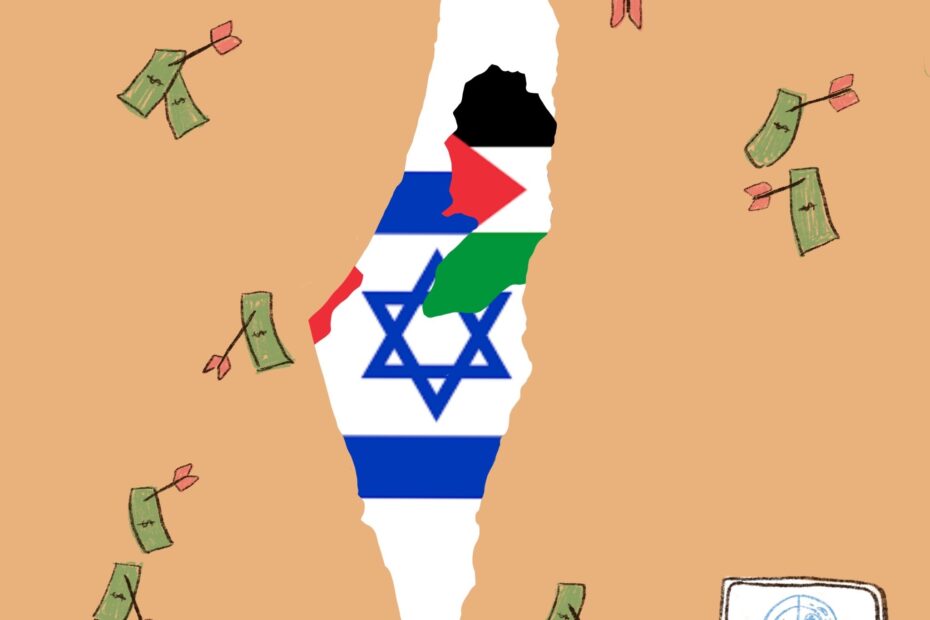
In 1993, the Palestinian Liberation Organization and Israel signed the Oslo Accords, lighting the path for a two-state solution: a framework ensuring two sovereign states. While the deal pledged a peaceful compromise to the never-ending conflict, more than three decades later, the world seems nowhere closer to achieving this utopic ideal. This begs the question: is the two-state solution even feasible?
For the last two years, a nation’s “right to exist,” has been a common subject of debate. This discourse revealed the West’s efforts to reassert its moral authority while continuing to protect their political interests through various trade agreements. Canada, the UK, and France formally recognized the existence of Palestine. Meanwhile, the United States, which arguably is one of the most influential international players in the current conflict itself, is one of the few countries that has not formally recognized a Palestinian state. President Donald Trump’s recent claims that he has solved the conflict captures his performative approach to diplomacy. He has taken credit for organizing a ceasefire, which was promptly violated, while also asserting that the US will “take over” Gaza. His recent proposal, the Board of Peace, a newly formed independent commission with the goal of achieving an independent Palestine has drawn significant concern. The commission is headed by Tony Blair, a controversial figure given his long history with the Middle East, dragging the UK into the War in Iraq, and the atrocities that followed. Rather than self autonomy, this initiative appears to only cement US control in the region.
The UK and Canada recently began to take on a more active role in the conflict by sending large amounts of humanitarian aid to the Gaza Strip. Take for example Canada, who has pledged 355 million dollars. Meanwhile, the total amount given by the United Nations (UN) between 2014-2020 has reached 4.5 billion dollars, and it has only increased. However, sympathetic sentiments and words of support are not enough; few nations have attempted to distance themselves from Israel economically. France had multiple Israeli defence firms at a recent expo, despite banning them earlier in the year, and as the war continues, civilians are still being killed despite a supposed ceasefire. This lack of substantial solidarity reveals that merely recognizing Palestine often absolves these nations from taking concrete action towards supporting Palestinian statehood.
The lack of coordinated action from the UN highlights their failure. Despite the multiple General Assembly votes to create a Palestinian state, the amount of effort exerted to aid Palestine has been close to none. The security council’s veto powers only prove the UN’s failure to make meaningful change, as the US vetoed multiple resolutions attempting to end the conflict. By vetoing most of the resolutions proposed, the US had prevented meaningful UN action leaving the organization to stand by, as to not interrupt the interests of their permanent members. Without a centralized and neutral organization capable of enforcing agreements necessary to produce an autonomous Palestinian state, the state will not emerge. It is clear that the institutional structure needed for a two-state solution does not exist in the UN.
Even if we ignore every political obstacle, the realities of the situation are damning. The region is geographically split in two. Palestinians reside in the West Bank and Gaza, with each territory operating under rival political authorities: Fatah and Hamas. Both authorities are at the behest of the economic power of Israel and, as a whole, Palestine lacks control over its borders. This economic and geographical control came as a result of the Oslo Accords that were meant to allow for the eventual emergence of a Palestinian state. Yet to me, this is the textbook definition of institutional subjugation. The lack of action from the international community and Palestinians’ structural dependence on Israel requires Israel’s presence at the negotiating table. However, Benjamin Netanyahu, the current prime minister of Israel, is difficult to reason with.
Netanyahu, a wanted war criminal in various parts of the globe, has stated the possibility of a two-state solution in a speech. However, he simultaneously told the UN that any vote in support of a two-state solution should not be passed. Netanyahu is also the architect of the continued wanton killing of Palestinian people. He asserts he would allow a Palestinian state if certain preconditions are met: the redrawing of the borders to one that is favourable to Israel, the acceptance that annexed land is now Israeli, and a requirement for Palestinian demilitarization. This does not create a state; it creates a faux-nation susceptible to attack and theft from its neighbour, which has repeatedly proven it will take advantage of such opportunities. To assume that these preconditions would be accepted by Palestinians is an absurd presumption; it does not guarantee them self- determination and is suggestive of a colonial Israeli agenda.
If there is any hope for the existence of a two-state solution, it cannot reiterate the colonial systems that initially removed Palestinians’ authority. The steps towards Palestinian autonomy that have been proposed have only been reminiscent of these same colonial policies. So far, the future looks bleak, and the two- state solution has now, more than ever, been exposed as the carrot- on-a-stick that it is, absolving the international community from taking action. While I pray that this inaction will change in our lifetimes, without large institutional reform, neutral governing bodies, and changes to past agreements, the two-state solution will remain a fantasy. The question is no longer, is the two-state solution ideal or equitable, but instead, should we continue to pretend that it is even possible?
For me, at least, the answer to that is no.