It only took one step from the dimly-lit Peterson Hall lobby into the Critical Media Lab to transport me into another world — away from the stress of finals season and into another realm entirely; spell-binding in its tranquility. As the door closed behind me, a welcoming darkness washed over me like a gentle wave, easing the tension in my shoulders and neck.
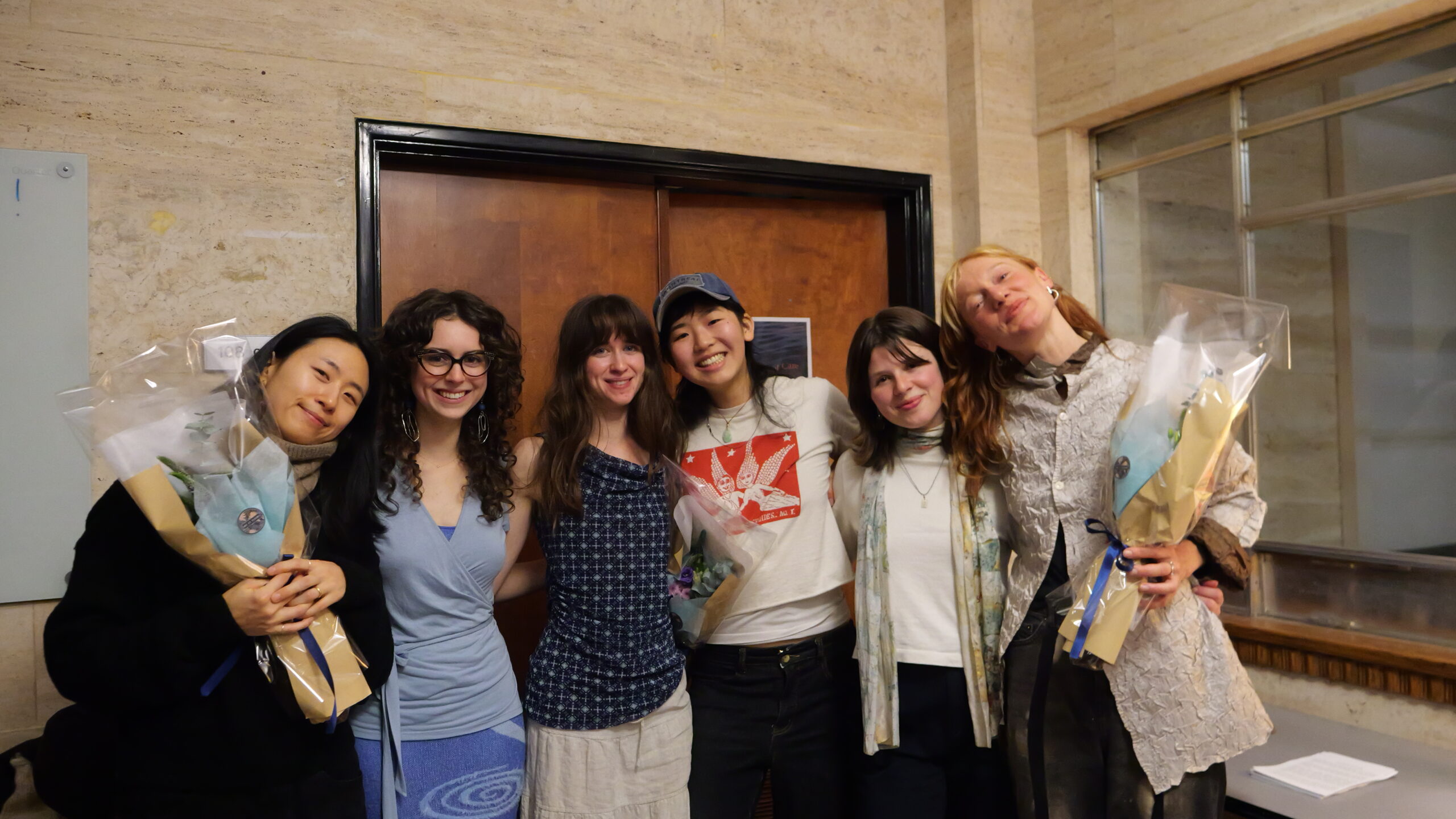
This decisive calm characterises Currents of Care, the newest exhibition in conjunction with McGill’s Critical Media Lab. Ideated and curated by Saskia Morgan, Ava Williams and Hannah Marder-MacPherson — the bright-eyed trio behind Fleeting Form Studio — Currents of Care magnifies water’s role as a key lifesource, inextricably connected to all other life forms on Earth. Fleeting Form aims to fill a gap in fine arts programming at McGill, creating a space for students who are passionate about the intersections between environmental action and art but lack the outlets to materialise those interests.
Currents of Care marks the collective’s most ambitious endeavour yet. The exhibition, which was set in motion last fall, marries works from Fleeting Form’s artist workshop series last year and fresh ideas informed by the three curators’ experiences with water in their unique academic domains. It unites artists across creative disciplines and backgrounds through a common vision: expressing narratives of hope and desire about the global water crisis through visual, auditory, and tactile art.
“A multi-media exhibition allows people to consider water from where they currently are, which is what we want for our exhibition: to multiply the often singular understanding of water as a particular thing,” Hannah expressed in an interview with the Daily.
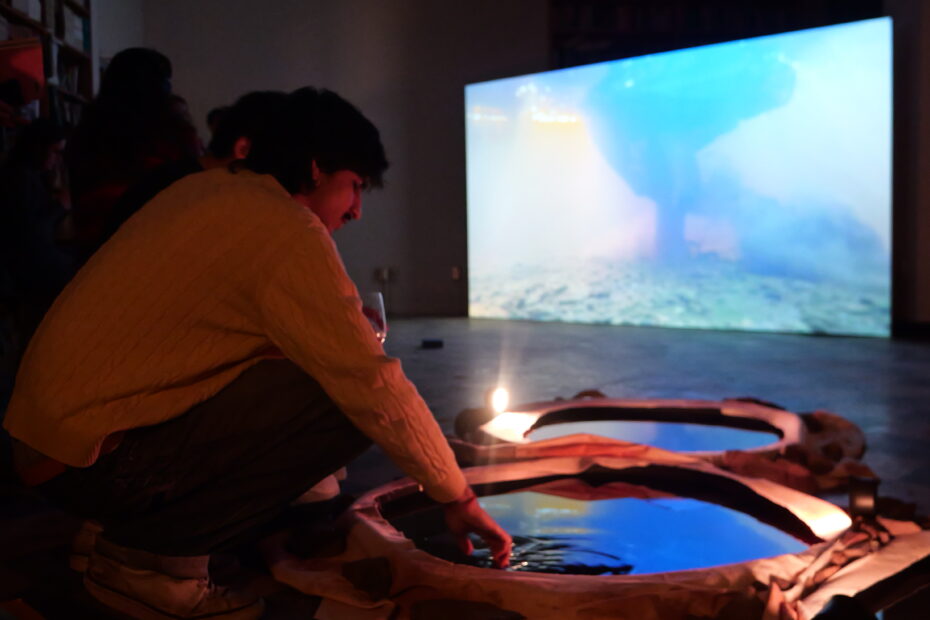
As the viewer first steps into the Currents of Care space, they are met most strikingly by three small pools at the centre of the room: an interactive format designed by the three curators themselves. Even up close, the pools look like abysses stretching far below the Critical Media Lab’s checkered tile floors. In each pool, which is lined by canvas from Fleeting Form’s workshop series, poems by Erin Robinsong lay printed on laminated sheets and floating on the water’s surface. Viewers are not only permitted but encouraged to touch and interact with the water, sourced from the St. Lawrence river.
“Even if you live in Montreal, chances are you haven’t had the chance to actually touch or swim in the St. Lawrence, especially now during the winter,” recounted Ava. “We wanted our viewers to think about water’s availability to us, and the ways we come in contact with it in our everyday lives. Having water physically present in the room was really important to us to make the space feel alive.”
“In interacting with the water, the people who come into the exhibition aren’t just static observers but participants leaving physical traces,” continued Hannah. “In a small way, they then become part of the piece, which reproduces the cyclical ways in which we affect water and it affects us.”
The pools of water allow viewers to think deeply about their interactions with water and reflect on its weight in their lives. This sentiment is echoed by Robinsong’s three poems, which explore water’s ties with colonialism, movement and growth. The motif of water acts as a lens through which one can re-imagine the everyday motions of life and thus notice the tributaries that weave through so many of them.
As the viewer walks around the room, their thoughts (or perhaps the blissful lack thereof) is accompanied by a soundscape of water and nature composed by Lina Choi. Mixing sound recordings from natural spaces and bodies of water in Montreal and Quebec, the fifteen-minute soundscape is faintly audible even when one puts on the headphones placed on wooden benches around the pools to listen to readings of Robinsong’s poems, narrated by a lilting voice. The soundscape further immerses the viewer in the exhibition’s peaceful ambience: as if they were drifting, unbidden, on the ripples of a calm lake.
At the back of the room are sculptures by Montreal artist Nina Vroemen, whose works centre water as an active element of each piece. Be it dripping from a conch shell or expelled as a gentle stream of vapour, each work amplifies the subtle give-and-take dynamics between the viewers and the medium they are observing. Emphasized is the status of water not only as a resource we can exploit, but an age-old entity.
Throughout one’s visit to the exhibition, a stunningly shot short film by Innu filmmaker Uapukun Mestokosho plays on a loop on a large projector screen in front of the door. Entitled “Nipi utaiamun” (The Voice of Water), the film depicts the personal relationship between the filmmaker and water. It further explores the element’s capacity to relieve pain and smooth over trauma through wide shots of women interacting with water: from a girl playfully blowing bubbles underwater, to a woman playing a drum on the shore with the tide flowing quietly onto the sand beneath her feet. Mestokosho’s voice, accompanied by drumming and the rush of rivers, delivers her poetic essay in both Innu-aimun and French through the set of headphones offered before the screen.
“Our dominant understanding of water as a resource is deeply influenced by colonial ways of thinking,” remarked Saskia. “In curating our exhibition, we were deeply inspired by the works of Indigenous thinkers like Leanne Betasamosake Simpson that resisted these colonial understandings and exploitations of water — conceiving of water not as a resource, but as kin and co-creator of worlds.”
As a whole, Fleeting Form Studio, through and beyond Currents of Care, are passionate activists for art as a form of resistance, and as a critical means of reframing ecological crises. “The emotional response it can evoke in people as they personally reconsider dominant ideas becomes one they can materialise through action in their own lives,” mused Ava.
“Change has to be something everyone can participate in,” stated Hannah.
The team is confident in the transformative potential of art not just for individuals, but for large-scale structural change. “Rethinking our current structures cannot be done without art, where you can tangibly realise the emotional, the beautiful. What we do attempts to bring people’s imagined futures into a space of action,” asserted Saskia. “Engaging in practice that allows for continual change, growth and movement is where we will start to see the seeds of change.”
Currents of Care is being shown at the Critical Media Lab at Peterson Hall 108 from 11-20 December from 12 – 6 p.m. Entry is free.